

A performance build is only as refined as its weakest component. For many riders, that weakness is often hidden beneath a layer of yellowing resin and excess weight. Choosing the wrong material doesn't just hurt your handling; it compromises the very soul of your machine. This is why understanding the benefits of pre-preg carbon fiber for motorcycles is essential for any serious enthusiast looking to elevate their ride.
You already know that every ounce matters on a high-performance bagger. You've likely seen the common pitfalls of standard "wet lay" carbon: poor fitment, heavy resin, and the inevitable cracking that ruins a show-quality finish. It's frustrating to invest in a build only to watch the components degrade under the sun or vibrate loose on the open road.
We will demonstrate why pre-preg is the definitive choice for those seeking the ultimate balance of weight, strength, and aesthetic perfection. This article previews the meticulous autoclave curing process, the superior strength-to-weight ratios achieved through precision engineering, and how this bespoke material ensures your investment lasts for years. Discover how we bridge the gap between beauty and utility through master craftsmanship.
Key Takeaways
- Understand how pre-impregnated resin and meticulous cold storage maintain the structural integrity of high-end carbon components.
- Learn how reducing unsprung weight through specialized fenders and fairings directly improves your motorcycle's flickability and handling.
- Discover why the benefits of pre-preg carbon fiber for motorcycles include a "dry" aesthetic and significant weight savings over traditional wet-lay fiberglass.
- Gain the expertise to identify genuine 3K weave patterns and avoid common "carbon-look" imitations that fail over time.
- Explore how components like the Road Glide Carbon Fiber Fairing serve as a strategic investment in both performance and show-quality style.
What is Pre-Preg Carbon Fiber and Why Does it Define Performance?
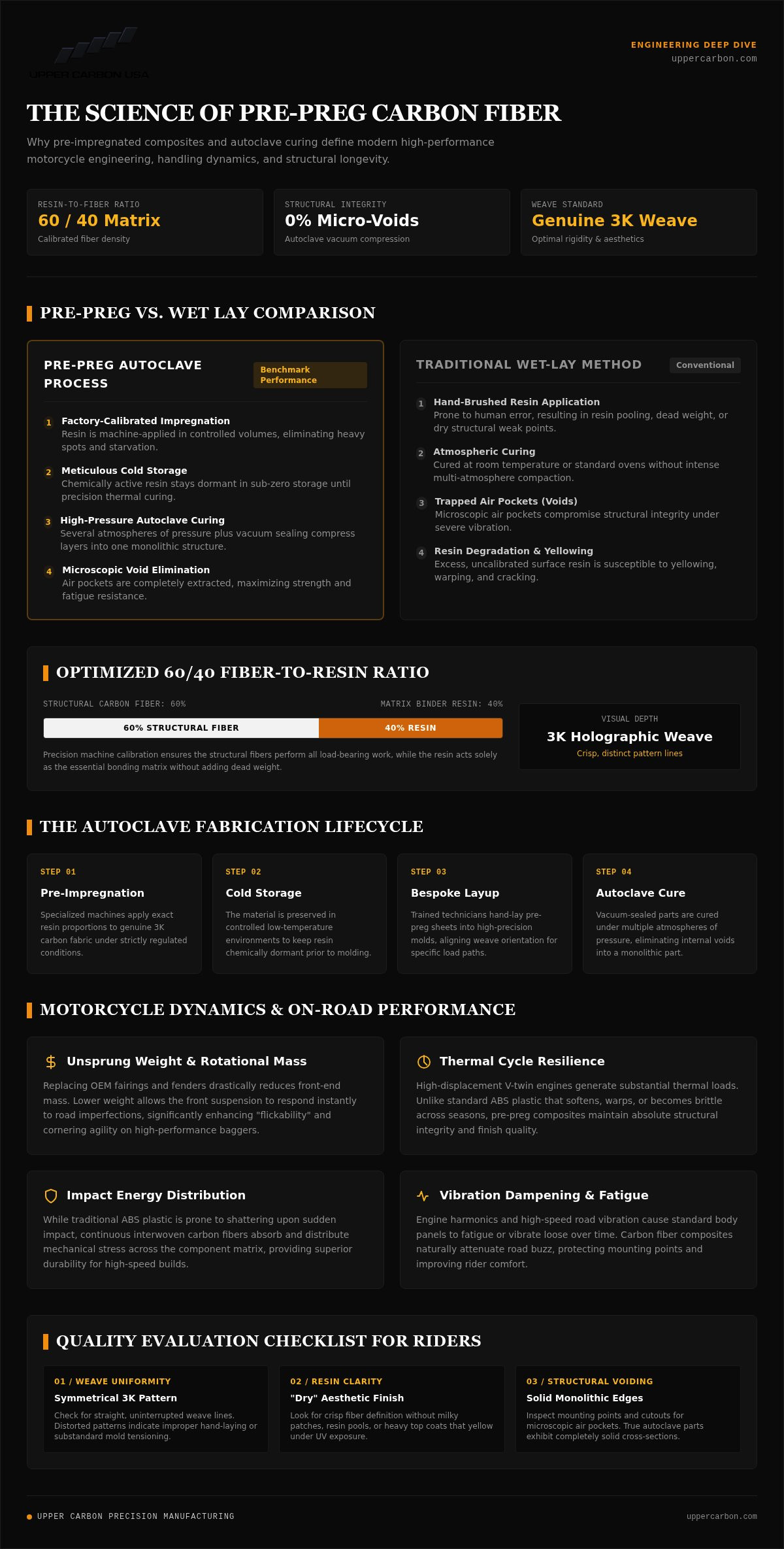
Performance isn't accidental. It's a deliberate choice that begins at the molecular level. For the serious rider, pre-preg isn't just a premium material; it's a structural philosophy. The term refers to carbon fiber fabric that's pre-impregnated with a factory-calibrated amount of resin. This removes the human error inherent in traditional "wet lay" methods, where resin is hand-brushed onto the cloth. In those builds, you often find heavy spots or resin-starved areas that compromise the part. Pre-preg eliminates that inconsistency, establishing a baseline of excellence for elite performance bagger builds.
The Science of Pre-Impregnation
The manufacturing process for carbon fiber reinforced polymers requires absolute control to achieve peak results. In pre-preg production, specialized machines apply resin to the 3K weave fabric under strict conditions. This resin remains dormant until it's triggered by specific heat profiles during the curing stage. Because the resin is chemically active at room temperature, the material must be kept in meticulous cold storage. This careful handling ensures the material's integrity remains perfect until the moment of fabrication. For a rider, the benefits of pre-preg carbon fiber for motorcycles start long before the part is even shaped. The 3K weave itself is chosen for its ideal balance of structural rigidity and the iconic, tight-pattern aesthetic that defines a high-end build.
The Role of the Autoclave
True engineering excellence is forged under intense pressure. Once the pre-preg layers are hand-laid into a bespoke mold, they don't just sit in a standard oven. They enter an autoclave. This high-pressure vessel cures the part while a vacuum seal removes every trace of trapped air. This process is vital because it eliminates "voids," which are microscopic air pockets that weaken traditional carbon parts. The result is a component with total structural uniformity and incredible density. Wet-lay parts simply can't compete with this level of strength. By applying several atmospheres of pressure, the layers are compressed into a single, monolithic structure. It's the difference between a part that merely looks the part and one that's designed to withstand the high-speed vibrations of a performance machine. We view this level of precision as a strategic investment in your motorcycle's longevity and handling.
The Engineering Advantage: Strength, Weight, and Resilience
Engineering a performance bagger requires a relentless focus on physics. Every component must justify its presence through measurable gains. The primary benefits of pre-preg carbon fiber for motorcycles center on the strength-to-weight ratio. This metric isn't just for aerospace; it's the secret to "flickability" on a heavy machine. By replacing factory plastics with advanced composite materials, you reduce the rotational mass and unsprung weight that slow your steering response. When a front fender or fairing weighs significantly less than its OEM counterpart, your suspension reacts faster to road imperfections. The bike feels lighter, more intuitive, and more aggressive in the corners.
Resilience is another hallmark of this material. High-displacement V-twin engines generate significant heat cycles that can degrade lesser materials. Traditional plastics often warp or become brittle after a single season of hard riding. Pre-preg composites are specifically engineered to withstand these thermal loads without losing structural integrity or finish quality. Unlike ABS, which can shatter upon impact, high-quality carbon fiber possesses a level of resilience that absorbs and distributes energy. It's a safer, more durable choice for high-speed builds where material failure isn't an option.
Optimizing the Resin-to-Fiber Ratio
In the world of composites, less is frequently more. Wet-lay parts often suffer from resin pooling, which adds dead weight without increasing strength. Pre-preg achieves an optimized 60/40 fiber-to-resin ratio through machine-controlled application. This precision ensures that the structural fibers do the heavy lifting, while the resin serves only as the necessary binder. This balance creates the crisp, holographic depth seen in a high-quality 3K weave. It's a look that signals substance over hype, ensuring the part looks as good as it performs.
Vibration Dampening and Fatigue Resistance
Road buzz is the enemy of rider comfort and part longevity. Carbon fiber naturally dampens high-frequency vibrations better than aluminum or heavy fiberglass. This fatigue resistance is critical for components like saddlebag lids that endure constant stress from wind and road shock. Pre-preg parts exhibit superior material memory. They maintain their exact fitment and seal after thousands of miles of aggressive riding. For those looking to elevate their build, these engineering advantages represent a strategic shift in performance. You aren't just buying a part; you're investing in a more refined riding experience.
Pre-Preg vs. Wet Lay: A Performance Comparison
The performance gap between wet lay and pre-preg is wider than most riders realize. Wet lay is essentially a manual craft. It involves hand-brushing liquid resin into a mold, which inevitably leads to "pooling" in corners and uneven thickness across the surface. This excess resin adds dead weight without contributing to the part's strength. In contrast, the benefits of pre-preg carbon fiber for motorcycles are found in the machine-precision of the material itself. Because the resin is already integrated into the cloth at a factory level, the finished part has a tight, "dry" look that highlights the weave rather than burying it under a thick, cloudy layer of epoxy. A pre-preg fairing can weigh up to half as much as a fiberglass or wet-lay version. This weight reduction is a strategic advantage for any performance build.
Manufacturing Consistency and Fitment
Precision engineering demands repeatability. In the autoclave process, the intense heat and pressure ensure the part matches the mold with microscopic accuracy. Wet-lay parts often warp during the curing process, requiring "massaging" or trimming to fit. This adds hours of frustration to your build. We prioritize a true "bolt-on" experience. Molds stay cleaner, and parts stay truer, ensuring that every mounting point aligns perfectly without the need for modifications. For a deeper look into how these components transform your bike, see The Definitive Guide to Carbon Fiber Fairings. This level of consistency is what separates a bespoke component from a generic accessory.
Aesthetic Longevity: Avoiding the Yellow Fade
Sunlight is the enemy of inferior epoxy. Traditional wet-lay components often use standard resins that react to UV exposure, leading to a dull, yellowed finish within a few seasons. High-grade pre-preg resins are formulated for long-term stability. They maintain their clarity and depth, allowing the 3K weave to remain the focal point of your build. This aesthetic longevity is a core component of the benefits of pre-preg carbon fiber for motorcycles. We apply a deep, high-solids clear coat that protects the fiber without masking its texture. It's a strategic investment. Paying for quality now prevents the inevitable cost and hassle of replacing faded, brittle parts in the future. Your build deserves a finish that lasts as long as the engine. By choosing pre-preg, you're ensuring that the visual impact of your machine doesn't degrade over time.
Evaluating Carbon Quality: What Every Rider Should Inspect
Discernment is a requirement for any elite build. The market often hides inferior materials under a thin veneer of carbon fabric. To truly understand the benefits of pre-preg carbon fiber for motorcycles, you must look beyond the initial shine. Many "carbon" parts are actually fiberglass shells with a single decorative layer. This "carbon-over-fiberglass" method lacks the structural integrity and weight savings of a true composite. It's a compromise that fails the moment you push your machine to its limits.
Perform the "Tap Test" to verify density. A high-quality pre-preg part produces a crisp, sharp ring when tapped with a fingernail or a small coin. This acoustic profile indicates a dense, void-free structure. Conversely, brittle plastics or heavy wet-lay parts emit a dull, muffled thud. You should also inspect the back side of the component. A meticulous manufacturing process leaves the interior smooth and uniform. If the underside is "hairy" with loose fibers or shows messy resin pooling, the part was likely hand-brushed rather than autoclave-cured. True craftsmanship is visible from every angle.
Identifying Genuine 3K Pre-Preg
Premium parts feature a 3K weave that's tight and perfectly aligned. Inspect the pattern for shifts, gaps, or "drifting" in the weave. These distortions aren't just aesthetic flaws; they represent structural weak points where the fibers aren't properly tensioned. High-grade components will also be free of pinholes or micro-bubbles on the surface. These tiny imperfections suggest a failure in the vacuum sealing process. For a deeper dive into these technical standards, read Mastering the Machine: The Definitive Guide to Carbon Fiber for Harley-Davidson in 2026.
Hardware and Mounting Points
The true benefits of pre-preg carbon fiber for motorcycles become clear at high speeds. Stability depends on the hardware. Inspect the mounting points for reinforcement. Premium parts integrate metal inserts or reinforced carbon layers to prevent the material from cracking under torque. This is especially critical for high-stress components like Carbon Fiber Saddlebag Lids, which must maintain a perfect seal despite constant vibration. Precision at the mounting point ensures the part remains secure and silent. If you're ready to invest in precision engineering, prioritize materials that meet these rigorous standards.
Elevating Your Build with Upper Carbon’s Pre-Preg Components
Upper Carbon exists at the intersection of aerospace technology and aggressive bagger style. We recognize that for the modern rider, the motorcycle is more than transportation; it's a platform for engineering excellence. By specializing in 3K pre-preg construction, we provide the tools necessary to transform a standard build into a precision machine. The core benefits of pre-preg carbon fiber for motorcycles, including reduced mass, increased rigidity, and lasting clarity, are the foundation of every part we produce. We don't just offer upgrades. We offer strategic investments in your riding dynamics.
Our commitment to this standard is visible in the meticulous craftsmanship of the Road Glide Carbon Fiber Fairing and The Shorty Front Fender. These components aren't mass-produced in a generic factory. They are proprietary designs by Big Al Lloyd, crafted to push the boundaries of what's possible in the performance world. Each part undergoes the rigorous autoclave curing process we've discussed, ensuring that the finish is as flawless as the fitment. We invite you to view our curated catalog of elite components, where substance always takes priority over hype.
The Performance Bagger Standard
Elite builders no longer view carbon as a purely aesthetic modification. It's a handling necessity. In the performance bagger niche, the transition from heavy factory plastics to 3K pre-preg represents a fundamental shift in philosophy. Reducing weight high on the chassis or at the ends of the fork tubes directly impacts how the bike tracks through a corner. For a comprehensive look at this evolution, explore Performance Bagger Carbon Fiber: The Definitive Guide. We've moved beyond the era of simple "bolt-on" accessories. We're now in the era of lightweight engineering where every gram saved is a performance gain earned.
Meticulous Craftsmanship as a Strategy
Every word we write, every pixel we design, and every weave we lay serves a specific purpose. We don't believe in excess. Our parts are stripped of the unnecessary and refined to the essential. This minimalist approach mirrors our broader design philosophy: beauty is the natural byproduct of utility. When you choose Upper Carbon, you're partnering with a collective of specialists who take personal accountability for your build's success. It's time to move past the compromises of wet-lay alternatives and embrace the definitive choice for performance. Explore the Upper Carbon Collection and discover the standard of excellence your machine deserves.
The Definitive Standard for Your Machine
High-performance engineering requires a departure from the ordinary. You now understand how the benefits of pre-preg carbon fiber for motorcycles extend beyond mere aesthetics to include structural density and handling precision. By choosing autoclave-cured 3K pre-preg construction, you eliminate the compromises of weight and poor fitment that plague lesser materials. These components are meticulously designed to meet the demands of elite performance bagger builders who refuse to settle for second-best. It's a strategic investment in the longevity and soul of your machine.
True excellence is found in the details that others overlook. When you prioritize substance over hype, you secure a finish that resists the yellowing of time and a structure that survives the rigors of the road. We remain committed to bridging the gap between beauty and utility through intentional design. Don't settle for anything less than the highest tier of material science. It's time to redefine what's possible for your ride. Elevate your machine with Upper Carbon's premium 3K pre-preg collection. Your build deserves the precision of a master craftsman.
Frequently Asked Questions
Is pre-preg carbon fiber worth the extra cost for a street bike?
It is a strategic investment. The benefits of pre-preg carbon fiber for motorcycles include superior durability and resistance to warping. While the initial cost is higher, you avoid the replacement cycle associated with brittle plastics or yellowing wet-lay parts. It's about buying quality once. For a street bike, the improved handling and reduced vibrations make every mile more refined. You are investing in long-term performance rather than a temporary aesthetic change.
How much weight can I actually save with carbon fiber fairings and fenders?
You can often reduce the weight of specific components by 50% or more compared to OEM plastic or fiberglass. A Road Glide Carbon Fiber Fairing significantly sheds mass from the front end. This reduction in unsprung and rotational weight improves steering response and suspension travel. The bike feels lighter and more flickable in corners. Every pound removed from the chassis is a direct gain in agility and braking efficiency for your performance build.
Does pre-preg carbon fiber require special maintenance or cleaning?
Maintenance is straightforward and mirrors the care of a premium paint job. Use pH-neutral soaps and clean microfibers to prevent surface scratches. Avoid using abrasive polishing compounds that might wear down the clear coat. The high-solids finish on our parts is designed to withstand the elements, but a regular coat of high-quality wax or ceramic coating provides an extra layer of protection against road debris and UV exposure.
Can pre-preg carbon fiber parts be painted or clear-coated?
Yes, pre-preg components can be painted or clear-coated to suit your specific design vision. While most riders prefer the exposed 3K weave for its technical look, the surface is ready for professional paint prep. You can scuff the existing clear coat and apply custom colors or "ghost" finishes. This flexibility allows you to integrate high-performance engineering into a show-quality build without compromising the underlying structural integrity of the part.
What is the difference between 3K and 12K carbon fiber weaves?
The "K" refers to the number of filaments in each bundle of the weave. A 3K weave contains 3,000 filaments, creating the tight, intricate pattern synonymous with high-end motorcycle parts. A 12K weave is much larger and coarser. We prioritize 3K pre-preg because it offers the ideal balance of structural rigidity and aesthetic depth. It provides a more refined finish that aligns with the meticulous standards of the performance bagger community.
Why do some carbon fiber parts turn yellow over time?
Yellowing is the result of UV degradation in low-grade resins. Many wet-lay parts use cheap epoxies that lack UV stabilizers, causing them to break down and discolor under sunlight. One of the primary benefits of pre-preg carbon fiber for motorcycles is the use of high-stability resins. These materials are engineered to remain clear and vibrant for years. When combined with a premium UV-resistant clear coat, the part maintains its deep, holographic finish.
Is carbon fiber stronger than the stock ABS plastic on my Harley?
Carbon fiber is significantly stronger and more resilient than factory ABS plastic. While ABS is prone to cracking and becomes brittle after repeated heat cycles from a V-twin engine, carbon fiber maintains its structural integrity. It offers a much higher strength-to-weight ratio and better fatigue resistance. This means your fairings and lids won't warp or vibrate loose over time. It is a structural necessity for riders who demand reliability at high speeds.
Can I install pre-preg carbon fiber parts myself or do I need a pro?
You can certainly install these parts yourself. We design our components with meticulous precision to ensure a true bolt-on fitment. Unlike wet-lay parts that require trimming or "massaging" to align mounting points, our autoclave-cured parts match OEM specifications exactly. Most installations require only basic hand tools and a moderate level of mechanical aptitude. However, for complex fairing swaps, seeking a professional ensures that all internal wiring and brackets are managed with expert care.


