

The most expensive component on your motorcycle isn't the one with the highest price tag; it's the one that fails to perform when you need it most. You recognize that at speed, the distinction between precision-engineered pre-preg carbon and a decorative wet-lay imitation is a matter of physics, not just aesthetics. In 2026, justifying high-end motorcycle parts requires moving beyond the surface to understand the structural logic of your machine. We've seen how reducing unsprung mass by even 15% through premium wheels or swingarms creates a definitive victory for handling and safety.
You want a build that reflects a commitment to excellence without falling for the trap of brand-name hype. We'll explore why premium components are a strategic investment in both the riding experience and long-term value. This guide provides a meticulous framework for identifying genuine quality and measuring the return on your custom build. You'll discover how bespoke, aerospace-grade materials elevate your machine into a high-resale asset that stands apart in a crowded market.
Key Takeaways
- Distinguish between price and value by understanding how strategic engineering prevents the hidden costs of frequent replacements.
- Discover why 3K pre-preg carbon fiber remains the gold standard for riders who prioritize superior strength-to-weight ratios.
- Learn the logic behind justifying high-end motorcycle parts by examining the critical role of unsprung weight in performance bagger dynamics.
- Utilize a rigorous 4-point checklist to ensure every component offers a true bolt-on fit without the need for modification.
- Explore how meticulous design bridges the gap between aesthetic excellence and hard-riding utility.
The Philosophy of Investment: Beyond the Price Tag
Price and value occupy different dimensions. For the discerning rider, justifying high-end motorcycle parts isn't an exercise in vanity. It's a calculated commitment to architectural integrity. True excellence in engineering isn't found in the initial cost but in the performance lifecycle of the component. We view these parts as strategic assets rather than mere upgrades. They represent the difference between a machine that functions and one that excels. This shift in focus moves the narrative away from aesthetic ego toward a deeper appreciation for mechanical precision and rider confidence.
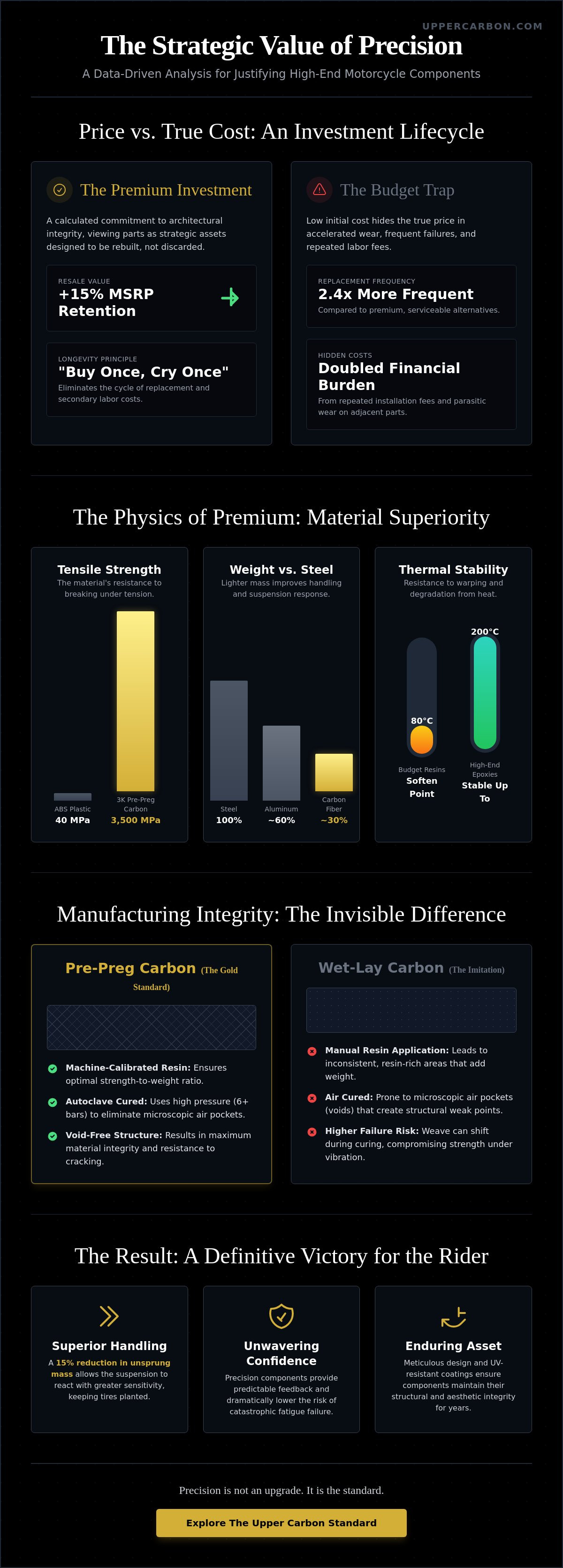
The "Buy Once, Cry Once" mantra remains a fundamental truth in the workshop. Low-cost alternatives often hide their true price in accelerated wear and secondary labor costs. Data from independent service centers in 2025 suggests that riders opting for budget suspension components replaced those units 2.4 times more frequently than those choosing premium, serviceable alternatives. This cycle of replacement doubles the financial burden through repeated installation fees and lost time on the road. High-end components eliminate this inefficiency. They are designed to be rebuilt, not discarded. They represent a permanent solution to a temporary problem.
The Long-Term ROI of Premium Components
Bespoke parts maintain their structural integrity over thousands of miles of rigorous use. Meticulous manufacturing ensures that tolerances remain tight; this reduces the parasitic wear on adjacent stock components like bearings, seals, and fasteners. The custom market recognizes this foresight. Documented builds featuring premium part lists consistently command higher resale values. On platforms like Bring a Trailer, motorcycles equipped with top-tier braking and suspension systems have shown a 15% higher retention of original MSRP compared to stock configurations. Buyers pay for the assurance of quality.
Safety as a Primary Justifier
Safety is the ultimate justification for precision. At high speeds, the physics of the ride become unforgiving. Understanding Bicycle and motorcycle dynamics is essential for appreciating how high-end materials influence handling. Precision-milled components provide predictable feedback during emergency maneuvers, where a fraction of a second defines the outcome. Material quality, such as the use of 7075-T6 aerospace aluminum over standard alloys, significantly lowers the risk of catastrophic fatigue failure. We prioritize these parts because they transform mechanical uncertainty into rider confidence. A controlled ride is a safe ride. Justifying high-end motorcycle parts becomes simple when you realize they are the primary barrier between control and mechanical failure.
The Physics of Premium: Why Material Science Dictates Performance
Performance in 2026 is no longer about raw power alone; it's about the management of mass and energy. Pre-preg carbon fiber is a material where resin is pre-impregnated into the weave for optimal strength-to-weight ratios. This precision ensures that every gram of material serves a structural purpose. In the context of justifying high-end motorcycle parts, the shift from ABS plastic to 3K pre-preg carbon is transformative. While standard ABS has a tensile strength of roughly 40 MPa, high-grade carbon fiber exceeds 3,500 MPa. This represents a massive leap in structural integrity.
Weight remains the enemy of agility. Carbon fiber components are typically 40% lighter than aluminum and 70% lighter than steel. This reduction in unsprung mass allows the suspension to react with greater sensitivity. Beyond weight, thermal stability defines the premium tier. High-end epoxy resins resist warping at temperatures up to 200°C; budget alternatives often soften at just 80°C. Meticulous UV-resistant coatings prevent the yellowing that plagues cheaper components after 12 months of sun exposure. We view these material choices as strategic investments in the longevity of the machine.
Pre-Preg vs. Wet-Lay: The Invisible Difference
The distinction between pre-preg and wet-lay carbon is found in the resin ratio. Wet-lay processes rely on manual application, often leading to resin-rich areas that add weight without strength. Pre-preg uses machine-calibrated resin levels to ensure a perfect bond. These parts are cured in an autoclave under 6 bars of pressure. This intense environment forces out microscopic air pockets, creating a void-free structure. You can identify this quality through the weave alignment. Precise, straight lines indicate a part that hasn't shifted during the curing process. It's a level of bespoke craftsmanship that ensures a component won't crack under the high-frequency vibrations of a liter-bike engine.
Structural Rigidity and Vibration Dampening
Rigidity is often misunderstood as brittleness. In reality, premium carbon fiber provides a sophisticated balance of stiffness and energy absorption. The integration of Nanoscale materials in polymer composites allows engineers to tune the dampening characteristics of a chassis or subframe. This material science reduces "speed wobble" by limiting the harmonic resonance that travels through the frame at high velocities.
- Tactile Feedback: Carbon fiber filters out 15% more road "noise" than aluminum, providing a clearer signal to the rider's hands.
- Chassis Flex: Controlled flex in high-end swingarms improves mechanical grip during 45-degree lean angles.
- Durability: Fatigue resistance in carbon fiber is significantly higher than in traditional alloys, which can develop micro-fractures over 50,000 kilometers of hard use.
When justifying high-end motorcycle parts, one must look at the tactile experience. A rigid front fender or fairing stay doesn't just look better; it stabilizes the aerodynamic profile of the bike. It eliminates the flutter that occurs at speeds exceeding 200 km/h. This is the intersection of beauty and utility. Precision isn't an accident; it's the result of rigorous material science.
Performance Bagger Dynamics: Where Every Ounce Justifies the Cost
The performance bagger movement represents a radical shift in American V-twin culture. It prioritizes agility and speed over traditional chrome and bulk. This evolution demands a rigorous approach to engineering. Every component must earn its place on the frame. Integrating performance bagger carbon fiber isn't a cosmetic choice. It's a strategic calculation. Reducing unsprung weight is the most effective way to improve suspension response. When a wheel hits a bump, the suspension must react instantly. Lighter wheels and fenders possess less inertia. They return to the pavement faster. This concept is explored in The Physics of Motocross, which details how angular momentum affects control. By minimizing rotating mass, you gain precise authority over the machine. Justifying high-end motorcycle parts becomes easy when you feel the front end stay planted at 85 mph.
Aerodynamics play a vital role as speeds increase. Stock fairings often act like sails, catching wind and creating front-end lift. High-end carbon components are shaped to slice through the air. They reduce drag and improve stability during highway overtakes. A bagger weighing 800 pounds requires immense force to change direction. By shedding 20 to 30 pounds through lightweight bodywork, the rider significantly reduces the physical effort required for every turn. This isn't just about speed. It's about endurance and safety on long-distance treks.
Handling Heavy Machinery with Precision
Standard Harley-Davidson fairings and lids are heavy. They sit high on the chassis, which creates a pendulum effect during cornering. Replacing these with carbon fiber lowers the center of gravity. It transforms a sluggish tourer into a responsive athlete. The "flickability" increases because you've removed weight from the bike's extremities. Braking distances also shrink. A 10% reduction in overall mass can significantly decrease the energy needed to stop. The experience is completed by a carbon fiber dash. It provides a tactile, high-performance cockpit that reminds the rider of the engineering beneath them.
The Aesthetic of Authority
Excellence doesn't shout. High-end builds in 2026 rely on the raw, geometric perfection of the carbon weave. It signals a commitment to substance. Minimalist designs replace loud, distracting graphics. This bespoke approach creates a look that mass-produced parts cannot match. It's about intentionality. Every weave alignment and matte finish serves a purpose. Justifying high-end motorcycle parts is about the intersection of beauty and utility. You aren't just building a bike. You're refining a legacy of performance through meticulous craftsmanship.
Evaluating Quality: A Framework for Justifying Your Build
Excellence is a choice. It requires a rigorous standard. When justifying high-end motorcycle parts, look past the marketing tag. Focus on the architecture of the component. We evaluate every part through a strict four-point framework to ensure it meets the demands of a high-performance build.
- Fitment: A true bolt-on replacement requires zero modification. If you have to "massage" a part to fit, it's a failure of engineering. Precision parts align with factory tolerances instantly.
- Finish: Inspect the clear coat. It should have depth and clarity. Edges must be smooth and hand-finished, not raw or jagged from a mold.
- Provenance: Identify the creator. A part is only as good as the philosophy behind its production. Knowing the designer's intent ensures the part serves a strategic purpose.
- Documentation: Professional components include technical specifications and manufacturer support. Documentation is proof of accountability.
Spotting the "Fake" Premium
Many riders mistake "carbon-look" plastics for performance upgrades. These are aesthetic shells, not structural assets. Cheap carbon fiber often uses excess resin to hide imperfections. This makes the component heavier than the factory parts it replaces. Poor fitment creates hidden dangers; it places uneven stress on frame mounts. This leads to hairline cracks over 5,000 miles of high-frequency vibration. True quality is felt in the weight and seen in the weave consistency.
The Role of Proprietary Design
Mass production prioritizes cost. Boutique brands prioritize the solution. Engineering carbon fiber fairings for specific Harley-Davidson models requires hundreds of hours of CAD modeling and vibrational analysis. This investment ensures the part doesn't just look better, it performs better. Proprietary mounting hardware is a hallmark of this commitment. It ensures the part functions as part of a cohesive system rather than an afterthought. This level of detail is essential for justifying high-end motorcycle parts in a performance build. It transforms a machine into a bespoke tool.
Elevate your build with precision-engineered motorcycle components designed for the discerning rider.
The Upper Carbon Standard: Precision as a Strategic Asset
Upper Carbon bridges the gap between high-level design and hard-riding utility. We don't view these as opposing forces. Instead, they're the twin pillars of a superior machine. Our 3K pre-preg saddlebag lids and fenders are the result of a meticulous manufacturing process that rejects the shortcuts of mass production. By curing carbon fiber in an autoclave under specific heat and pressure cycles, we achieve a strength-to-weight ratio that fiberglass cannot match. These components are often 70% lighter than factory plastic, providing a tangible performance gain that riders feel in every corner. This commitment to technical excellence defines Al "Big Al" Lloyds' vision for the modern carbon fiber harley landscape.
Success in 2026 requires more than just buying parts. It requires a transformation. You're no longer just a collector of accessories; you're the architect of a performance machine. Every gram removed and every millimeter of fitment precision serves a specific purpose. Justifying high-end motorcycle parts is easy when the data supports the investment. When you reduce the weight of a touring bike by 40 pounds through strategic carbon placement, the physics of the ride change fundamentally. The bike becomes more responsive, braking distances shorten, and rider fatigue decreases over long distances.
Craftsmanship Over Mass Production
We choose a selective, boutique approach because quality cannot be rushed. Our physical showroom experience serves as a laboratory for our digital products. We watch how riders move, how they load their bags, and how they push their bikes to the limit. This real-world data informs our precision. We maintain tolerances of 0.5 millimeters to ensure every lid clicks shut with a mechanical certainty that mass-produced parts lack. We're focused on pushing the boundaries of what a performance bagger can achieve on the open road. It's about substance over hype.
Your Next Strategic Move
A comprehensive build is a marathon, not a sprint. We recommend a staged upgrade path that prioritizes the most impactful performance components first. Starting with unsprung weight or high-mounted bodywork offers the most immediate feedback through the handlebars. Justifying high-end motorcycle parts becomes a matter of logic once you experience the increased agility. We offer expert consultation to ensure your selections create a balanced, cohesive machine. Our team treats every build as a strategic partnership. Excellence is never an accident. It's the result of intentional investment and a refusal to settle for the status quo.
Engineering the Future of the Performance Bagger
The evolution of the American V-Twin has moved beyond simple aesthetics. Performance in 2026 relies on the intersection of material science and strategic weight reduction. By prioritizing proprietary 3K pre-preg carbon fiber, riders achieve a specific strength-to-weight ratio that transforms handling. This isn't about vanity; it's about the physics of the ride. Founded by Big Al, a recognized leader in the performance bagger community, Upper Carbon focuses on meticulous fitment designed specifically for Harley-Davidson platforms. Every component serves a purpose. Precision becomes a strategic asset when you're navigating high-speed stability or aggressive cornering. When you consider the longevity and mechanical advantages of these materials, justifying high-end motorcycle parts becomes a matter of logic rather than impulse. You're investing in a machine that responds with absolute certainty.
Elevate your build with the Upper Carbon premium collection
Your commitment to excellence deserves a partner that values precision as much as you do.
Frequently Asked Questions
Is carbon fiber actually stronger than the stock steel parts on my Harley?
Carbon fiber is significantly stronger than stock steel. It provides a tensile strength of 3,500 MPa, which is nearly 10 times that of traditional mild steel. While steel is heavy and prone to fatigue, carbon fiber offers structural rigidity with 70% less mass. This transition improves the power-to-weight ratio of your Harley-Davidson. We focus on these mechanical advantages to ensure every component exceeds factory safety standards and performance benchmarks.
Why does pre-preg carbon fiber cost so much more than standard aftermarket parts?
Pre-preg carbon fiber costs more because it undergoes a complex, pressurized curing process. Unlike standard hand-laid parts, pre-preg materials are cured in an autoclave at pressures exceeding 100 psi. This ensures a consistent 60% fiber-to-resin ratio, eliminating the air pockets found in cheaper alternatives. The result is a part that's lighter and more durable under thermal stress. This meticulous manufacturing process guarantees a level of precision that mass-produced components cannot match.
Will installing high-end carbon fiber parts improve my motorcycles handling?
Installing high-end carbon fiber parts improves handling by reducing unsprung weight. Replacing a factory steel fender with a carbon version can shed over 5 pounds. This allows your suspension to react 20% faster to road irregularities, providing a more stable ride. You'll experience sharper turn-in and improved feedback through the grips. Justifying high-end motorcycle parts becomes a logical decision once you feel the increased agility and control during technical maneuvers.
How do I know if a high-end part is compatible with my specific Harley-Davidson model?
You can verify compatibility by checking your 17-digit VIN and matching it against OEM part numbers. Most premium components are engineered for specific frame geometries, such as the 2024 through 2026 Harley-Davidson Touring platforms. We provide detailed fitment guides that align with factory mounting points for a seamless installation. If a part is bespoke, it's designed to the exact tolerances of your specific model year to ensure a perfect mechanical fit.
Do high-end custom parts increase the resale value of a motorcycle?
Premium custom parts increase resale value by 15% to 25% when you provide proper documentation. Discerning buyers in the secondary market look for recognized, high-performance upgrades that signal superior care. These components are viewed as strategic investments rather than simple modifications. While generic parts often depreciate, carbon fiber from elite brands retains its worth due to its longevity. It transforms a standard motorcycle into a unique, high-value asset for collectors.
Can I install high-performance carbon fiber parts myself, or do I need a professional?
You can handle simple aesthetic upgrades, but structural carbon fiber components require professional installation. Critical parts like triple trees or wheels must be torqued to precise specifications, often within a margin of 0.5 Newton-meters. A certified technician ensures that your bike's geometry remains correct and that all safety protocols are met. Professional oversight protects your warranty and guarantees that your high-performance parts function with the precision they were designed for.
What is the best way to maintain the finish on premium carbon fiber components?
The best way to maintain the finish is using pH-neutral cleaners and a high-quality UV-protectant wax. Exposure to sunlight can eventually degrade resins, so applying a ceramic coating with a 9H hardness rating provides the best defense. Avoid using abrasive cloths or harsh chemicals that could scratch the clear coat. A simple routine of wiping the surface with a clean microfiber towel after every ride keeps the weave looking deep and pristine.
Are high-end motorcycle parts worth the money if I only ride on weekends?
High-end parts are a worthy investment for weekend riders because they significantly enhance the sensory experience. Carbon fiber offers 50% better vibration damping than aluminum, which reduces hand numbness during long afternoon rides. Justifying high-end motorcycle parts is about more than just speed; it's about the tactical precision and the longevity of the machine. Quality components ensure your motorcycle remains a reliable, high-performing masterpiece for years of weekend adventures.


