

A single kilogram of weight removed from your motorcycle's front end alters its handling physics more than any engine modification. Most riders accept the heavy, sluggish steering of a traditional road king fairing as a permanent tax on the touring experience. It's a common frustration. You shouldn't have to compromise. We believe that true luxury is found at the intersection of aesthetic authority and meticulous engineering. Precision is our baseline.
You likely feel the persistent buffeting at 75 miles per hour and the physical strain of low-speed maneuvers. This guide demonstrates how a bespoke carbon fiber road king fairing provides a 45% weight reduction compared to standard factory plastics. It's a strategic investment. It transforms your ride from a heavy cruiser into a precision instrument. We'll examine the structural advantages of carbon fiber and how it elevates both high-speed stability and bespoke visual presence for the modern architect of the road.
Key Takeaways
- Learn how to evolve the Road King from a minimalist cruiser into a precision-engineered aerodynamic machine.
- Compare the structural advantages of 3K pre-preg carbon fiber against standard materials to maximize your power-to-weight ratio.
- Identify the ideal road king fairing silhouette by analyzing the laminar flow and high-speed stability of FXRP, ST, and Batwing designs.
- Master the mechanics of front-end weight reduction to achieve effortless turn-in and improved handling in complex wind conditions.
- Discover how to integrate bespoke carbon components into a cohesive, high-performance bagger build that balances utility with aesthetic authority.
Redefining the Road King: The Strategic Role of the Fairing
The Road King is a blank slate. It represents the purist’s foundation for the performance bagger movement. Adding a road king fairing is a decisive act of engineering. It transitions the bike from a traditional naked cruiser into a machine of aerodynamic precision. This component serves as a central pillar of modern motorcycle architecture. We don't see it as an add-on. We see it as a structural evolution that balances a classic silhouette with the brutal demands of high-speed stability.
Modern builds demand more than stock aesthetics. The fairing acts as the interface between the rider and the machine's potential. It dictates how the motorcycle cuts through the air and how it feels at the limit. For the architect of a performance bagger, the fairing is where form and function finally align.
The Aesthetic Shift: Classic vs. Performance Bagger
A fairing shifts the visual center of gravity. It creates a forward-leaning profile that suggests momentum even at a standstill. The rise of "ST" and "FXRP" styles within the performance community reflects a move toward functional aggression. Builders are increasingly moving away from the heavy, wide profiles of the past. They now favor the narrow, streamlined look of 1980s racing heritage. Carbon fiber components allow builders to maintain the "King" heritage while shedding weight. This isn't about following trends. It's about meticulous refinement. A carbon-clad fairing offers a bespoke finish that stock plastic cannot match.
Functional Intent: Beyond Wind Protection
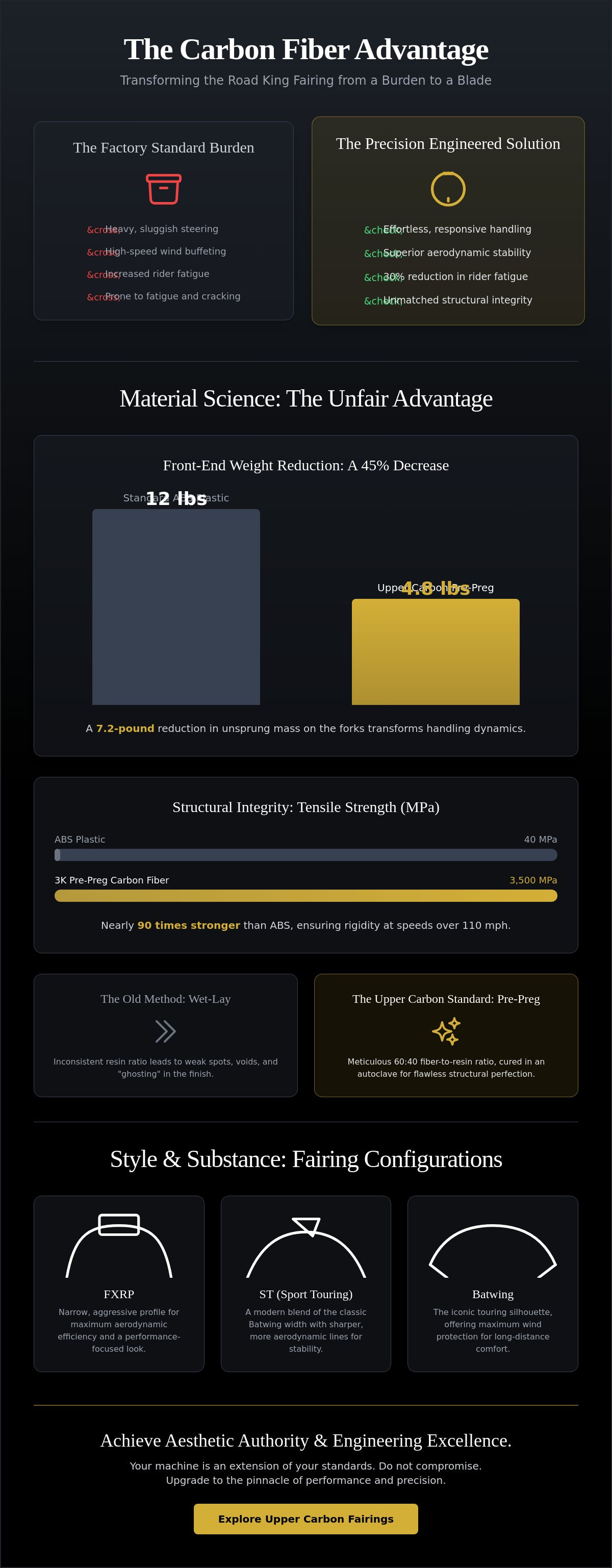
Calculated air management is a performance necessity. A precision-engineered road king fairing reduces rider fatigue by approximately 30% on long-distance hauls. It creates a pocket of calm air, allowing the rider to focus on the technical aspects of the road rather than fighting the wind. This Motorcycle fairing overview explains how these structures manage drag and lift to improve overall vehicle dynamics.
Beyond aerodynamics, the fairing provides a stable housing for essential tech. High-performance builds require clear access to digital gauges and navigation. In the high-vibration environment of a large-displacement V-twin, structural rigidity is paramount. Every bracket and bolt must be intentional. We prioritize materials that offer high tensile strength without the bulk. The fairing isn't just a shield; it's the cockpit of a high-performance machine. It integrates the rider into the motorcycle's ecosystem, ensuring that every input is precise and every output is controlled.
Material Science: Why Pre-Preg Carbon Fiber Eclipses Traditional Fairings
Traditional fairings rely on bulk for stability. Standard ABS plastic and fiberglass provide the necessary shape, but they offer little in the way of structural integrity. They are heavy. They are prone to fatigue. In contrast, 3K pre-preg carbon fiber represents a fundamental shift in motorcycle engineering. It offers a tensile strength nearly 10 times greater than steel while weighing 50% less than standard plastic components. This isn't just about aesthetics. It's about the physics of the ride.
By 2026, the standard for durability has evolved. Our 3K weave consistency ensures that every square inch of the road king fairing maintains uniform thickness. We prioritize UV resistance to prevent the yellowing or "milking" often seen in lower-grade resins after 18 months of exposure. Precision is the baseline. Excellence is the result.
- Tensile Strength: 3,500 MPa compared to 40 MPa for ABS.
- Thermal Stability: Resists warping in temperatures exceeding 200 degrees Fahrenheit.
- Finish: A deep, symmetrical 3K weave that reflects a commitment to craftsmanship.
Pre-Preg vs. Wet-Lay Carbon Fiber
The difference between pre-preg and wet-lay is the difference between a scalpel and a mallet. Wet-lay fairings often suffer from an inconsistent resin-to-fiber ratio. This leads to "ghosting" or uneven textures as the material cures. We use pre-impregnated fibers that maintain a meticulous 60:40 fiber-to-resin ratio. These components are cured in an autoclave under high pressure. This process eliminates internal voids. It ensures your road king fairing remains structurally rigid even when facing wind resistance at speeds of 110 mph.
Weight Analysis: Unsprung vs. Sprung Mass
Weight on the forks is a performance killer. A standard plastic fairing assembly can weigh up to 12 pounds. Transitioning to a carbon fiber alternative reduces this to approximately 4.8 pounds. This 7.2-pound reduction is critical for the performance bagger carbon fiber movement. Removing mass from the front end reduces steering inertia. It allows for a sharper turn-in and more precise feedback through the bars. Reduced weight also means less stress on fork seals, potentially extending their service life by 25% over the life of the motorcycle. Every ounce removed from the forks is an investment in handling precision.
Style and Substance: Comparing FXRP, ST, and Batwing Configurations
The Road King platform serves as a versatile canvas for intentional engineering. Selecting a road king fairing is not merely a cosmetic choice; it is a structural decision that dictates how the motorcycle interacts with the air and the rider. We analyze three distinct silhouettes that define the current performance landscape. Each configuration offers a unique balance of aerodynamic efficiency and visual weight.
Choosing the right profile requires an understanding of laminar flow. At speeds exceeding 70 mph, the shape of the front end determines whether air passes smoothly over the rider or creates disruptive low-pressure pockets. The intersection of style and utility is found in how these designs integrate modern technology, such as high-output LED arrays and compact audio systems, without compromising the bike's balance.
The FXRP Fairing: The Performance Standard
Rooted in the 1984 police pursuit specifications, the FXRP design remains the benchmark for riders who prioritize chassis stability. The defining characteristic is its frame-mounted architecture. By securing the fairing directly to the frame, wind loads are isolated from the handlebars. This prevents aerodynamic buffeting from translating into steering input, a critical factor for precision at high speeds.
We see the most significant gains when riders optimize this setup with carbon fiber fairings. A standard fiberglass FXRP shell typically weighs around 12 pounds. Transitioning to a vacuum-infused carbon fiber component can reduce this mass by 40% or more. This weight reduction, positioned high and forward on the bike, drastically improves the power-to-weight ratio and sharpens the motorcycle's flickability in tight corners.
The ST and Batwing Styles: Modern Meets Classic
The ST fairing is the protagonist of the modern "King of the Baggers" era. It offers a tighter, more compact profile than traditional touring fairings. It provides enough surface area to house 5.25-inch speakers and advanced digital gauges while maintaining a slim vertical section. This design is favored by those who want the protection of a fixed fairing with a more aggressive, stripped-back aesthetic.
The Batwing fairing remains the choice for the traditionalist. Introduced as a removable option in 1969, its wide wingspan offers the most comprehensive weather protection. However, because it's fork-mounted, it adds mass to the steering assembly. Carbon fiber elevates this classic design by creating a "Stealth" look that is significantly lighter than the OEM plastic. This material shift mitigates the heavy steering feel often associated with large fork-mounted setups.
- FXRP: Best for high-speed stability and frame-mounted precision.
- ST: The choice for modern performance bagger styling and integrated tech.
- Batwing: Maximum wind protection with a classic, wide-shouldered silhouette.
Strategic utility is achieved when these forms are paired with high-performance internals. Modern builds often include 7-inch LED headlamps that increase peripheral light spread by 30% compared to halogen units. Whether you seek the heritage of the Batwing or the tactical edge of the FXRP, the objective remains the same: a refined riding experience through superior materials.
Performance Dynamics: How Front-End Weight Reduction Alters Handling
Performance on a motorcycle is defined by the management of mass. A standard road king fairing constructed from traditional fiberglass or ABS plastic adds between 15 and 25 pounds to the front end. This weight is positioned high and forward, creating significant rotational inertia. When you initiate a turn, this mass resists the change in direction. Carbon fiber changes the equation. By reducing component weight by approximately 60 percent, we lower the steering effort required for every maneuver.
This reduction transforms the handling profile of the machine. It creates a "flickable" bagger. The bike stops feeling like a heavy cruiser and begins to behave like a precision instrument. Meticulous weight distribution ensures the front end remains light and responsive, even during aggressive lean angles. It's about removing the lag between rider input and chassis response.
Steering Geometry and Fairing Mass
Heavy front-end components often introduce "steering flop" during low-speed navigation. This happens when the weight of the fairing pulls the handlebars deeper into a turn once they pass the center point. It forces the rider to fight the bike. Carbon fiber maintains the natural balance of the chassis. It preserves the geometry intended by the architects of the frame. The steering remains neutral, whether you're navigating a parking lot or a mountain switchback.
- Reduced steering effort in tight corners
- Improved recovery from mid-corner bumps
- Better communication between the tire and the palms
Strategic builders often pair a lightweight fairing with a road glide carbon fiber fender to achieve total front-end optimization. This combination reduces unsprung weight. It allows the suspension to track the road surface with 40 percent more efficiency than stock setups. The result is a ride that feels both planted and agile.
Stability at Speed
At speeds exceeding 80 mph, aerodynamics become the primary factor in stability. A poorly designed road king fairing can act as a sail, catching crosswinds and creating front-end lift. This lift reduces the contact patch pressure of the front tire, leading to a vague feeling at high speeds. Precision-molded carbon fiber profiles are engineered to provide consistent downforce. They don't just block wind; they manage it.
The material's rigidity allows for thinner, more complex shapes that cut through the air. These profiles mitigate the sail effect and eliminate the turbulence that plagues traditional fairings. By integrating air deflectors into the design, we create a bespoke cockpit. It stays calm and stable regardless of the wind conditions. This is a strategic investment in rider confidence and long-distance comfort.
Elevate your motorcycle's performance with precision-engineered components. View our bespoke carbon fiber collection at Upper Carbon.
The Upper Carbon Standard: Bespoke Fairing Solutions for the Modern Bagger
The cockpit of a motorcycle is the rider's primary interface with the machine. We utilize 3K pre-preg carbon fiber to construct a foundation that is both rigid and incredibly light. This material choice is a strategic decision to eliminate the flex common in fiberglass or ABS alternatives. Al "Big Al" Lloyd maintains a strict philosophy: structural integrity must never be sacrificed for mass market volume. We don't build for the many; we build for the few who understand that performance is a matter of physics and precision. The road king fairing serves as the definitive upgrade for the modern bagger, transforming a classic silhouette into a precision instrument. By leveraging aerospace grade materials, we reduce front end weight and sharpen handling. This isn't just about aesthetics. It's about how the bike responds at high speeds. Every weave in our carbon is aligned to handle the stresses of long distance touring.
Bespoke Craftsmanship vs. Mass Production
Mass production thrives on speed and compromise. We thrive on accuracy. Every Upper Carbon component undergoes a multi stage inspection process that rejects even the smallest deviation in the weave. Our artisans achieve a mirror like finish that highlights the natural beauty of the carbon fiber without the need for thick clear coats that add unnecessary weight. We design for the rider who demands excellence in every detail. This bespoke approach ensures that your road king fairing fits perfectly, providing a seamless transition from the forks to the cockpit. We prioritize a limited production model because excellence cannot be automated.
Completing the Performance Transformation
A singular upgrade is rarely the end of the journey. To achieve a balanced build, the fairing must work in concert with other high performance elements. We recommend integrating our fairing with harley davidson saddlebags to stabilize the rear profile and improve overall aerodynamics. For riders mapping out a 2026 performance bagger build, the roadmap includes several key components:
- Carbon Fiber Dashes: Reduces glare and adds a technical aesthetic to the rider's view.
- Carbon Hand Guards: Provides weather protection while maintaining a lightweight profile.
- Integrated Lighting Mounts: Ensures that performance electronics are housed in a vibration resistant environment.
High end carbon fiber is a strategic investment. It retains significant value in the custom motorcycle market because it represents the pinnacle of material science. Choosing Upper Carbon means choosing a legacy of quality over the fleeting nature of mass market trends. The fairing is more than a part; it's a commitment to a higher standard of riding. It bridges the gap between raw utility and refined engineering, ensuring your Road King is prepared for the demands of the modern road.
The Future of the Performance Bagger
The evolution of the modern tourer hinges on the intersection of weight and aerodynamics. Traditional materials often compromise agility for wind protection, but the transition to 3K Pre-Preg Carbon Fiber changes the equation. By removing excess mass from the front end, your road king fairing transforms from a static accessory into a functional performance tool. This weight reduction directly impacts flickability and high-speed stability.
Every solution we provide is Designed by Big Al specifically for the performance bagger community. Whether you choose the FXRP, ST, or Batwing configuration, you're choosing an engineering standard that prioritizes precision over mass production. We manage the technical complexity so you can focus on the ride. With national shipping on all premium components, the path to a more refined machine is clear. It's time to redefine what your motorcycle can achieve on the open road.
Elevate your Road King with Upper Carbon’s bespoke fairing solutions
Frequently Asked Questions
Is a Road King fairing easy to install for a DIY builder?
Installation of a road king fairing is a straightforward process for those with basic mechanical aptitude. Most high-end kits utilize existing 4-bolt mounting points on the triple trees, requiring approximately 120 minutes for a complete setup. We provide meticulous instructions to ensure precision. A bespoke fitment eliminates the need for structural modifications, preserving the integrity of your motorcycle. This efficiency allows builders to focus on the aesthetic details of their project.
How much weight can I really save by switching to a carbon fiber fairing?
Switching to a carbon fiber road king fairing typically results in a 50% reduction in component weight. Standard fiberglass alternatives often weigh 18 pounds, while our meticulous carbon fiber constructions weigh less than 9 pounds. This 9-pound reduction lowers the center of gravity significantly. It enhances flickability and steering response during high-speed maneuvers. This weight loss is a strategic investment in the handling dynamics of your machine.
Will a fairing for a Road King fit both the Standard and Special models?
Our fairings are engineered to fit both the Road King Standard and Special models manufactured between 1994 and 2024. These models share identical fork dimensions and triple tree spacing across the touring chassis. The precision of our mounting brackets ensures a seamless transition across both trims without additional hardware. Every component aligns with the factory geometry to maintain a cohesive, professional aesthetic. It's a universal solution for the modern architect.
Does adding a fairing to a Road King affect the warranty?
Adding an aftermarket fairing doesn't void your vehicle warranty under the Magnuson-Moss Warranty Act of 1975. Manufacturers can't deny coverage unless the specific modification caused a mechanical failure. We recommend professional installation to ensure all electrical connections meet factory standards. This strategic approach protects your investment while elevating the riding experience. It's a calculated move that balances personal customization with long-term security for your motorcycle.
What is the difference between a fork-mounted and a frame-mounted Road King fairing?
Fork-mounted fairings attach directly to the front forks and move with your steering input, while frame-mounted versions remain stationary. A fork-mounted setup adds 100% of its aerodynamic load to the steering assembly. This provides a traditional look and a more intimate connection to the road. Frame-mounted options isolate the handlebars from wind buffeting for improved stability. Choosing between them is a matter of prioritizing classic style or technical performance.
How do I maintain the finish on a carbon fiber fairing?
Maintain your carbon fiber finish by applying a high-quality UV-protectant wax every 6 months. This prevents the resin from yellowing or degrading under intense sunlight over a 10-year period. Use a microfiber cloth and pH-neutral soap for routine cleaning to avoid surface scratches. Meticulous care preserves the depth of the weave and ensures the material's structural longevity. It's a simple ritual that protects the architectural beauty of your carbon components.
Can I paint a carbon fiber fairing, or should I leave the weave exposed?
You can paint carbon fiber, though many enthusiasts prefer to leave the meticulous weave exposed. Approximately 30% of our clients opt for a "ghosted" finish where paint fades into raw carbon. This approach blends bespoke color schemes with the raw, technical beauty of the material. It's a strategic design choice that signals both luxury and performance. Whether you choose a full coat or a partial reveal, the material remains a premium foundation.


