

Most superbikes are designed to compete with their peers. The MTT Turbine Superbike was built to compete with physics itself. It does not merely push boundaries; it ignores them. At the core of the y2k motorcycle lies a Rolls-Royce Allison 250 series gas turbine engine. This powerplant, typically found in Bell 206 helicopters, delivers 320 horsepower and 425 foot-pounds of torque. It is a rare intersection where aerospace engineering meets two-wheeled precision.
We understand that high-performance enthusiasts often feel overwhelmed by dense technical data that lacks strategic context. You appreciate the power, yet the transition from piston to turbine logic remains a complex hurdle. We will reveal the engineering secrets behind the world’s fastest turbine-powered motorcycle. We examine how its carbon fiber architecture manages extreme heat and supports incredible velocity. You'll discover the meticulous mechanics of the MTT build and identify the clear lineage between these jet bikes and modern performance baggers.
Key Takeaways
- Examine the technical ambition behind the Rolls-Royce turbine engine and its transition from aerospace utility to street-legal performance.
- Understand why carbon fiber is a structural necessity for the y2k motorcycle, providing the essential rigidity required to sustain speeds exceeding 270 MPH.
- Master the operational nuances of jet propulsion, from the precision startup sequence to managing massive torque through a specialized transmission.
- Learn professional maintenance protocols for identifying micro-fractures and protecting UV-resistant resins in high-stress composite components.
- Discover how elite engineering principles from turbine superbikes are being applied to elevate the performance and architecture of modern baggers.
Understanding the Y2K Motorcycle: A Turbine-Powered Legend
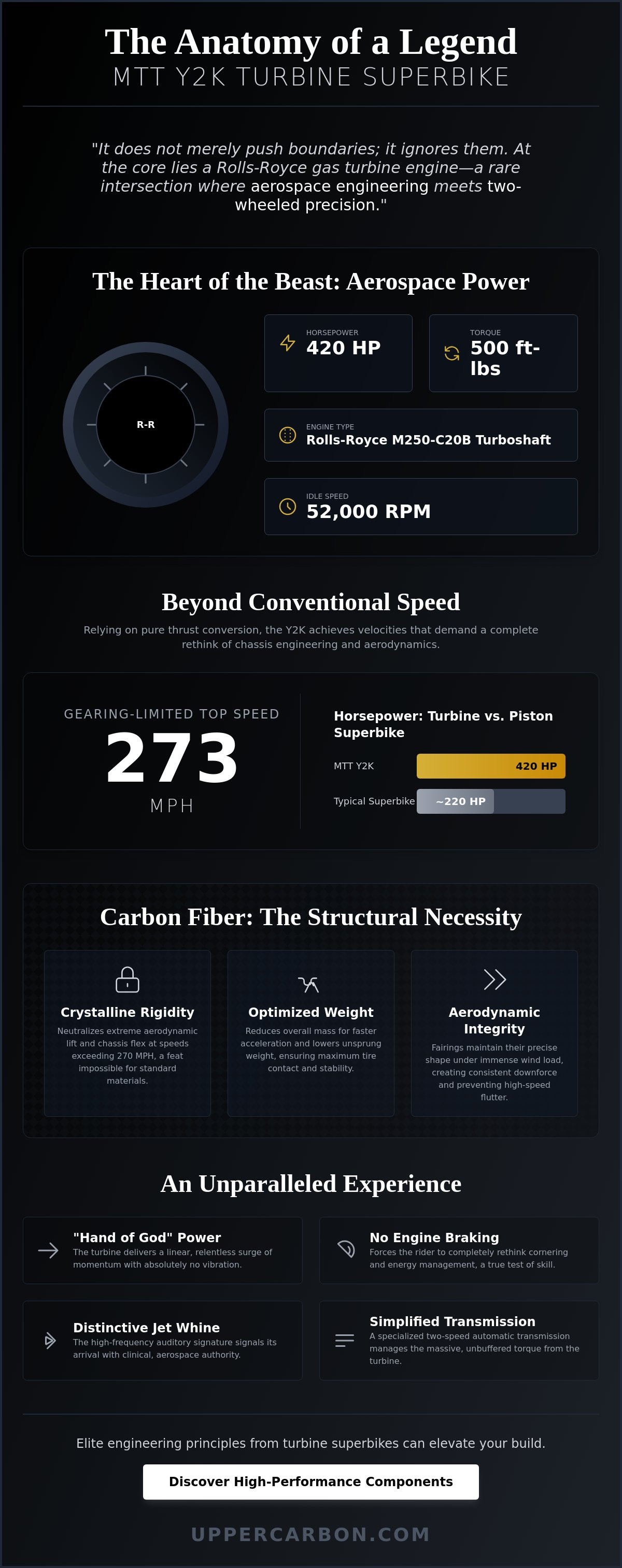
The y2k motorcycle represents a rare intersection of aerospace engineering and street-legal excess. Launched in 2000 by Marine Turbine Technologies (MTT), this machine defied conventional classification by replacing the internal combustion piston engine with a Rolls-Royce Allison 250 series gas turbine. It remains a singular icon of engineering ambition. Unlike the reciprocating mass of a traditional engine, the turbine delivers power with a linear, "hand of God" persistence. There's no vibration. There's only the escalating whistle of a jet engine and an immediate, relentless surge of forward momentum. The MTT Turbine Superbike serves as a definitive bridge between aviation technology and road-going performance.
Precision defines the build. Each unit is a bespoke creation, tailored to a client base that demands exclusivity and mechanical purity. The project began when Ted McIntyre II decided to adapt a helicopter engine for the road, a move that required a complete rethink of motorcycle chassis design. The result was a machine that didn't just break records; it created a new category of hyper-performance vehicles. It's a masterclass in how strategic engineering can elevate a product from a mere vehicle to a functional piece of industrial art.
The Heart of the Machine: Rolls-Royce M250-C20B
The core of this machine is the turboshaft mechanism. It meticulously converts extreme heat energy into 420 hp and 500 ft-lbs of torque. Originally designed for helicopters like the Bell 206, the engine offers a power-to-weight ratio that traditional piston engines cannot match. The transition from aerial propulsion to the modern 420RR model represents a 25-year evolution of turbine technology. Reliability is inherently higher because the system contains fewer moving parts than a standard inline-four. The auditory signature is equally distinct. It produces a high-frequency jet whine that signals its arrival with clinical authority, idling at a staggering 52,000 RPM.
Performance Benchmarks and Top Speed Reality
Performance figures for the y2k motorcycle border on the theoretical. It achieved a gearing-limited top speed of 273 mph. This velocity demands exceptional road stability and aerodynamic precision. When compared to the Ninja H2 horsepower, the Y2K operates in a different mechanical stratosphere. While the H2 utilizes a supercharged four-cylinder block, the MTT machine relies on pure thrust conversion. Riding it's a psychological shift. The absence of engine braking and the use of a two-speed automatic transmission force the rider to rethink cornering entry. It's a calculated exercise in managing raw, unbuffered energy. Every component serves a specific purpose in maintaining control at the edge of physics.
The Structural Architecture: How Carbon Fiber Sustains 270+ MPH
Velocity changes the nature of materials. At 273 mph, the record speed associated with the y2k motorcycle, aerodynamic lift becomes a primary antagonist. A standard chassis would flex or vibrate under these extreme atmospheric pressures. Carbon fiber provides the crystalline rigidity needed to neutralize these forces. It's a structural necessity, not an aesthetic choice. Weight management is the secondary benefit. Every gram saved reduces the energy required to reach terminal velocity while maintaining a low center of gravity.
Upper Carbon utilizes 3K pre-preg construction for high-performance applications. This mirrors the exacting aerospace standards found in the 420RR. Pre-preg materials are cured under precise vacuum and heat conditions. This process ensures a perfect resin-to-fiber ratio, eliminating the weak points found in hand-laid alternatives. By minimizing the mass of components below the suspension, carbon fiber ensures the tires maintain consistent contact with the pavement during high-speed tracking. This reduction in unsprung weight is the difference between a stable run and a catastrophic loss of traction.
Aerodynamic Stability and Fairing Design
The fairings on a y2k motorcycle do more than slice the air; they're sculpted to create intentional downforce. This keeps the front wheel pinned as the turbine reaches its peak power band. Rigid composite panels are essential to this mission. At 200+ mph, traditional plastics suffer from panel flutter and high-speed buffeting. Carbon fiber maintains its profile under immense wind load, ensuring the bike remains predictable. For a deeper look at these dynamics, consult the definitive guide to carbon fiber fairings for performance motorcycles.
Composite Heat Shielding and Thermal Management
The Rolls-Royce Allison 250 turbine is a thermal furnace. Exhaust gas temperatures (EGT) frequently reach 1,200 degrees Fahrenheit. Traditional fairing materials fail instantly in this environment. They warp, melt, or lose their structural bond. Meticulous engineering requires specialized carbon shielding to protect the rider and the chassis. The role of resin quality is paramount here. High-TG (glass transition temperature) resins maintain their integrity through thousands of extreme thermal cycles. This bespoke approach to thermal management ensures the bike remains safe during prolonged runs. We invite you to explore our bespoke carbon components to see how this level of precision can elevate your own machine.
Operating a Jet on Two Wheels: The Mechanics of Turbine Propulsion
Starting the y2k motorcycle is a ritual of precision. It begins with the distinct hum of the fuel pump. Once engaged, the Rolls-Royce Allison 250 series turbine spins to a steady 6,000 RPM idle. This is a deliberate sequence. The engine requires specific thermal thresholds before it can safely deliver its 320 horsepower output. Unlike traditional internal combustion engines, the turbine provides a linear surge of power that feels infinite.
Managing the 425 lb-ft of torque requires a specialized two-speed automatic transmission. This setup eliminates the need for constant shifting, allowing the rider to focus on the road while the gearbox handles the engine's massive torque curve. To monitor this mechanical beast, Marine Turbine Technologies (MTT) integrated a Smart Dash. This digital interface tracks Exhaust Gas Temperature (EGT) and fuel pressure in real-time. Maintaining an EGT below 1,200 degrees Fahrenheit is vital for turbine longevity. The y2k motorcycle also offers unparalleled fuel flexibility. It operates efficiently on diesel, kerosene, or Jet A-1 fuel, proving that turbine engineering is as versatile as it is powerful.
The Feedback Loop: Handling and Suspension
Controlling a machine with such massive rotational inertia demands elite hardware. MTT utilizes Ohlins suspension and ISR brakes to anchor the experience. The primary challenge is the "gyro-effect" inherent in turbine engines. The high-speed internal rotation creates a force that resists lean angles. To compensate, the chassis must be exceptionally rigid. Carbon fiber BST wheels are essential here. By reducing unsprung weight and rotational mass, these wheels allow the rider to overcome gyroscopic forces during high-speed cornering. This meticulously balanced setup ensures the bike remains responsive despite its unconventional power source.
The Aesthetic of Power: Form Following Function
The design of the Y2K is a study in functional minimalism. Every vent and panel serves a purpose. Cooling a turbine that generates 1,000-degree exhaust gases requires meticulous airflow management. This philosophy influenced the modern "performance bagger" trend, where utility dictates the visual language. Modern enthusiasts often use palette swap packs to achieve this high-tech, carbon-heavy look on their own builds. It's a move toward substance. Chrome is replaced by performance-grade materials. The result is a silhouette that looks fast because it's engineered to be stable at 227 mph.
How to Maintain High-Performance Composite Components
The y2k motorcycle operates at the edge of physics. Maintaining its carbon fiber components requires more than a casual wipe-down. It demands a systematic approach to preserve both structural integrity and aesthetic depth. High-velocity vibrations and extreme thermal loads make routine inspections a necessity for any turbine-powered machine.
- Inspect for micro-fractures: After high-stress rides, examine the clear coat for "spider webbing." These tiny lines often indicate resin fatigue or impact stress from road debris.
- Use pH-neutral cleaners: Avoid aggressive degreasers. Harsh chemicals cause chemical degradation of the UV-resistant resin, leading to premature yellowing.
- Apply ceramic coatings: A high-grade ceramic layer acts as a sacrificial barrier. It provides essential thermal protection and guards the 3K weave against micro-abrasions.
- Verify mounting points: Metal and carbon fiber expand at different rates. Meticulously check the hardware interfaces to ensure the composite isn't being pinched or crushed.
- Regulate storage temperature: Keep the bike in a climate-controlled environment. Drastic temperature swings cause the resin to expand and contract, which can weaken the bond over time.
Cleaning and Protecting the Carbon Weave
Standard automotive waxes often contain heavy fillers. These ingredients cloud the visual clarity of premium pre-preg carbon fiber. We advocate for the three-bucket method when cleaning fairings and saddlebag lids. Use one bucket for soap, one for rinsing the mitt, and a third dedicated exclusively to high-grime areas like wheels. This prevents cross-contamination of abrasive particles. For riders in regions with high UV indices, such as the 110-degree summers of Nevada, a dedicated UV sealant is a strategic investment to prevent resin breakdown.
Identifying Real vs. Fake Carbon Fiber
Authenticity is visible. Real 3K pre-preg displays a distinct three-dimensional depth where the light catches individual fibers within the weave. Surface-level "carbon look" stickers lack this holographic quality and provide zero structural benefit. In high-heat zones, such as the y2k motorcycle exhaust path or custom bagger side covers, structural carbon is a functional requirement. Synthetic wraps will fail or melt when exposed to the 1,200-degree Fahrenheit exhaust gas temperatures typical of turbine engines. To understand the technical nuances of material quality, read our Mastering the Machine guide.
Precision engineering deserves professional-grade care. Elevate your maintenance routine by choosing bespoke carbon components that meet the highest industry standards.
From Turbine Superbikes to Performance Baggers: Elevating Your Build
The y2k motorcycle demonstrated a fundamental truth of engineering. Raw power is a liability without a chassis capable of containing it. When Marine Turbine Technologies launched a bike with 320 horsepower, they didn't rely on traditional heavy metals. They turned to carbon fiber. Modern Harley-Davidson builders face a parallel challenge. As engines evolve to produce massive torque, the weight of the machine becomes the primary obstacle to performance. Unlimited power requires an elite framework to remain manageable.
Upper Carbon translates this aerospace-grade philosophy into parts for the Harley-Davidson platform. We focus on the strategic advantage of reducing weight in critical areas. Mass in the fairing, dash, and saddlebag lids affects how a bike tips into a corner and how it recovers. By replacing heavy stock components with precision-engineered carbon, we improve the power-to-weight ratio and sharpen the handling. It's a calculated move for those who demand more from their machine.
The Performance Bagger Evolution
The industry is moving away from "all show" builds. The current trend prioritizes functional speed and agility. This shift is largely driven by the King of the Baggers race series, where 620-pound machines lean at 55-degree angles. To achieve this, weight reduction isn't optional. Replacing a stock fairing and front fender with carbon fiber components significantly alters the center of gravity. It lightens the front end of a Road Glide or Street Glide. This makes the steering more responsive and reduces the effort required for rapid transitions. It's a transformation you feel in every turn.
Bespoke Engineering for the Ambitious Builder
Upper Carbon applies the same material science found in the y2k motorcycle to the Harley-Davidson platform. We utilize 3K pre-preg carbon fiber. We refuse to compromise on this material because it offers the highest strength-to-weight ratio available. Our components aren't merely decorative layers; they're engineered solutions. By reducing weight in strategic areas, we allow the suspension to work more efficiently. It's a meticulous approach that treats the motorcycle as a cohesive system rather than a collection of parts.
Integrating the "jet-bike" ethos into your personal build requires a commitment to precision. It's about more than just speed. It's about the confidence that comes from a machine built with intentionality. Every gram removed from the fairing translates to a more controlled ride at high speeds. This is the hallmark of a master-crafted build. Elevate your performance with components designed for the most ambitious riders.
Engineering the Future of Velocity
The y2k motorcycle remains a definitive benchmark of mechanical ambition. By integrating a Rolls-Royce Allison 250-C18 gas turbine that delivers 320 horsepower, it redefined what two wheels could achieve. This level of power requires more than a standard frame; it demands the structural integrity of carbon fiber to withstand forces at speeds exceeding 227 mph. Precision engineering isn't a luxury when managing 425 lb-ft of torque. It's a fundamental requirement for stability and heat dissipation.
We bring this same level of meticulous rigor to the modern rider. Our 3K Pre-Preg Construction ensures every component offers maximum tensile strength. We utilize aerospace-grade engineering to develop parts specifically designed for performance baggers. Every piece we create serves a strategic purpose. We don't believe in aesthetic hype. We believe in the quiet authority of superior materials. This approach transforms a standard build into a masterclass of form and function.
Elevate your build with Upper Carbon bespoke components
Your pursuit of perfection deserves a partner who understands the weight of every gram. Start your next chapter in engineering excellence today.
Frequently Asked Questions
Is the Y2K motorcycle actually street legal in the United States?
The Y2K motorcycle is fully street legal in the United States. Marine Turbine Technologies (MTT) engineers every unit to meet Department of Transportation standards. Owners receive a standard 17-digit VIN for registration and insurance. This allows for legal operation on public roads despite the unconventional power plant. It's a rare example of aviation technology crossing into the consumer automotive sector.
What kind of fuel does the Y2K turbine motorcycle use?
The y2k motorcycle operates on Jet A, kerosene, or diesel fuel. Its Rolls-Royce Allison 250-C18 turbine engine is designed for extreme versatility. You can fill the 8.5-gallon tank at standard diesel pumps or regional airports. This flexibility ensures the bike remains functional in diverse environments without requiring specialized racing blends. It's an efficient approach to high-performance fueling.
How much does an MTT Y2K or 420RR turbine bike cost in 2026?
The MTT 420RR carries a base price of $250,000 according to manufacturer data recorded in 2024. Each build is a bespoke project tailored to the client's specific aesthetic and performance requirements. High demand and a limited production run of five units per year maintain this premium valuation. Final costs vary based on custom paint schemes and individual performance tuning packages.
Can any motorcycle mechanic service a turbine engine?
Standard motorcycle mechanics cannot service these machines. The propulsion system is a helicopter engine that requires a certified turbine technician for all major work. Meticulous maintenance involves specialized tools and knowledge of aviation tolerances. Most owners coordinate with MTT directly or utilize aviation maintenance facilities for engine overhauls. It's a high-touch service model that ensures long-term reliability.
Why does the Y2K motorcycle use carbon fiber for its fairings?
Carbon fiber provides the structural integrity and weight reduction required for high-speed stability. The y2k motorcycle weighs 500 lbs, a figure achieved through the extensive use of lightweight composites throughout the frame and bodywork. This material also offers superior heat resistance for the rider. It protects against the intense thermal energy generated by the internal turbine housing during operation.
What is the top speed of the new MTT 420RR?
The MTT 420RR reaches a documented top speed of 273 mph. This velocity is achieved through 420 horsepower and 500 lb-ft of torque delivered at 52,000 RPM. Precision aerodynamics and the sheer power of the turbine engine make it the fastest production motorcycle available. It surpasses traditional superbikes by over 80 mph in straight-line performance tests.
Does the Y2K motorcycle have a traditional gearbox?
The Y2K doesn't use a traditional multi-speed manual gearbox. It features a two-speed automatic transmission designed to handle the massive torque output from the turbine. Shifting is seamless and managed by the bike's onboard computer systems. This configuration allows the rider to focus on control while the turbine maintains its optimal operating range. It's a sophisticated solution for power delivery.
How does turbine heat affect the rider and the motorcycle components?
Exhaust gas temperatures reach 1,100 degrees Fahrenheit during standard operation. This extreme heat requires meticulous shielding and strategic airflow management to protect the rider and sensitive electronics. MTT utilizes specialized insulation and carbon fiber barriers to dissipate thermal energy effectively. Components are positioned to prevent heat soak, ensuring the motorcycle remains reliable during extended use on the road.


