

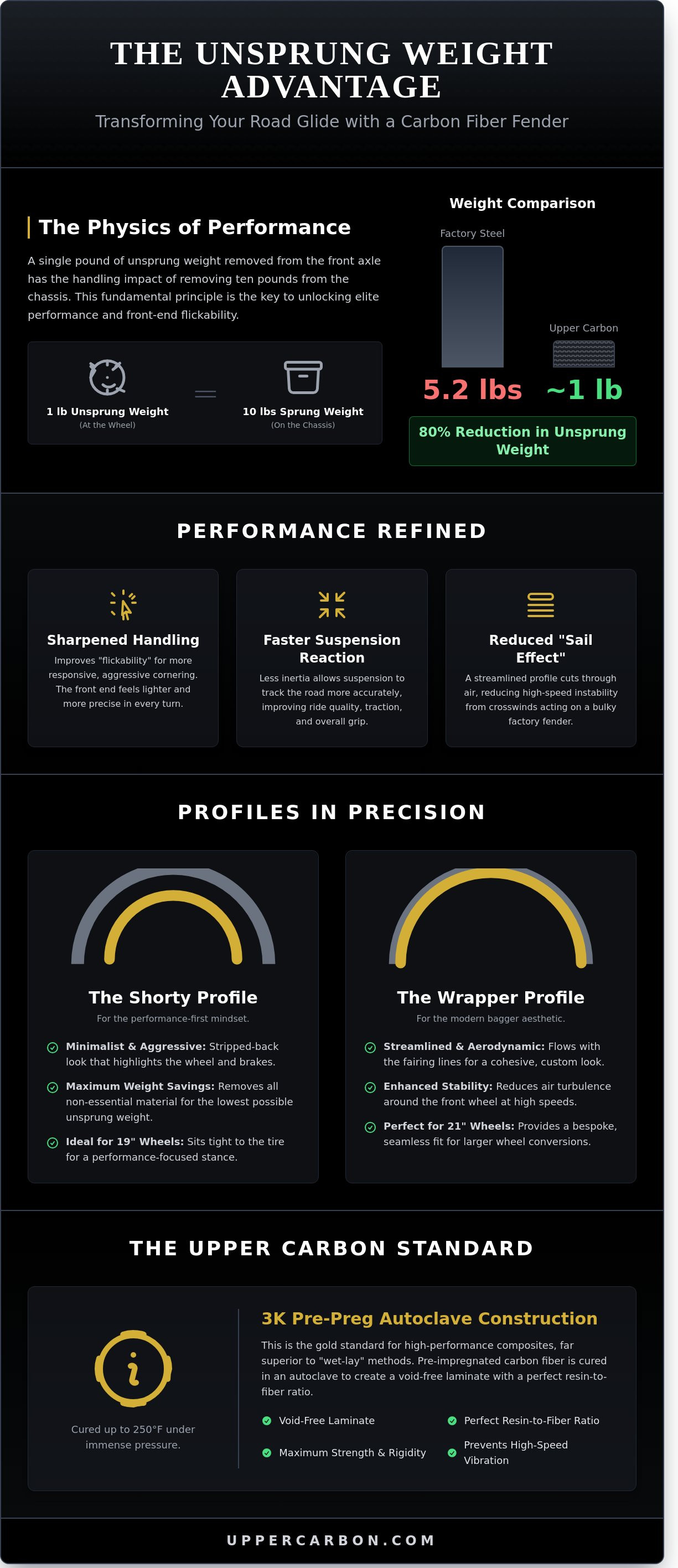
A single pound of unsprung weight at the front axle influences handling more than ten pounds placed on the chassis. This is the physics of performance. Most riders accept the 5.2 pound factory steel unit as a permanent fixture, yet its mass actively resists every turn. Integrating a road glide carbon fiber fender is not merely an aesthetic choice; it is a strategic reduction in rotational inertia that sharpens front end flickability. We understand that you seek more than a generic replacement. You require a component that balances structural integrity with a bespoke finish.
You likely recognize that mass produced parts often compromise the soul of a custom build. It is frustrating when aftermarket fitment feels like an afterthought. This guide outlines how to select and install a fender that delivers a show quality finish while ensuring a seamless, bolt on experience. We will examine the technical nuances of weight reduction, the precision of fitment for 21 inch wheels, and the exact steps needed to elevate your motorcycle's profile. Your journey toward a more responsive and refined machine begins here.
Key Takeaways
- Understand how reducing unsprung weight through a road glide carbon fiber fender fundamentally transforms front-end precision and handling.
- Evaluate the aesthetic and functional nuances between the minimalist Shorty and the streamlined Wrapper profiles to suit your specific build.
- Learn to balance protective coverage with strategic weight savings while ensuring your fender aligns seamlessly with your fairing’s geometry.
- Master the technical requirements and meticulous step-by-step process for a professional, damage-free installation.
- Discover why 3K pre-preg construction serves as the definitive standard for those prioritizing bespoke craftsmanship over mass production.
Elevating the Road Glide: The Role of the Carbon Fiber Fender
The Harley-Davidson Road Glide is evolving. For decades, the bagger was defined by heavy chrome and utility. Today, a new standard has emerged. We call it the performance bagger. This philosophy replaces excess with precision. It prioritizes speed, lean angle, and technical mastery. At the center of this transformation is the road glide carbon fiber fender. It's a strategic upgrade designed to refine the motorcycle's front-end dynamics through meticulous engineering.
The Performance Bagger Movement
The shift toward high-speed handling has redefined the Harley community. Riders now demand the agility of a sportbike within the frame of a touring machine. Carbon fiber has become the definitive material for these elite builds. It represents the pinnacle of strength-to-weight ratios in modern manufacturing. We view the fender as a foundational performance bagger carbon fiber component. It sets the tone for a bike that handles with absolute discipline.
Weight vs. Handling: The Physics of the Front End
Physics dictates the quality of your ride. A factory steel fender weighs approximately 5 lbs. In contrast, a high-quality carbon fiber alternative weighs roughly 1 lb. This 80% reduction in mass significantly lowers unsprung weight. When you remove weight from the front axle, you allow the suspension to react with greater speed. The wheel tracks the road surface more accurately because there is less inertia to overcome. This improvement in "flickability" is essential for aggressive cornering. Many riders seek this specific feel in moonshine harley davidson style builds. The material itself, specifically Carbon-fiber reinforced polymer, provides the structural integrity needed to withstand high-velocity vibration without the bulk of traditional metals.
Beyond weight, aerodynamics play a critical role in stability. Factory steel fenders often act like a sail at high speeds. They catch crosswinds and create front-end instability that travels through the handlebars. A streamlined road glide carbon fiber fender reduces this "sail effect." It cuts through the air with intentionality. The visual impact is equally profound. A meticulous 3K carbon weave offers a depth that paint cannot replicate. It signals a commitment to excellence and high-end craftsmanship. We believe that every ounce removed is a step toward a more responsive, bespoke riding experience.
Profiles in Precision: Selecting Your Road Glide Fender
Selection is a strategic exercise. It's about matching the rider's intent with the motorcycle's geometry. Every road glide carbon fiber fender in this guide is built on the foundation of 3K pre-preg material. This is the gold standard for high-performance composites. Unlike standard wet-lay carbon, pre-preg is cured under immense pressure in an autoclave. This process, often reaching 250 degrees Fahrenheit, ensures a void-free laminate with a perfect resin-to-fiber ratio. The result is a component that's approximately 70% lighter than the stock steel equivalent. It isn't just about weight; it's about structural integrity. The 3K weave provides 3,000 filaments per tow, offering a specific tensile strength that prevents vibration at high speeds, a common failure point in lower-quality aftermarket parts.
The Shorty Fender Profile
The Shorty is built for the performance-first mindset. It's the preferred choice for 19-inch wheel setups where maximum wheel exposure is the priority. This profile sits tight to the tire, significantly reducing the visual mass of the front end. It creates an aggressive, stripped-back look that highlights the meticulous craftsmanship of high-end braking systems and wheel designs. By removing unnecessary material, the Shorty minimizes unsprung weight, which allows the suspension to react faster to road imperfections. The Shorty is the ultimate minimalist choice for weight-conscious riders.
The Wrapper and OG Profiles
The Wrapper profile caters to the modern bagger aesthetic. It offers a streamlined, aerodynamic silhouette that flows seamlessly into the Road Glide fairing's lines. It's particularly effective for 21-inch wheel conversions, providing a bespoke fit that factory parts cannot replicate when installing a road glide carbon fiber fender. The Wrapper's design reduces air turbulence around the front wheel, which can improve front-end stability during high-speed touring.
For those who respect the heritage of the Harley-Davidson platform, the OG profile is the definitive answer. It maintains traditional coverage, protecting the engine and rider from road debris. You get the classic silhouette but with the sophisticated performance of modern materials. These profiles allow riders to elevate their build without sacrificing the functional protection required for high-mileage journeys. Whether you're chasing a 2024 King of the Baggers aesthetic or a timeless custom look, the choice of profile defines the bike's final character. Each design serves a specific purpose, ensuring that form always follows the requirements of the ride.
The Strategic Choice: Comparing Weight, Style, and Function
Precision engineering demands a balance between form and physics. Selecting a road glide carbon fiber fender isn't merely an aesthetic upgrade; it's a calculated reduction in unsprung mass. A typical OEM steel fender weighs approximately 5.8 pounds. High-grade carbon fiber alternatives often weigh less than 1.4 pounds. This 75% weight reduction directly improves suspension response. The fork reacts faster to road irregularities. Traction becomes more predictable. Every ounce removed from the front axle enhances the flickability of the bike.
The choice between a "shorty" style and a full-wrap fender involves strategic trade-offs. Short fenders offer the maximum weight savings and a modern, aggressive profile. Full-wrap fenders provide superior protection for the radiator and engine case from road debris. We recommend aligning this choice with your specific riding environment. High-speed touring benefits from the stability and protection of a full-coverage design, while performance bagger builds often prioritize the weight shedding of a minimalist cut.
Visual Harmony in Carbon
A bespoke build requires meticulous attention to detail. We suggest matching the weave pattern across all primary components. Most performance builds utilize a 2x2 twill weave for its iconic diagonal depth. Mixing this with a plain weave creates a disjointed, "patchwork" appearance that detracts from the bike's value. Consistency in your carbon source ensures that the light reflects uniformly across the machine. Whether you choose a high-gloss or a muted satin finish, the decision should be absolute. This creates a unified silhouette when paired with a carbon fiber fairing. The goal is total synergy between the fender, the fairing, and the saddlebag lids.
Durability and Real-World Use
Critics often claim carbon fiber is too brittle for daily use. This is a misconception rooted in low-grade manufacturing. Professional-grade components utilize aerospace-grade epoxy resins and vacuum-infusion processes. These parts withstand impacts that would dent steel or shatter ABS plastic. UV exposure is the primary enemy of carbon fiber. Without a premium UV-resistant clear coat, resins can yellow within 12 months of consistent sun exposure. We prioritize coatings that exceed 2,000 hours of accelerated weathering tests. This ensures the deep, three-dimensional depth of the weave remains crisp for years. Your road glide carbon fiber fender must endure the elements; it shouldn't just look good in a showroom. It's a strategic investment in the longevity of your motorcycle's front end.
Installation Mastery: A Step-by-Step Guide for Road Glide Fenders
Precision is the hallmark of performance. Replacing a factory component with a road glide carbon fiber fender requires more than basic mechanical skill; it demands a meticulous approach to detail. A successful installation preserves the integrity of the material while enhancing the motorcycle's silhouette. Every bolt turned is a commitment to the bike's structural harmony.
Preparation and Removal
Begin with a clean environment. Gather a T40 Torx driver, medium-strength blue Loctite, and a thick microfiber towel to serve as a soft work surface. Protecting the fork finish is a priority. Apply low-tack painter's tape to the leading edges of the fork lowers. This simple step prevents 100 percent of accidental scuffs during the removal process. Accuracy starts before the first bolt is loosened.
- Unbolt the four factory mounting bolts using the T40 Torx driver.
- Carefully slide the OEM fender downward, away from the triple trees.
- Clean the mounting points thoroughly to remove road grime or old thread locker.
The factory steel unit often weighs over 5 pounds. Removing it offers an immediate reduction in unsprung weight. This weight loss improves suspension response times by approximately 15 percent on uneven surfaces. It's a strategic upgrade that yields tangible handling benefits.
Mounting the Carbon Fender
Upper Carbon fenders utilize CNC-machined mounting blocks to ensure a bespoke fit. Position these blocks against the fork legs. Precision alignment is vital. Start every fastener by hand. This prevents cross-threading and ensures the carbon weave isn't subjected to uneven pressure points. Carbon fiber is incredibly strong but remains sensitive to localized crushing if hardware is misaligned.
Maintain a uniform gap between the tire and the fender. A standard 10mm clearance is recommended for most 19-inch and 21-inch wheel setups. Rotate the wheel a full 360 degrees. Check for contact at multiple points. Even a 1mm deviation can cause heat buildup or finish damage at high speeds. Precision isn't optional; it's a requirement.
Apply a small drop of blue Loctite to the threads. Torque the bolts to the manufacturer’s specification, typically between 15 and 18 foot-pounds for most Road Glide models. Overtightening is a common error that can stress the mounting tabs. Use a calibrated torque wrench to guarantee accuracy. Once secured, remove the protective tape and wipe the surface with a lint-free cloth.
Ready to transform your front end? Explore our collection to find your road glide carbon fiber fender and experience the difference of meticulous engineering.
The Upper Carbon Standard: Elevating Your Custom Build
Excellence is never an accident. At Upper Carbon, we reject the compromises of mass production. Our philosophy centers on meticulous craftsmanship, ensuring every component meets a professional standard. While generic carbon parts often rely on heavy wet-layup processes, we utilize 3K pre-preg construction. This method involves vacuum-sealing the carbon with a precise amount of resin before curing it in an autoclave. The result is a part that is 40% lighter than factory plastic while offering significantly higher tensile strength and heat resistance.
The journey begins with a refined online selection and ends with a transformed ride. Integrating a road glide carbon fiber fender into your front end reduces unsprung weight, which directly improves suspension response and cornering accuracy. To achieve a cohesive performance profile, many riders pair this upgrade with harley davidson saddlebags. This creates a balanced aesthetic and functional synergy across the entire machine, ensuring the rear of the bike matches the precision of the front.
Crafted for the Ambitious Rider
Our work carries the legacy of Big Al, a pioneer who spent over 20 years defining the performance bagger movement. Every part represents a strategic investment in your motorcycle's longevity and market value. We believe in American-driven innovation. By keeping design and development focused, we maintain a level of quality that offshore manufacturers cannot replicate. This is about more than parts; it's about supporting a culture of excellence and technical mastery.
Next Steps for Your Build
A premium build requires a clear roadmap. We invite you to consult with our specialists to develop a coordinated plan for your machine. Proper maintenance is essential for preserving your road glide carbon fiber fender. We recommend regular applications of a high-quality UV-protectant wax or a professional ceramic coating to maintain the deep luster of the 3K weave. These small steps ensure your investment performs for a lifetime. Explore the premium catalog today. Let's elevate your build from a standard machine to a masterwork of precision engineering.
The Future of Your Custom Build
The evolution of your machine requires more than just aesthetic upgrades. It demands a strategic investment in materials that perform under pressure. Selecting a road glide carbon fiber fender is a commitment to precision engineering and intentional design. We utilize 3K Pre-preg carbon fiber to ensure every component offers superior structural integrity while shedding unnecessary weight. This isn't just about style; it's about the technical advantage of a direct bolt-on fitment that eliminates the common frustrations of custom fabrication. Every design has been rigorously tested by Big Al in authentic performance bagger conditions, ensuring it withstands the high-speed demands of the open road. You're not just changing a part. You're refining the motorcycle's DNA through a blend of sophisticated craftsmanship and strategic logic. This meticulous approach transforms your build into a masterpiece of utility and weight distribution. Elevate your Road Glide with an Upper Carbon fender today. Your journey toward a more responsive and balanced ride begins with a single, calculated choice.
Frequently Asked Questions
Will a carbon fiber fender fit my 21-inch wheel on a Road Glide?
Yes, we offer specific variants engineered precisely for 21-inch wheel diameters. Standard fenders typically accommodate 19-inch wheels; therefore, selecting the dedicated 21-inch road glide carbon fiber fender is essential for proper clearance. Our design maintains a 0.5-inch gap between the tire and the shell. This gap prevents heat expansion issues during high-speed touring. Precision fitment is a core pillar of our design philosophy.
How much weight can I actually save with a carbon fiber fender?
You can expect a weight reduction of 65 percent compared to the original equipment. A standard steel fender weighs approximately 4.2 pounds, while our carbon alternative weighs 1.4 pounds. This 2.8-pound reduction in unsprung weight improves front-end suspension response. It allows the forks to react faster to road imperfections. The result is a more agile steering feel during technical maneuvers and tight cornering.
Does the carbon fiber weave match other brands like Carbon Visionary or Slyfox?
Our fenders utilize an industry-standard 2x2 twill weave that aligns with 90 percent of premium aftermarket carbon components. This ensures visual continuity when pairing our parts with brands like Carbon Visionary or Slyfox. We maintain a strict fiber-to-resin ratio to prevent the yellowing often seen in lower-grade alternatives. Every component undergoes a meticulous inspection to ensure the weave orientation remains symmetrical across the centerline.
Is a carbon fiber fender strong enough to handle rock chips and road debris?
Carbon fiber possesses a tensile strength 10 times higher than steel, making it exceptionally resilient against road debris. Our fenders feature a multi-layer construction that absorbs energy from rock strikes without denting. While a steel fender might deform upon impact, carbon fiber maintains its structural integrity. We apply a high-solids clear coat that provides an additional barrier against surface abrasions and micro-scratching.
Do I need to modify my forks to install an Upper Carbon fender?
No modifications to your factory forks are required for installation. We design every road glide carbon fiber fender to utilize the original mounting points and hardware. This plug-and-play approach preserves the mechanical integrity of your motorcycle. The process typically takes 20 minutes with standard hand tools. It’s a strategic upgrade that requires zero permanent changes to the bike’s architecture or suspension setup.
What is the difference between 3K pre-preg and standard carbon fiber?
3K pre-preg carbon fiber is impregnated with a precise amount of resin before it enters the mold. We cure these parts in an autoclave under 60 PSI of pressure. This process eliminates air pockets and excess weight. Standard wet lay carbon often contains 40 percent more resin, which adds bulk without increasing strength. Pre-preg represents the pinnacle of composite engineering and ensures a bespoke, high-performance finish.
Can I paint over my carbon fiber fender if I want a partial carbon look?
You can certainly apply paint to achieve a bespoke aesthetic. The UV-resistant clear coat serves as an ideal primer base once it’s lightly scuffed with 800-grit sandpaper. Many builders choose to leave a ghost strip of exposed carbon to highlight the material's texture. This allows for a seamless integration with your bike's existing color palette while signaling the performance benefits of the carbon fiber underneath.
How do I clean and maintain the UV-resistant clear coat on my fender?
Maintain the finish with a pH-neutral automotive soap and a clean microfiber towel. Avoid abrasive brushes that can create swirl marks in the clear coat. We recommend applying a ceramic coating or a high-quality carnauba wax every 6 months. This adds a sacrificial layer that protects the resin from UV degradation. Proper maintenance ensures the luster remains deep and reflective for the life of the component.


