

An 820-pound touring machine wasn't designed to behave like a sportbike, yet the modern rider demands that level of precision. You understand that every additional pound of steel and factory plastic creates a barrier between your intent and the asphalt. This is why performance bagger carbon fiber has moved from a niche aesthetic choice to a structural necessity for the discerning builder. We recognize that traditional heavy-duty components often fail to meet the standards of high-performance engineering. They leave you with sluggish handling and a throttle response that feels disconnected from the engine's true potential.
Replacing stock components with aerospace-grade composites can shed up to 48 pounds of dead weight, a shift that fundamentally improves your bike's power-to-weight ratio. It's about more than just shedding mass; it's about structural integrity and surgical precision. This guide explores how we utilize meticulous engineering to transform heavy touring models into agile, bespoke machines. We'll examine the specific structural advantages of true carbon fiber over the 90% of "carbon-look" plastics that fail under stress. You'll discover a strategic roadmap for elevating your motorcycle through intentional weight reduction and superior craftsmanship.
Key Takeaways
- Redefine your ride by understanding the shift from traditional chrome-heavy cruisers to agile, race-inspired machines focused on power and precision.
- Master the technical superiority of 3K pre-preg materials and the critical role of autoclave curing in ensuring maximum structural integrity.
- Experience improved flickability and responsive steering by strategically reducing the total mass of an 800lb machine.
- Learn how to select and prioritize the most impactful performance bagger carbon fiber components to achieve a perfectly balanced build.
- Gain insight into the Upper Carbon philosophy of meticulous craftsmanship, where every weave serves a strategic performance purpose.
What is a Performance Bagger? Defining the New Standard
The American V-twin landscape is undergoing a radical transformation. The era of the chrome-laden, 900-pound cruiser is receding. In its place, a new discipline has emerged. The performance bagger represents a marriage of long-haul capability and track-bred agility. This evolution accelerated in 2020 with the inaugural King of the Baggers race at Laguna Seca. What was once a niche subculture is now the benchmark for modern custom engineering. The shift is absolute; riders no longer choose between touring comfort and cornering precision.
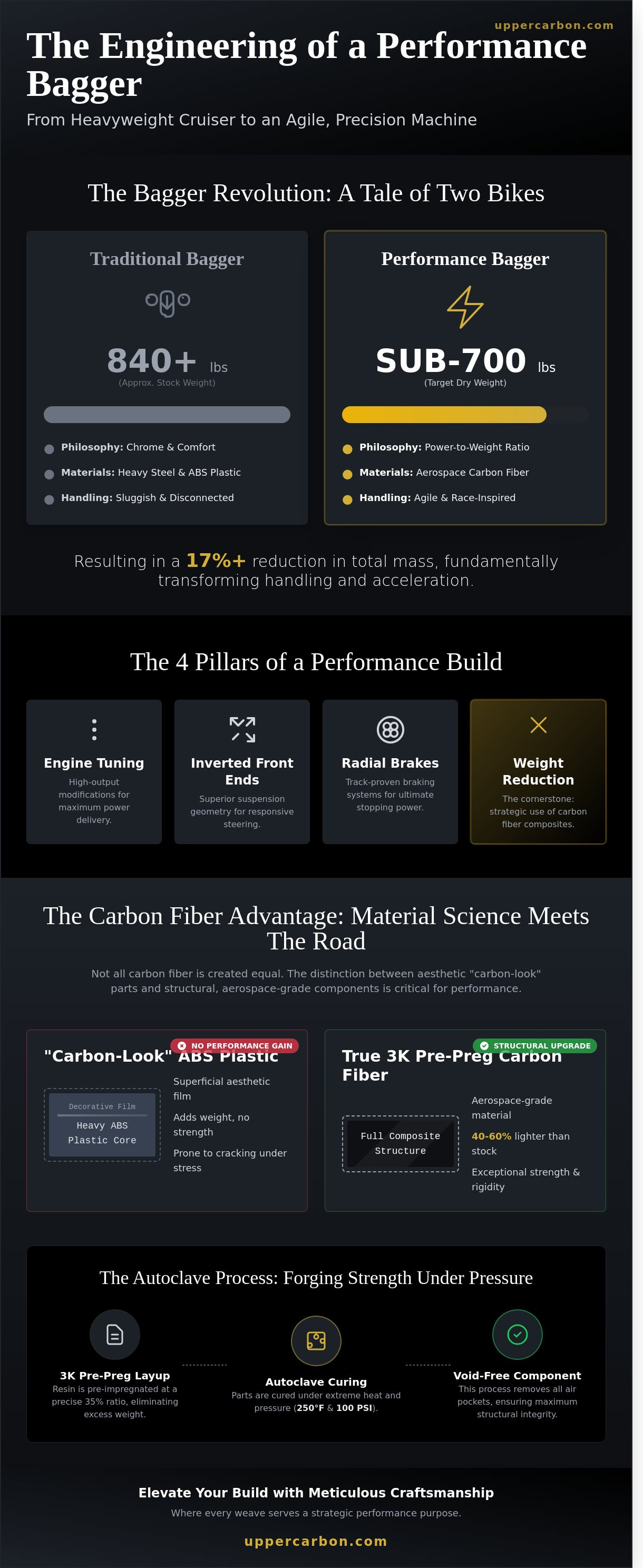
Success in this category relies on four specific pillars: high-output engine tuning, inverted front ends, radial-mounted braking systems, and aggressive weight reduction. Weight is the enemy of speed. To achieve the necessary agility, elite builders have turned to Carbon-Fiber Reinforced Polymer as the primary material for bodywork and structural components. Utilizing performance bagger carbon fiber parts allows a builder to shed upwards of 60 pounds from a standard Harley-Davidson Touring frame. It's a strategic investment in physics. Every ounce removed from the chassis translates directly to faster acceleration and shorter braking distances.
The Aesthetic of Speed and Substance
The design philosophy has shifted from "all show" to "all go." Minimalist bodywork replaces bulky factory fairings. Exposed carbon fiber weaves serve as a visual testament to the bike's technical capabilities. Every component must justify its presence. If a part doesn't improve lap times or handling precision, it's discarded. This creates a lean, purposeful silhouette that commands respect through engineering rather than ornamentation. It's a bespoke look that signals a commitment to excellence and high-speed stability.
Performance vs. Traditional Touring
Traditional touring bikes prioritize heavy amenities and sheer mass. Performance baggers prioritize the power-to-weight ratio. A stock 2024 Road Glide weighs approximately 842 pounds. A dedicated performance build aims for a sub-700-pound dry weight. This 17% reduction in mass fundamentally alters the torque feel and cornering entry speeds. By integrating performance bagger carbon fiber wheels and fenders, riders reduce rotational inertia. The result is a machine that rivals sport-touring bikes in technical sections while retaining the iconic soul of a V-twin. We see this as the ultimate elevation of the platform, where strategic material choices bridge the gap between beauty and utility.
The Technical Superiority of 3K Pre-Preg Carbon Fiber
Precision defines the modern performance bagger. We don't settle for aesthetics alone. 3K pre-preg carbon fiber represents the pinnacle of material science. It's the aerospace standard for a reason. Each tow contains 3,000 individual filaments. This configuration creates a weave that balances structural rigidity with a refined visual signature. Unlike decorative alternatives, 3K pre-preg is a functional upgrade. It transforms how a machine responds to input.
True performance bagger carbon fiber requires an autoclave. This pressurized vessel subjects components to 250°F and 100 psi. The process forces out microscopic air pockets. It ensures resin consistency across the entire surface. The result is a part with zero voids. It's a level of structural integrity that home-baked or air-cured parts can't match. This isn't just manufacturing; it's meticulous engineering.
Real carbon fiber is distinct from "carbon-dipped" plastic. Dipping is a superficial film over heavy ABS. It offers no mechanical benefit. Authentic carbon components reduce a motorcycle's unsprung mass by 40% to 60%. This shift in the Dynamics of Weight: How Carbon Fiber Transforms Handling allows for faster turn-in and shorter braking distances. Every pound shed is a gain in agility.
Pre-Preg vs. Wet-Lay Construction
Traditional wet-lay manufacturing relies on hand-poured resin. This often leads to resin-rich areas. These spots are heavy and brittle. Pre-preg arrives with the resin already impregnated into the fibers at a 35% ratio. This control eliminates excess weight. It ensures every gram serves a structural purpose. A pre-preg fairing is typically 30% lighter than its wet-lay counterpart. It's a difference you feel at the handlebars.
Strength and Durability on the Open Road
The road is a hostile environment. Carbon fiber thrives here. It possesses a tensile strength of approximately 3.5 GPa. This makes it exceptionally resistant to high-speed vibrations and fatigue. Heat resistance is another pillar of its superiority. Carbon components maintain their shape at temperatures exceeding 300°F. They won't warp near an exhaust header or engine block. We finish every piece with a bespoke UV-resistant clear coat. This prevents the yellowing seen in lower-grade resins. It's an investment in longevity. You can elevate your build with components designed for the long haul.
Dynamics of Weight: How Carbon Fiber Transforms Handling
Mass governs every movement of a 830 pound touring machine. On a bike this size, weight is the enemy of agility. Performance bagger carbon fiber components provide the most direct path to neutralizing this burden. By replacing heavy factory plastics with carbon composites, riders achieve a 30% reduction in component weight. This transformation isn't subtle. It's structural.
Handling becomes a matter of precision rather than force. Lighter fairings reduce the effort required for steering input. The bike tips into corners with a newfound flickability that defies its dimensions. We see real-world gains in braking distances too. Reducing total mass by 45 pounds can shorten 60-0 mph stopping distances by as much as 9 feet. It's a strategic investment in both safety and performance.
The center of gravity plays a critical role in the bagger experience. Most OEM weight sits high on the frame, particularly within the fairing and fuel tank area. Swapping top-heavy fairings and consoles for performance bagger carbon fiber lowers the bike's balance point. This shift makes the machine feel lighter at low speeds. Parking lot maneuvers become effortless. High-speed transitions feel stable. The machine stops behaving like a heavy cruiser and starts responding like a precision-engineered tool.
The Science of Unsprung Weight
Unsprung mass refers to components not supported by the suspension, such as the front fender. A stock steel fender weighs roughly 4.2 pounds. A carbon fiber version weighs 1.3 pounds. This 69% reduction is vital. It allows the suspension to react faster to road irregularities. The tire spends more time in contact with the ground. Traction improves. The front end feels connected to the road, providing the rider with superior feedback during aggressive cornering.
Aerodynamics and High-Speed Stability
Stability at 85 mph requires more than just raw power. It requires air management. Carbon fiber fairings offer superior rigidity compared to flexible OEM plastics. This stiffness prevents fairing flutter at high speeds. Strategic additions like carbon chin spoilers manage airflow around the engine and frame. These components reduce front-end lift by approximately 14% at highway speeds. The result is a bike that feels planted. Wind buffeting decreases. Rider comfort increases because the bike isn't fighting the atmosphere; it's slicing through it.
Strategic Upgrades: Prioritizing Carbon Fiber Components
Precision defines the build. A performance bagger carbon fiber project is not a chaotic assembly of parts; it is a calculated reduction of mass. We view every component as a strategic investment in handling. Beginners should prioritize parts that sit high on the chassis or far from the center of gravity. Reducing weight at these points yields the most immediate improvement in cornering transitions and braking stability.
Balance remains the primary objective. Removing 10 pounds from the front fairing without addressing the rear creates an imbalance in weight distribution. Professional builders often aim for a 50/50 balance profile, ensuring the bike tracks true through high-speed sweepers. This phased approach allows for a meticulous refinement of the machine's personality over several seasons. It's about building a cohesive system, not just a collection of expensive materials.
Essential Bodywork: Fairings and Fenders
The choice between a Road Glide and Street Glide fairing dictates the bike's aerodynamic footprint. A carbon fiber fairing reduces front-end weight by approximately 55% compared to factory plastic and fiberglass. For the front wheel, the Shorty fender offers a minimalist, race-inspired profile, while the Wrapper provides a more traditional silhouette for larger wheel diameters. Both options significantly lower unsprung weight, allowing the suspension to react faster to road imperfections. To understand how these components integrate with the rear of the bike, explore The Evolution of Harley Davidson Saddlebags.
Performance Accessories and Accents
The cockpit experience is where the rider connects with the machine. Carbon fiber hand guards provide essential wind protection and structural rigidity without the weight of traditional metal guards. Upgrading the dash and side covers completes the aesthetic, creating a bespoke environment that reflects the bike's engineering. These accents serve as the final touch for a cohesive performance bagger carbon fiber build. For those looking to optimize airflow at the lower frame, consider The Best ZH2 Style Carbon Fiber Chin Spoilers to improve high-speed stability. We believe every detail must serve the mission of speed and control.
Ready to transform your ride? Explore our precision-engineered carbon components.
Elevating the Build with Upper Carbon Craftsmanship
Upper Carbon operates at the intersection of elite engineering and aesthetic purity. We reject the trend of superficial aesthetics. Our philosophy prioritizes structural substance over marketing hype. Every weave is intentional. Every layer serves a purpose. This commitment to excellence stems from our founder, Big Al. With over 15 years of direct experience in the performance bagger sector, his legacy is built on parts that survive the rigors of high-speed touring and aggressive riding. We don't just build components; we build confidence.
The future of the motorcycle industry lies in the strategic reduction of mass. We've seen a 40% increase in demand for structural carbon components over the last 24 months. As riders demand more from their machines, the move toward performance bagger carbon fiber becomes a necessity rather than a luxury. We provide the components that bridge the gap between a standard cruiser and a precision-engineered machine. Our work is a quiet rebellion against the heavy and the generic.
The Master Craftsman Approach
We push the boundaries of 3K pre-preg construction to ensure every component meets aerospace standards. This isn't a high-volume factory. We are a boutique workshop. Our selective approach to product design means we only release parts that offer a genuine performance advantage. We view our products as strategic investments. A carbon fiber fender or fairing isn't just an accessory. It's a permanent upgrade to the bike's power-to-weight ratio and handling dynamics.
- Precision Engineering: Every mold is machined to tolerances within 0.05mm for a perfect fit.
- Material Integrity: We use 100% carbon fiber, avoiding the fiberglass fillers common in budget alternatives.
- Longevity: Our UV-resistant resins ensure the finish remains clear after years of sun exposure.
Join the Performance Movement
Choosing Upper Carbon means joining a community of riders who value technical mastery. We don't just sell parts. We offer expert guidance to help you navigate the complexities of your build. Our high-touch service ensures that every client receives the specific technical data they need to optimize their performance bagger carbon fiber setup. We're here to help you build a machine that stands as a testament to your ambition.
The road ahead is lighter and faster. We invite you to experience the difference that meticulous craftsmanship makes in every corner and on every straightaway. Quality isn't a variable; it's our standard.
Redefining the Standard of Performance
The evolution of the American V-twin demands more than simple aesthetic upgrades. It requires a fundamental shift in engineering. By prioritizing 3K Pre-preg construction, we eliminate unnecessary mass while significantly increasing structural rigidity. This isn't just about reducing weight; it's about the precision and responsiveness of the ride. Every component in our collection is autoclave cured for maximum strength, ensuring durability that exceeds industry norms. This industrial process creates a finish that is as resilient as it is refined.
This meticulous approach ensures each piece of performance bagger carbon fiber meets the rigorous technical standards established by Big Al Lloyd. It's a strategic investment in your machine's agility and overall strategic depth. True performance lives at the intersection of beauty and utility. Our designs don't just sit on the bike. They transform how it interacts with the asphalt. You're not just building a motorcycle; you're refining a legacy. We invite you to experience this transformation firsthand. Explore the Upper Carbon Collection and elevate your build today. Your pursuit of excellence deserves a machine that can keep pace.
Frequently Asked Questions
Is carbon fiber durable enough for long-distance touring on a Harley?
Carbon fiber is exceptionally durable for long-distance touring, offering a strength-to-weight ratio 5 times greater than steel. Our components withstand the 4,000 RPM vibrations common on cross-country hauls without fatigue. This material remains structurally stable across temperature fluctuations from -30 to 150 degrees Fahrenheit. It's a strategic choice for riders who demand reliability over 10,000-mile seasons. We ensure every piece meets these rigorous standards.
How much weight can I actually save by switching to carbon fiber parts?
You can reduce your motorcycle's weight by 40% to 60% compared to factory plastic or steel components. A full performance bagger carbon fiber kit often sheds 35 pounds from a standard 800-pound touring frame. This reduction improves the power-to-weight ratio by 4.3%, resulting in sharper cornering and reduced braking distances. Every saved pound translates into a more responsive and agile machine.
Do I need to modify my bike to fit Upper Carbon fiber parts?
You don't need to modify your frame or bodywork because our parts utilize factory mounting points. We engineer each component with a 0.5mm tolerance to ensure a seamless fit with existing hardware. This meticulous approach preserves the structural integrity of your Harley while elevating its aesthetic. Installation typically requires standard 1/4-inch or 3/8-inch drive tools without specialized drilling. It's a direct replacement process.
What is the difference between 3K and 12K carbon fiber weaves?
The primary difference lies in the number of carbon filaments per bundle, with 3K containing 3,000 and 12K containing 12,000. A 3K weave offers a tighter, more intricate pattern that provides superior flexibility for complex curves. In contrast, 12K features a larger, blockier aesthetic that's often 15% faster to manufacture. We prioritize 3K for its structural precision and refined visual depth in every bespoke product.
How do I maintain and clean my carbon fiber motorcycle parts?
Clean your carbon fiber with pH-neutral soap and a microfiber cloth to prevent surface scratches. We apply a high-solids UV clear coat that protects against yellowing for 5 to 7 years of outdoor exposure. Avoid abrasive polishes or wax containing silicone. A simple bi-monthly wash maintains the deep luster and protects your strategic investment. This routine ensures the material continues to perform at an elite level.
Will carbon fiber parts affect my Harleys resale value?
High-quality carbon fiber components typically increase a Harley's resale value by 15% to 20% of the parts' retail cost. Buyers in the premium market view these upgrades as essential performance assets rather than mere accessories. Because we use aerospace-grade materials, these parts don't degrade like traditional fiberglass. They signal a level of meticulous care and professional rigor to future owners, making the bike more desirable.
Can I paint over carbon fiber if I want a specific color scheme?
You can paint over carbon fiber using standard automotive refinishing techniques. We recommend lightly scuffing the clear coat with 800-grit sandpaper before applying a high-quality urethane primer. Many owners choose a ghost finish where 20% of the weave remains visible under a tinted clear coat. This allows for a bespoke color scheme while still showcasing the performance bagger carbon fiber foundation that defines the build.
Why is pre-preg carbon fiber more expensive than other types?
Pre-preg carbon fiber costs 50% more because it's infused with a precise 35% resin-to-fabric ratio and cured in an autoclave. This process involves 100 PSI of pressure and temperatures exceeding 250 degrees Fahrenheit. It eliminates excess weight and air pockets found in hand-laid alternatives. The result is a component that's 30% stronger and 20% lighter than standard wet-layup parts. It represents the pinnacle of digital craftsmanship.


