

Table of Contents
- Carbon Fiber Harley Side Covers: What Sets Them Apart
- Comparison Table: Top Carbon Fiber Side Covers by Model and Price
- Real Carbon Fiber vs. Carbon Fiber Look: How to Spot the Difference
- Harley-Davidson Side Cover Fitment by Year: Compatibility Guide
- Carbon Fiber Side Cover Installation: Tools, Time, and Fitment Verification
- Carbon Fiber Side Cover Care and Maintenance for Long-Term Durability
- Weight Reduction and Performance Gains: Real-World Impact
- Frequently Asked Questions
Last Updated: October 12, 2026
Carbon Fiber Harley Side Covers: What Sets Them Apart
Carbon fiber side covers represent a genuine upgrade for Harley-Davidson riders serious about performance and aesthetics. Unlike plastic OEM covers, real carbon fiber delivers measurable weight savings while maintaining structural rigidity and durability.

The difference between real carbon fiber and carbon-look alternatives starts with material composition. Genuine carbon fiber uses woven strands bound in epoxy resin, creating a composite that's lighter and stronger than its appearance alone suggests. This matters for Harley Touring models and Softail variants where unsprung weight directly impacts suspension response and handling.
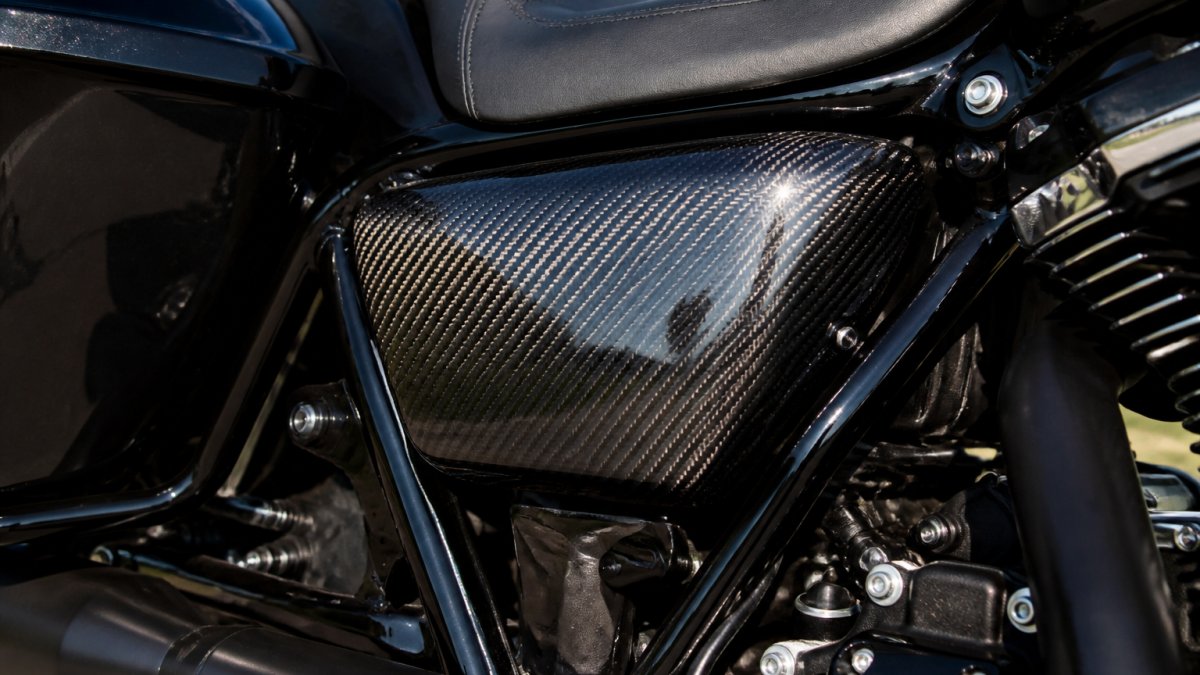
Performance-oriented riders and bagger racing competitors understand that every pound counts. A quality carbon fiber side cover set can shed several pounds compared to stock covers, weight that translates directly to quicker acceleration and sharper cornering response. The aesthetic payoff is equally important: the aggressive carbon weave appearance signals serious intent to other riders, and the gloss or clear-coat finishes add visual depth that plastic simply cannot match.
Comparison Table: Top Carbon Fiber Side Covers by Model and Price
| Product | Model Fitment | Material | Price | Best For |
|---|---|---|---|---|
| 24+ Harley Touring Carbon Fiber Side Covers | Touring (2024+) | 100% Pre-preg Carbon Fiber | $500 | Budget-conscious touring riders seeking durable protection |
| Harley Touring Side Cover Forged Carbon Fiber | Touring Models | Forged Carbon Fiber | $625 | Riders prioritizing lightweight construction and precision fit |
| Harley Touring Twill Carbon Fiber Side Cover | Touring Models | Twill Carbon Fiber | $575 | Riders wanting sophisticated appearance with weather resistance |
| Upper Carbon Platinum Series FXR Style Side Covers | Road Glide, Street Glide (2015-2025) | Premium Carbon Fiber, Twill Weave | $629 | Road Glide and Street Glide owners seeking FXR aesthetics |
| Low Rider ST Side Covers Forged Carbon | Low Rider ST | Forged Carbon | $370 | Low Rider ST riders seeking aggressive styling and performance |
| Low Rider Side Covers Twill Carbon | Low Rider | Twill Carbon | $370 | Low Rider owners wanting lightweight durability and sleek appearance |
| Harley Davidson Touring Carbon Fiber Triangle Side Covers | Touring Models | Premium Carbon Fiber | $625 | Long-distance riders needing strong weather protection |
| Side Cover Triangle Twill Carbon | Touring Models | 100% Carbon Fiber | $525 | Riders balancing durability, strength, and value |
| Triangle Side Covers Forged Carbon | Touring Models | Forged Carbon | $625 | Performance-focused riders seeking aerodynamic improvements |
Our lineup spans Touring and Low Rider platforms, with pricing from $370 to $629. The variation reflects construction methods, forged carbon offers precision and lightweight properties, while twill weave delivers sophisticated appearance and excellent durability. Every product from Fat Boy Design USA features direct bolt-on fitment with no modifications required, ensuring your specific model year installs cleanly without drilling, grinding, or custom work.

Real Carbon Fiber vs. Carbon Fiber Look: How to Spot the Difference
This distinction matters because carbon-look alternatives won't deliver the weight savings or long-term durability you're paying for. Real carbon fiber uses actual woven carbon strands embedded in epoxy resin. Carbon-look products are typically ABS plastic or fiberglass with a printed or painted carbon pattern on the surface, they look convincing from a distance but lack structural properties and fade quickly under UV exposure.
Here's how to verify what you're buying. Real carbon fiber shows visible weave patterns that shift slightly depending on viewing angle. The surface feels smooth but textured, not glossy like paint. When you tap it, the sound is sharp and resonant, plastic produces a dull thud. Carbon-look parts feel hollow and produce that characteristic plastic sound.
A UV-resistant ceramic clear coat is the critical protection layer. Fat Boy Design USA applies this protective finish to prevent oxidation and fading that plague unprotected carbon fiber. The ceramic coating creates a barrier against UV rays, salt spray, and environmental contaminants while maintaining the visual clarity of the carbon weave beneath. This is why our side covers look as sharp in year three as they do on installation day.
The weight difference is measurable. For a Harley Touring side cover set, that translates to roughly 2-3 pounds of unsprung weight reduction, not massive, but enough to noticeably improve suspension tuning and handling response, especially on longer rides where fatigue becomes a factor.

Harley-Davidson Side Cover Fitment by Year: Compatibility Guide
Fitment is where many riders encounter frustration. Harley-Davidson redesigned side panel mounting points across multiple generations, and a cover engineered for a 2023 Road Glide will not fit a 2018 model without modification. The outline, mounting bosses, and clearance tolerances differ enough to matter.
Fat Boy Design USA produces fitment-specific covers for distinct model families. Our Touring lineup covers Road Glide, Street Glide, and FLH/FLT variants from recent model years. The Upper Carbon Platinum Series FXR Style Side Covers are engineered specifically for Road Glide and Street Glide models from 2015-2025, accommodating the design evolution across that decade.
Low Rider ST and Low Rider models use a different mounting architecture entirely. The side panel geometry, battery cover location, and air deflector positioning vary significantly from Touring bikes. Our Low Rider ST Side Covers Forged Carbon and Low Rider Side Covers Twill Carbon are engineered for that platform's specific mounting points, ensuring direct bolt-on installation without custom fabrication.
Before purchasing, verify your model year and variant. A 2023 Road Glide is not the same as a 2023 Street Glide, they share some DNA but have distinct side panel designs. Check your VIN documentation or contact your Harley dealer if you're uncertain. Fat Boy Design USA's product pages specify exact model-year compatibility for each cover.
Carbon Fiber Side Cover Installation: Tools, Time, and Fitment Verification
Installation difficulty depends on your mechanical comfort level and the specific cover design. Direct bolt-on covers from Fat Boy Design USA are engineered for straightforward replacement, no drilling, grinding, or modifications required. A competent DIY mechanic with basic hand tools can complete installation in 30-60 minutes.
You'll need basic tools: a socket set (metric, typically 10mm and 13mm), a torque wrench for final fastener tightening, and potentially a trim panel removal tool if your covers are mounted beneath any bodywork.
The fitment verification process is critical. Before final installation, dry-fit the covers without fasteners. Check clearance at the battery cover area, air deflector, and any wiring harnesses. The cover should sit flush against the mounting bosses with no gaps or misalignment.
Once you confirm proper alignment, install fasteners in a cross-pattern (tighten one, then the opposite side, then repeat) to ensure even pressure distribution. This prevents warping or stress concentration. Torque specifications vary by fastener type, but typically range from 8-12 foot-pounds for metric fasteners on side covers.
24+ Harley Touring Carbon Fiber Side Covers →
After installation, inspect seams and edges. A properly fitted cover should have consistent gaps around its perimeter. Any pinching, binding, or large gaps indicates fitment issues that require adjustment. Most installation problems stem from incorrect model-year selection rather than manufacturing defects.
Carbon Fiber Side Cover Care and Maintenance for Long-Term Durability
Carbon fiber is durable but requires thoughtful maintenance to preserve appearance and structural integrity. The ceramic clear coat is your primary defense against environmental damage, but you need to maintain it properly.
Wash your covers regularly with mild soap and water, using a soft microfiber cloth to avoid scratching the finish. Avoid harsh chemicals, abrasive scrubbers, or high-pressure washers that can degrade the clear coat. When drying, use a clean, lint-free cloth to prevent water spotting. This simple routine removes salt spray, road grime, and UV-blocking contaminants that accumulate on the surface.
Inspect your covers seasonally for any cracks, delamination, or clear coat damage. Small cracks can propagate under vibration and temperature cycling, so address them early. If you notice any damage, stop riding and assess whether repair is possible or replacement is necessary. A professional carbon fiber repair shop can address minor cracks with epoxy injection, but deep damage typically requires replacement.
Avoid prolonged parking in direct sunlight without cover protection. While our ceramic clear coat provides excellent UV resistance, any clear coat benefits from shade when possible. If you store your bike indoors during winter or extended downtime, your covers will last longer than bikes exposed to year-round sun.
Never use wax or polish formulated for paint on carbon fiber. These products can leave residue that degrades the clear coat's clarity. If you want to enhance appearance, use a dedicated carbon fiber polish designed for clear-coat protection. Apply sparingly and buff thoroughly.
Weight Reduction and Performance Gains: Real-World Impact
The performance impact of carbon fiber side covers depends on your riding style and bike setup. For casual street riding, the weight savings are subtle, you might not consciously feel the difference.
Unsprung weight refers to mass that isn't supported by your suspension, wheels, brakes, and in this case, side covers and mounting hardware. Reducing unsprung weight improves suspension responsiveness because your shocks don't have to work as hard to manage that mass during acceleration, braking, and cornering.
A typical carbon fiber side cover set reduces unsprung weight by 2-3 pounds compared to OEM plastic covers. For a 700-pound Harley Touring bike, that's roughly 0.3-0.4% weight reduction overall. Individually, that sounds negligible.
Bagger racing competitors understand this calculus intimately. In competitive environments where races are decided by fractions of a second, every pound matters. Fat Boy Design USA's track-tested components are engineered for riders who demand measurable performance gains.
For street riders, the psychological benefit often exceeds the measurable performance gain. You know your bike is lighter and more rigid, and that knowledge influences how you ride.
Choosing the right carbon fiber side covers depends on your model, budget, and performance priorities.
Frequently Asked Questions
How do I know if carbon fiber side covers will fit my specific Harley model year?
Fitment depends on your bike's platform, Touring models (FLH/FLT), Softail, or Low Rider, and production year. Most modern carbon fiber side covers are engineered for 2015-2026 model years, but compatibility varies by specific model. Check the product listing for your exact year and model designation (Road Glide, Street Glide, Low Rider ST, etc.). Direct bolt-on covers use OEM mounting points, so if the product specifies your model, installation requires no modifications. When in doubt, verify fitment before ordering by confirming your VIN-year and model name against the manufacturer's compatibility chart.
Are these carbon fiber side covers real 100% carbon fiber or just a printed finish?
Authentic carbon fiber side covers are constructed from woven carbon fiber material (3K pre-preg or forged carbon), not a printed decal. Real carbon fiber is visibly textured with a weave pattern and feels rigid; a printed finish is flat and feels like plastic. Premium covers use UV-resistant ceramic clear coats to protect against yellowing and fading. If a cover costs significantly less than $500, it's likely a carbon-look replica with a printed pattern rather than genuine carbon construction. Check product descriptions for material specifications, genuine covers explicitly state '100% carbon fiber' or 'forged carbon' construction.
How much weight will I actually lose with carbon fiber side covers, and will I feel the difference in handling?
Carbon fiber side covers typically reduce unsprung weight by 2-4 pounds per pair compared to stock plastic covers, depending on the model. In competitive bagger racing, even 5 pounds of weight reduction improves suspension response and cornering sharpness. On street riding, the handling improvement is noticeable in sharper turn-in and slightly quicker acceleration. The real benefit accumulates when you upgrade multiple components, side covers, battery covers, and other carbon parts, creating 10-15 pounds of total weight loss. For daily riders, the styling and durability matter as much as the weight savings; for racers, every ounce counts.
Do carbon fiber side covers require special cleaning or maintenance to keep them looking new?
Carbon fiber covers with UV-resistant ceramic clear coats are low-maintenance. Wash them with mild soap and water using a soft cloth to avoid scratching the finish. Avoid harsh chemicals, abrasive pads, and high-pressure washers, which can damage the clear coat. Proper care ensures your covers maintain their finish for years of riding.


