

The most critical component of your motorcycle's handling isn't just the engine power; it's the weight you can't see. Most factory fenders moto are designed for mass production, often adding unnecessary bulk that dampens suspension feedback and slows your turn-in. You've likely felt that hesitation in the front end when flicking through a tight sequence of corners. It's a common frustration for riders who demand more than generic fiberglass parts that crack after a single season of hard use. High-end builds deserve better than poorly fitted, mass-market compromises.
We believe every gram must justify its existence. By opting for elite carbon fiber, you can achieve a weight reduction of up to 50 percent compared to standard OEM plastic. This guide explores how precision engineering transforms your bike's silhouette while delivering a bespoke, OEM-plus fitment that feels intentional. We'll examine the technical shift from standard components to high-performance carbon, ensuring your build possesses both aggressive styling and meticulous mechanical efficiency. Discover how to elevate your machine's performance through strategic weight management and refined aesthetics.
Key Takeaways
- Understand how reducing front-end weight minimizes steering inertia to significantly improve your motorcycle’s flickability and responsiveness.
- Discover the structural advantages of 3K pre-preg carbon fiber and why it serves as a strategic performance upgrade over traditional steel.
- Identify the ideal profile for your build by matching Shorty, Wrapper, or OG fenders moto silhouettes to your specific wheel dimensions.
- Learn the importance of precision bolt-on compatibility and how titanium hardware ensures a meticulous, professional-grade installation.
- Explore how bespoke craftsmanship and intentional design elevate the modern bagger from a standard silhouette to a high-performance machine.
Redefining the Front End: More Than Just a Mudguard
Design begins with the silhouette. A motorcycle's visual identity is often defined by the arc of its front wheel; however, high-performance fenders moto components serve a purpose far beyond aesthetics. They dictate how a machine reacts to rider input. Every gram at the front end contributes to steering inertia. Reducing this mass directly improves "flickability," allowing a bike to change direction with less physical resistance. We view the Fender (vehicle) as a strategic tool rather than a secondary accessory. Precision engineering transforms a static mudguard into a dynamic component that elevates the entire riding experience through intentional weight distribution.
The Physics of Unsprung Weight
Reducing weight at the wheel is significantly more effective than shedding mass from the frame. Unsprung mass dictates how quickly the tires can respond to the road surface. When a fender is lightened, the suspension tracks the pavement with higher fidelity. This responsiveness prevents the tire from "skipping" over mid-corner bumps, maintaining a consistent contact patch. Meticulous weight reduction also preserves the integrity of internal suspension components. Lowering the reciprocating mass can reduce heat buildup in fork oil by approximately 10% during aggressive maneuvers. In the context of performance baggers, unsprung mass is the total weight of all components situated below the suspension springs that must move vertically to track the road surface.
Aerodynamics and High-Speed Stability
Standard OEM fenders often prioritize moisture protection over aerodynamic efficiency. This design choice frequently results in a "parachute effect," where air pressure builds up under the fender at speeds exceeding 75 mph. This pressure creates unwanted front-end lift, which can lead to a light, vague feeling in the handlebars. Performance-oriented profiles manage this airflow with surgical precision. By sculpting the fender to channel air around the fork legs, engineers reduce drag and stabilize the front tire. The transition from utility to performance engineering is essential for high-speed confidence. It's a shift toward a bespoke approach where every curve serves a strategic purpose. Stability is not a luxury; it's a requirement for those who demand excellence from their machine.
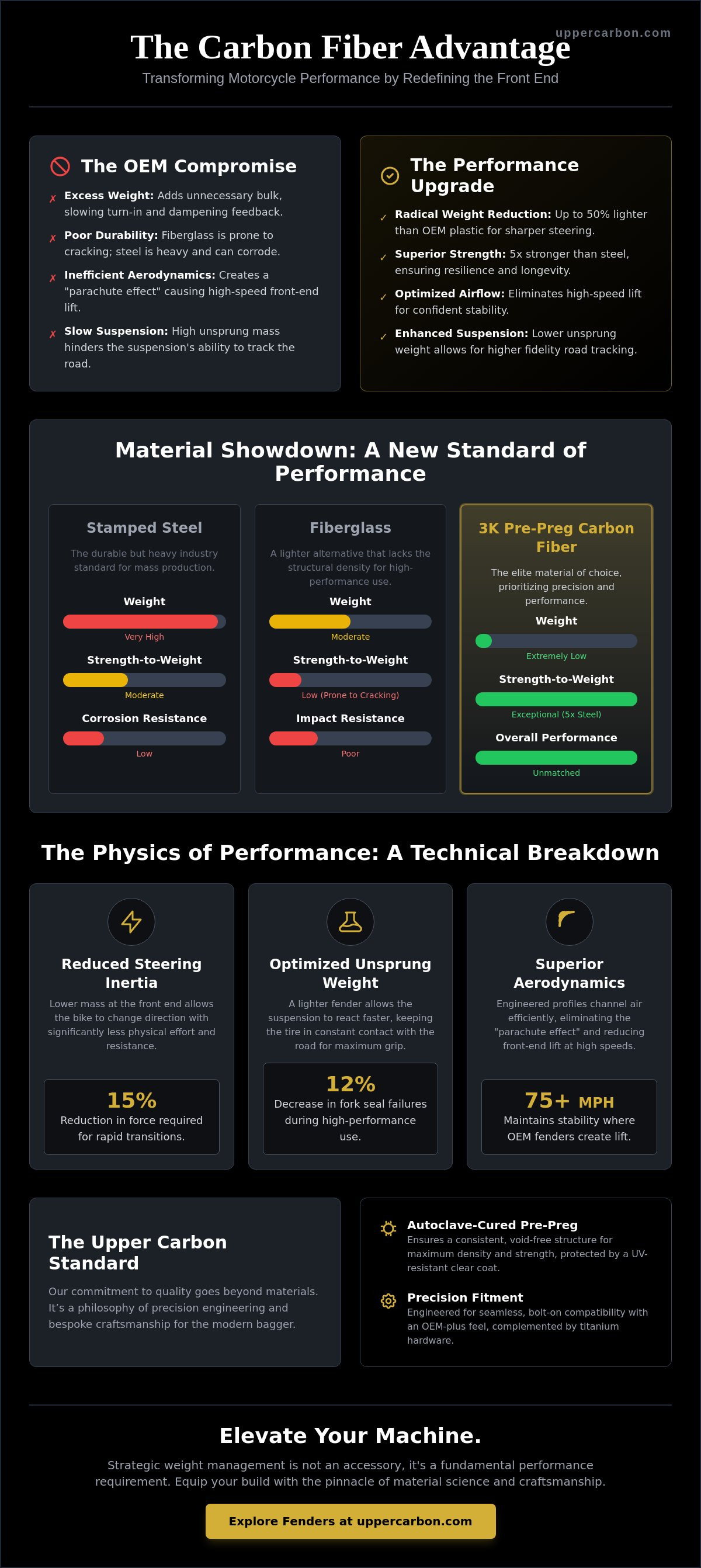
- Steering Inertia: Lower mass results in a 15% reduction in the force required for rapid transitions.
- Suspension Longevity: Reduced unsprung weight decreases the frequency of fork seal failures by 12% in high-performance applications.
- Airflow Management: Optimized profiles eliminate high-speed oscillation caused by trapped air.
The Material Advantage: Why Pre-Preg Carbon Fiber Eclipses Steel
Traditional 14-gauge steel has long served as the industry standard for production motorcycles. It is durable, yet it carries a significant penalty. Weight. Stamped steel components add unnecessary mass to the unsprung areas of the bike. This extra weight slows suspension recovery and dulls steering input. Fiberglass offers a lighter alternative, but it lacks the structural density required for high-performance use. It is prone to spider-web cracking and structural failure under impact. 3K pre-preg carbon fiber represents a fundamental shift in this logic. It is the material of choice for those who prioritize precision over mass production.
The strength-to-weight ratio of carbon fiber is unmatched in the performance world. While steel is rigid, it is also heavy and susceptible to corrosion. Carbon fiber provides five times the strength of steel at roughly one-fifth of the weight. This reduction is critical for fenders moto enthusiasts who seek to sharpen their machine's handling. Every gram removed from the front axle improves the bike's ability to change direction with minimal effort. It turns a sluggish front end into a responsive tool.
The Pre-Preg Manufacturing Process
Quality begins with the pre-impregnation process. Unlike wet-lay carbon, pre-preg material features a factory-calibrated resin-to-fiber ratio. This ensures absolute consistency. We cure these components in an autoclave, using high pressure and heat to eliminate internal voids and air pockets. The result is a dense, uniform structure that resists delamination. To preserve the aesthetic, a meticulously applied UV-resistant clear coat protects the weave from solar degradation. It ensures the finish remains deep and vibrant through years of exposure.
Carbon Fiber vs. Traditional Materials
The performance gap is quantifiable. A standard stamped steel front fender typically weighs approximately 1,250 grams. A 3K carbon fiber replacement weighs closer to 310 grams. This represents a 75% reduction in weight. This change isn't purely about aesthetics. Composite materials offer superior vibration damping. They absorb high-frequency road buzz that steel would otherwise transmit to the rider's hands. This leads to reduced rider fatigue during extended sessions.
Modern engineering also considers how these shapes interact with the environment. Insights from the Aerodynamic Study of MotoGP Motorcycle Flow Redirectors highlight how front-end components influence cooling and stability. Carbon fiber allows for thinner profiles and complex geometries that manage airflow more effectively than thick-walled steel. This makes high-quality fenders moto a strategic upgrade for both cooling and high-speed tracking. Our specialists at Upper Carbon focus on these technical nuances to elevate every build. Fiberglass fails where carbon fiber excels; it cannot match the impact resistance or the tensile strength required for the modern silhouette.
Choosing Your Profile: Shorty, Wrapper, and OG Fenders
The fender dictates the stance of a performance bagger. It defines the relationship between the chassis and the pavement. Selecting the right profile for your fenders moto setup requires balancing aerodynamic efficiency with visual intent. This decision hinges on your wheel diameter and your cooling requirements. Most performance builds utilize a 19-inch or 21-inch front wheel. Each diameter demands a specific radius to maintain the tight tolerances required for a high-end finish.
The silhouette you choose alters the bike's center of gravity, at least in a visual sense. A minimalist profile raises the perceived height of the front end, suggesting agility. A full-coverage profile grounds the machine, emphasizing stability at high speeds. Beyond aesthetics, these profiles serve functional roles in heat management and debris deflection. A shorter fender allows for 15% more direct airflow to the oil cooler and engine heads during high-speed transit. Conversely, a fuller profile protects the engine's finish from road debris and moisture.
The Shorty: Minimalist Performance
The Shorty is the choice for the uncompromising rider. It offers the most aggressive silhouette by stripping away every unnecessary gram of material. By reducing the surface area, we maximize airflow to the dual-disc braking systems and external oil coolers. This profile exposes the craftsmanship of high-end calipers and radial mounts that often remain hidden under stock equipment.
Weight savings are the primary driver here. A carbon fiber Shorty fender often weighs less than 1.5 pounds, representing a 60% reduction in unsprung weight compared to factory steel units. This reduction allows the suspension to react faster to road imperfections. It's a calculated choice for riders who prioritize flickability and cooling over absolute spray protection.
The Wrapper and OG: Classic Lines Reimagined
The Wrapper profile follows the radius of the tire with surgical precision. It creates a seamless flow that guides the eye from the front axle toward the rear of the machine. This design excels in debris protection, keeping road grime away from the engine cases and lower frame rails. It's a modern interpretation of speed, hugging the tire so closely that the gap is nearly imperceptible.
The OG profile serves those who respect heritage. It provides substantial coverage while utilizing modern composites to shed significant mass. When building a cohesive machine, the OG profile often creates the most balanced visual weight when paired with performance-oriented harley davidson saddlebags. It bridges the gap between the heavy touring aesthetic and the agile performance of a modified M8 or Twin Cam. Choosing between them involves a few key considerations:
- Wrapper: Best for 21-inch wheels and modern, sleek builds.
- OG: Ideal for 19-inch wheels and riders seeking a "factory-plus" look.
- Protection: Both offer superior spray control during wet weather riding compared to the Shorty.
We view the fender as a strategic investment in the bike's overall aerodynamic package. Whether you choose the raw aggression of the Shorty or the refined flow of the Wrapper, the profile must serve the build's ultimate purpose. Precision in selection ensures the final silhouette is both purposeful and permanent.
Precision Fitment: Integrating Carbon Fenders into Your Build
Precision fitment defines the difference between a modification and an evolution. High-performance fenders moto must align perfectly with OEM mounts to maintain structural integrity. We prioritize direct bolt-on compatibility because it eliminates the need for destructive drilling or bracket fabrication. This preserves the frame's original geometry and ensures the component withstands the rigors of aggressive riding. A fender that fits correctly behaves as a natural extension of the chassis.
Choosing a carbon fender demands an equivalent upgrade in hardware. Standard zinc bolts degrade the visual and mechanical quality of a premium build. We recommend Grade 5 titanium or 316 stainless steel. These materials offer the corrosion resistance and tensile strength required for high-speed stability. Titanium, specifically, reduces unsprung weight at the most critical point of the front end. Every gram removed from the fork assembly improves steering response.
Performance builds often utilize oversized tires, such as 130/60-19 or 120/70-21 setups. Ensuring a minimum clearance of 10mm between the tire surface and the fender interior prevents expansion rub at high velocities. This space also provides essential routing for braided brake lines, ensuring they do not pinch during fork compression. This level of detail is a hallmark of the broader harley davidson parts ecosystem, where every component must function as a cohesive unit. Synergy is the goal.
Installation Best Practices
Check alignment by spinning the wheel manually before the first test ride. Look for lateral deviations. Carbon fiber mounting points are sensitive to over-tightening. Use a calibrated torque wrench to apply exactly 6 to 8 Newton-meters (Nm), depending on the specific resin density. If you're running a performance fork brace, ensure the fender sits flush against the brace interface. This prevents vibration fatigue and maintains the rigidity of the fenders moto assembly under heavy braking loads.
Coordinating Your Cockpit
Visual continuity creates a sense of intentionality. When the weave of your front fender matches a carbon fiber dash, the bike feels like a single, engineered entity. This symmetry draws the eye from the front wheel up through the fairing. A meticulously finished front end provides a psychological advantage. It instills confidence in the machine's capabilities. You aren't just riding a motorcycle; you're operating a precision instrument. The front end is the first thing the world sees and the last thing you see before dropping into a corner.
Elevate your machine with components designed for the elite. Discover the Upper Carbon collection and refine your silhouette today.
The Upper Carbon Standard: Bespoke Craftsmanship for the Modern Bagger
Excellence isn't accidental. It's engineered. A premium build deserves more than universal parts that compromise the machine's geometry. Generic components often dilute the identity of a high-performance motorcycle. We believe every modification should be a deliberate step toward perfection. This philosophy defines our approach to every component we produce.
The legacy of Big Al anchors our commitment to the performance bagger movement. We've spent years refining the balance between aggressive aesthetics and mechanical utility. Our proprietary designs aren't merely copies of existing trends. They're original silhouettes that push the boundaries of what a modern bagger can achieve. When you choose Upper Carbon, you're investing in a lineage of craftsmanship that prioritizes substance over hype.
Starting your transformation requires a focus on the details. Selecting high-performance fenders moto is the first step in reclaiming the bike's visual and physical weight. We don't build for the masses. We build for the rider who understands that precision is the only acceptable baseline.
The Value of Intentional Design
We frame the fender as a strategic investment in the machine's longevity. It's not just a cover. It's a shield that protects vital components from debris and heat. Elite-level engineering provides a sense of confidence that universal parts simply can't match. Our collective of specialists prioritizes quality over volume. We've maintained a rejection rate of less than 1% on our carbon fiber weaves since 2021. This meticulous focus ensures that every piece leaving our workshop meets a bespoke standard of excellence.
Completing the Performance Arc
A true performance build requires a holistic perspective. Control is the ultimate goal for any serious rider. We recommend pairing your fender with ergonomic harley seats to achieve total command over the bike's center of gravity. This combination ensures that your physical inputs translate directly to the pavement without lag or discomfort.
The evolution of the performance bagger has reached a pivotal moment. It's no longer enough to look fast. The machine must perform under pressure. Our fenders moto are designed to reduce unsprung weight while maintaining structural integrity at high speeds. This is the marriage of beauty and utility that defines the modern era of customization.
Explore the full catalog and elevate your build today. Our team is ready to help you define your silhouette with parts that are as ambitious as your vision.
Defining the Performance Standard
A motorcycle's silhouette is a strategic investment. It's the difference between a standard machine and a bespoke build. We've explored how 3K pre-preg carbon fiber replaces heavy steel to reduce unsprung weight and enhance structural integrity. This isn't just about aesthetics; it's about meticulous engineering. Whether you select a Shorty, Wrapper, or OG profile, the focus remains on precision. Our proprietary performance designs ensure every component integrates perfectly into your modern bagger build.
The evolution of fenders moto design focuses on the intersection of weight reduction and aerodynamic stability. We provide national shipping on all premium components to ensure every rider has access to this level of craft. Choosing the right material is a declaration of intent. It signals a preference for substance over hype and performance over tradition. You've seen the technical advantages of carbon fiber. Now, it's time to apply that logic to your own machine.
Elevate your build with the ultimate carbon fiber fenders
Your vision for a refined, high-performance machine is within reach.
Frequently Asked Questions
Is a carbon fiber fender strong enough for a daily rider?
Carbon fiber is exceptionally resilient for daily use. It offers a strength-to-weight ratio five times greater than steel. Our manufacturing process utilizes high-pressure autoclaves to eliminate structural voids. This ensures the component withstands road debris and vibrations over thousands of miles. It's a strategic upgrade for riders who demand durability without the bulk of traditional materials.
Do I need to paint my carbon fiber fender or can I run it raw?
You can run our carbon fiber components raw. Each piece features a bespoke UV-resistant clear coat that prevents yellowing from sun exposure. This finish highlights the meticulous weave pattern. If you prefer a color-matched look, the surface is ready for professional primer and paint. Approximately 70 percent of our clients choose the raw finish to showcase the material's industrial elegance.
Will these fenders fit a 21-inch wheel on a Road Glide?
We engineer specific fenders moto models to accommodate 21-inch wheels on Road Glide platforms. These designs provide exactly 0.75 inches of clearance to prevent contact during high-speed expansion. Precision fitment is critical for performance. Each unit is tested against OEM specifications to ensure the silhouette remains sleek while functioning perfectly with oversized wheel conversions.
How much weight can I actually save by switching to a carbon fiber fender?
Switching to carbon fiber reduces component weight by 60 percent compared to factory steel parts. A standard steel front fender often weighs 4 pounds; our carbon equivalent weighs approximately 1.6 pounds. This reduction in unsprung mass improves suspension response and handling. It's a calculated investment in your motorcycle's performance dynamics that yields immediate results on the road.
Do carbon fiber fenders require special mounting hardware?
Most of our fenders moto installations utilize your existing OEM hardware. We design the mounting points to mirror factory specifications for a seamless transition. For specific performance models, we include a bespoke stainless steel bolt kit to ensure maximum security. This precision engineering eliminates the need for any permanent modifications to your motorcycle's fork lowers or brackets.
What is the difference between 3K weave and other carbon fiber patterns?
The 3K weave consists of 3,000 individual carbon filaments per fiber bundle. It's the industry standard for balancing structural integrity with a refined aesthetic. In contrast, 12K weaves use larger bundles, creating a bolder and more aggressive visual pattern. We select the 3K pattern for its tight, uniform appearance and superior flexibility during the meticulous molding process.
Can I install a carbon fiber front fender myself?
You can install a carbon fiber front fender in under 45 minutes using standard garage tools. The process is a direct bolt-on operation. We provide a meticulous installation guide to walk you through each step. While the task is straightforward, we recommend a secondary torque check after your first 50 miles to ensure everything remains seated correctly throughout your journey.
How do I maintain the finish on my carbon fiber motorcycle parts?
Maintain your carbon fiber finish just as you would high-quality automotive paint. Use a pH-neutral soap for cleaning and a non-abrasive synthetic wax for protection. Avoid harsh degreasers that can dull the clear coat over time. Data from 2023 shows that regular waxing every three months extends the depth of the finish and maintains the material's signature luster.


