

Speed is a mathematical inevitability; it's never a matter of chance. You recognize that a stock V-twin often feels anchored by its own heavy steel and plastic components. A standard touring frame carries a significant weight penalty that blunts the raw torque of a high-output engine. The moonshine harley philosophy rejects this compromise. It demands a machine that handles with the agility of a lightweight build while retaining the soul of an American heavyweight.
We prioritize the strategic integration of carbon fiber to achieve these elite results. By replacing factory parts with bespoke carbon components, riders can reduce vehicle mass by over 40 pounds in critical areas like the wheels and bodywork. This article demonstrates how these meticulous upgrades elevate your power-to-weight ratio and sharpen every movement on the road. We'll explore the specific technical pillars that transform a standard cruiser into a precision instrument of speed, ensuring your investment yields both aesthetic beauty and measurable performance gains.
Key Takeaways
- Understand how the moonshine harley standard redefined the performance bagger through a shift toward high-speed touring capability.
- Master the physics of weight-to-power ratios to unlock free horsepower by replacing heavy factory components with carbon fiber.
- Identify high-impact upgrades that prioritize structural integrity and measurable performance gains over mere aesthetics.
- Learn to strategically select bespoke components that complement your specific engine and suspension architecture.
- Discover how meticulous design bridges the gap between elite craftsmanship and strategic performance investments.
The Moonshine Harley Influence on Modern Performance
The performance bagger movement represents a fundamental shift in American V-twin culture. For decades, custom builds prioritized aesthetic excess and heavy chrome. The moonshine harley ethos changed that narrative. It moved the focus from static displays to high-speed, high-output touring machines. Today, an elite build often begins with a Milwaukee-Eight engine pushing 140 to 160 horsepower. Standard frames and mounts weren't designed for these extreme loads. Meticulous engineering is now a requirement for any serious builder.
This shift demands a new perspective on structural integrity. When torque figures exceed 150 lb-ft, stock components begin to reveal their limitations. We see this in chassis flex and drivetrain strain. Upgrading these parts isn't just about speed; it's about safety and reliability during long-distance travel. In this environment, aesthetics must follow function. A part's beauty is derived from its utility and its ability to withstand the rigors of the road. This is the hallmark of a bespoke build. We prioritize substance over hype to ensure every machine performs as well as it looks. The moonshine harley influence is unmistakable in how we approach these strategic builds.
The Anatomy of a Performance Bagger
A performance bagger is defined by its aggressive stance and functional upgrades. It sits higher than a standard cruiser to allow for deeper lean angles in tight corners. High-end suspension systems, such as those from Ohlins or Legend, replace soft factory components. These systems manage increased velocity and provide a stable platform for the rider. We've moved past traditional chrome finishes. Modern builds favor performance-oriented materials like hard-anodized aluminum and carbon fiber. Stock Harley components often fail when subjected to high-output stress, leading to warped rotors and compromised handling.
Why Weight Reduction Matters in 2026
By 2026, the performance standard is measured by more than just straight-line speed. Mass is the primary enemy of precision. Heavy bikes struggle with cornering and braking when traveling at high speeds. Reducing unsprung weight, particularly in the wheels and braking systems, transforms the riding experience. It allows the suspension to react faster to road imperfections and reduces the effort required for steering. A lighter machine stops sooner and accelerates with greater efficiency. The performance bagger is a strategic fusion of power and agility.
Weight vs. Power: The Physics of the Performance Bagger
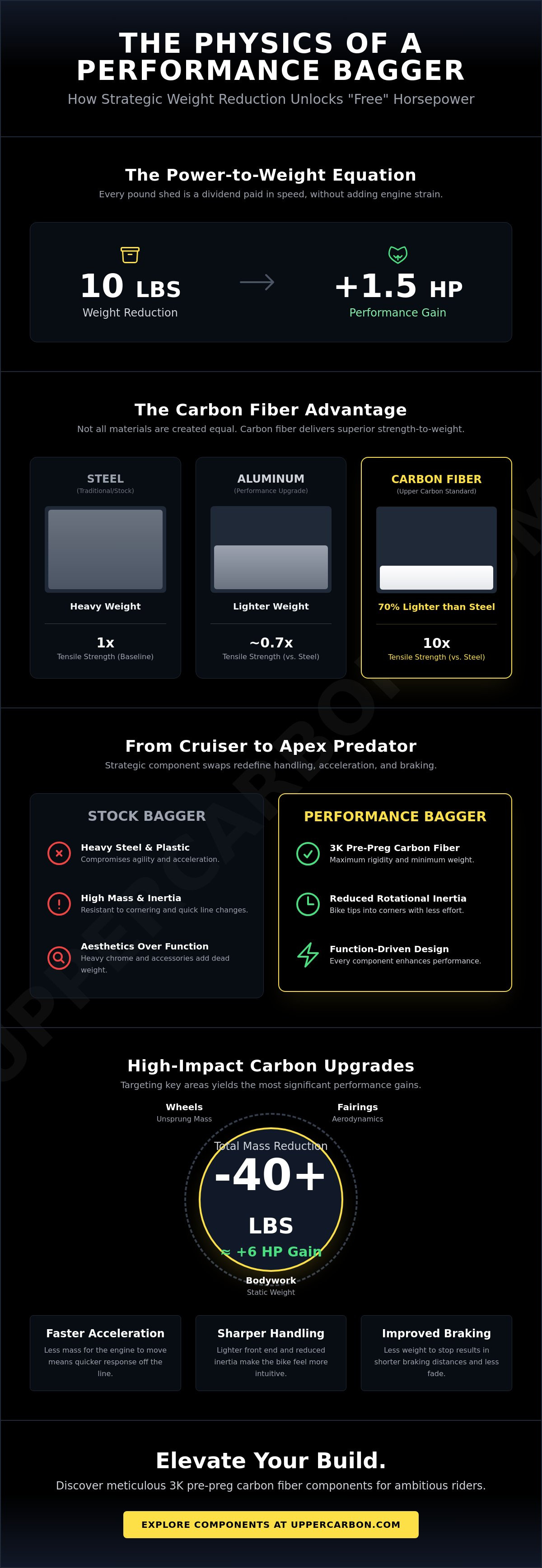
Performance is a calculation of resistance. In a high-caliber moonshine harley build, the power-to-weight ratio defines the machine’s ceiling. Physics dictates that accelerating mass requires energy; therefore, every pound shed is a dividend paid in speed. Removing 10 pounds of static weight provides a performance gain comparable to adding 1.5 horsepower, yet it does so without increasing mechanical strain on the Milwaukee-Eight engine. It's a method of gaining "free" power by simply making the engine's job easier.
Traditional materials like fiberglass or ABS plastic are heavy and prone to fatigue. Carbon fiber offers a 70% weight reduction compared to steel and remains significantly lighter than aluminum. This material isn't just about lightness. It provides superior structural rigidity and exceptional heat dissipation. These properties ensure that components don't warp or degrade under the intense thermal loads generated by high-output V-twin engines. When the goal is an elite build, the transition from plastic to composite is the first step toward mechanical excellence.
- Static Weight: Reducing the overall mass the engine must move.
- Unsprung Mass: Improving suspension reaction times by lightening wheels and fenders.
- Rotational Inertia: Allowing the bike to tip into corners with less physical input.
The Science of 3K Pre-Preg Carbon Fiber
Precision defines elite engineering. While aesthetic carbon wraps provide the look of performance, they lack the integrity required for a moonshine harley. We prioritize 3K pre-preg carbon fiber because the resin is meticulously infused into the fabric before molding. This process, followed by autoclave curing, eliminates excess resin and air pockets. The result is a material with 10 times the tensile strength of steel. This level of performance bagger carbon fiber is the industry standard for builds that demand both durability and extreme weight savings.
Handling and Aerodynamics
Weight distribution dictates how a motorcycle communicates with the rider. Reducing front-end mass by replacing heavy plastic fairings with carbon fiber drastically improves steering response. The bike feels intuitive rather than resistant. At speeds exceeding 100 mph, traditional fairings can flex under wind pressure, causing instability. Carbon fiber components maintain their shape, providing a stable aerodynamic profile. This rigidity translates to a psychological advantage; the rider feels a sense of absolute control. For those seeking to elevate their machine's dynamics, these structural upgrades are essential investments in precision.
Critical Carbon Fiber Upgrades for High-Output Harleys
Precision defines the elite build. In a high-output moonshine harley, every component must justify its presence through performance or weight reduction. We prioritize upgrades that offer a dual return: structural rigidity and mass reduction. High-impact areas focus on the front end and the rear chassis. At speeds exceeding 110 mph, minor fitment errors become dangerous vibrations. Excellence requires a meticulous eye for detail. We view each part as a strategic investment in the bike's overall velocity and handling profile.
Performance Fairings and Fenders
Performance starts where the wind hits first. When comparing harley motorcycle fairings, the mass difference is undeniable. A stock fairing can weigh 55% more than a carbon fiber alternative. This reduction lightens the load on the front forks. It sharpens steering response instantly. Choosing between a Shorty fender and a Wrapper style is a strategic decision. The Shorty minimizes surface area to reduce drag. The Wrapper offers a bespoke, flowing aesthetic. Both options provide the aerodynamic stability necessary when the speedometer climbs past 100 mph. Carbon fiber doesn't flex under high wind pressure. It maintains its shape to ensure consistent airflow over the rider.
Saddlebag Lids and Side Covers
The rear section dictates cornering behavior. Heavy lids create a pendulum effect that upsets the chassis during rapid transitions. Carbon fiber lids shed significant weight from the highest point of the saddlebags. This change increases flickability. It makes the machine feel responsive rather than heavy. These components are exceptionally resilient. Carbon fiber resists the micro-fractures common in plastic lids exposed to high-velocity road debris. Performance side covers complete the profile. They create a narrow silhouette that channels air with purpose. This streamlined approach reduces the low-pressure pocket behind the rider, which can cause instability at high speeds.
A cohesive design language is the hallmark of a master craftsman. We don't simply bolt on parts; we curate a unified system. Every weave must align perfectly to maintain visual continuity. Every mounting point must be exact to prevent harmonic resonance. This meticulous approach ensures the moonshine harley looks as fast as it performs. Precision fitment isn't an optional luxury. It's the difference between a standard custom bike and a professional-grade racing machine. By choosing components that serve both form and function, we elevate the Harley-Davidson platform into a new tier of engineering excellence.
Strategic Selection: Matching Carbon Parts to Your Build
Building a moonshine harley requires more than an aggressive engine. It demands a calculated selection of components that function as a single unit. We view carbon fiber as a strategic investment in balance. If your build features a high-output M8 engine, your bodywork must facilitate thermal management. Every component must justify its weight and serve a specific performance goal.
The chin spoiler is a critical piece of this performance puzzle. It serves as both an aerodynamic anchor and a cooling duct. Evaluating the best ZH2 style carbon fiber chin spoilers is essential for aggressive builds. These spoilers optimize airflow toward the oil cooler, often reducing operating temperatures by up to 15 degrees during sustained high-speed runs. This isn't just about aesthetics; it's about engine longevity.
Compatibility remains a technical priority. High-performance exhaust systems, such as a 2-into-1 shorty, create tight tolerances. We ensure every carbon panel clears these heat sources to prevent structural degradation. The integration must be seamless, accounting for the increased diameter of performance air cleaners and the reach of heavy-duty suspension components.
The Cockpit: Dash and Hand Guards
The rider's view should be focused and refined. A carbon fiber dash replaces bulky plastic with a minimalist, lightweight surface. It frames precision digital gauges without distraction. Carbon hand guards provide more than protection; they stabilize the front end by reducing wind buffeting at speeds exceeding 90 mph. This creates a quiet, controlled environment for the pilot. We aim for a cockpit that feels intentional and uncluttered.
Installation and Precision Fitment
Bespoke parts require a meticulous approach to installation. In high-output applications, poor fitment causes vibration and material fatigue. We prioritize a flush interface between the carbon and the frame to maintain rigidity. Precision engineering is non-negotiable for builds pushing 150+ horsepower. A single misaligned bracket can compromise the structural integrity of the machine under load. We treat every bolt and spacer as a critical failure point.
Elevate your next project with bespoke carbon solutions designed for elite performance and durability.
Upper Carbon: Meticulous Components for Ambitious Riders
Big Al changed the trajectory of the American V-twin. He demanded more from the platform. He proved that a heavy bagger could perform with the agility of a precision instrument. Upper Carbon exists to facilitate that evolution. We bridge the gap between boutique design and hard business logic. Every component we produce is a strategic asset for the rider. We don't believe in aesthetic fluff. We believe in engineering that justifies its own existence.
Our commitment to 3K pre-preg construction is absolute. This isn't a marketing choice; it's a technical necessity. Pre-impregnated fibers allow for a perfect resin-to-fiber ratio. This results in parts that are lighter and stronger than standard carbon fiber alternatives. It's the definitive choice for those chasing the moonshine harley standard. We provide the structural foundation for builds that refuse to compromise. Precision is our baseline. Excellence is our output.
Bespoke Craftsmanship for Elite Builds
The weaving process at Upper Carbon is a study in precision. We align every strand to handle specific load paths. Our curing process utilizes high-pressure autoclaves to ensure zero porosity. This level of detail is why our components are found on the most ambitious builds from coast to coast. We serve as a specialist partner for the performance bagger community. We understand that a build is only as strong as its weakest link. We ensure that link is never carbon fiber. Our parts offer a level of refinement that transforms the machine's profile and performance.
Elevate Your Machine
Selecting your components is the final stage of a performance strategy. It's a calculated move. You're investing in high-end, proprietary parts that define the character of your ride. These components offer long-term value through durability and weight savings. When you execute a moonshine harley build, you're making a statement about your standards. The process requires focus and an eye for technical detail.
- Identify your specific performance goals.
- Select components that reduce unsprung weight for better handling.
- Trust in the 3K pre-preg standard for structural integrity.
- Partner with specialists who prioritize substance over hype.
A performance bagger is a strategic investment in excellence. It's more than a motorcycle. It's a testament to what's possible when precision meets ambition. Quality is a deliberate choice. We invite you to make it. Your machine deserves the clarity of professional engineering.
Redefining the Standard of V-Twin Performance
The evolution of the American V-twin reaches its peak through the union of raw power and structural precision. Achieving the standard set by a moonshine harley build requires more than just engine work; it demands a strategic reduction in mass. Our 3K Pre-preg construction provides the maximum strength needed for high-output baggers while shedding the weight that hinders agility. These parts aren't merely aesthetic additions. They are meticulous components designed by Big Al for the performance bagger elite and used in high-performance builds nationwide. By selecting these strategic upgrades, you transform a heavy machine into a responsive, high-performance instrument. This is the intersection of craftsmanship and hard physics. Precision matters. Every gram removed translates directly to speed on the pavement. Your build deserves components that match your ambition for excellence. We provide the architecture for your vision. The road ahead rewards those who refuse to compromise on quality.
Explore our elite catalog of carbon fiber performance parts and begin your transformation.
Frequently Asked Questions
What exactly defines a Moonshine Harley style build?
A Moonshine Harley build prioritizes high-performance engine tuning and structural weight reduction to create an agile, powerful machine. These builds often feature Milwaukee-Eight engines producing over 140 lb-ft of torque. Every component serves a specific purpose. We focus on the synergy between raw power and precision handling, ensuring the heavy frame performs like a bespoke racing instrument. It's a meticulous approach to V-Twin engineering.
How much weight can I save by switching to a full carbon fiber fairing?
Switching to a full carbon fiber fairing reduces component weight by approximately 50 percent. A stock Road Glide outer fairing weighs nearly 14 pounds, while a bespoke carbon fiber replacement weighs roughly 6.5 pounds. This reduction lightens the front end significantly. It improves flickability and decreases the physical effort required for low-speed maneuvers. Precision matters in every ounce saved during the build process.
Is carbon fiber durable enough for long-distance touring Harleys?
Carbon fiber is exceptionally durable for long-distance touring due to its high fatigue resistance and structural rigidity. It possesses a strength-to-weight ratio five times greater than steel. Unlike traditional fiberglass, it doesn't crack under the constant vibration of a high-displacement engine. It's a strategic investment for riders who demand longevity. Meticulous engineering ensures these parts withstand thousands of miles across diverse road conditions.
Does carbon fiber require special maintenance or cleaning products?
Carbon fiber requires pH-neutral cleaning agents and consistent UV protection to maintain its structural integrity and finish. Most premium components feature a protective clear coat, but applying a ceramic coating with a 9H hardness rating provides an extra layer of defense. Avoid abrasive polishes that might scratch the resin surface. Simple, intentional care preserves the visual depth of the weave for years of ownership.
Can I mix carbon fiber parts from different manufacturers on one build?
You can mix manufacturers, but the visual alignment and scale of the weave patterns will likely vary. Most industry leaders use a 2x2 twill weave, yet the direction of the carbon strands often differs by 10 percent between different brands. For a cohesive aesthetic, we recommend sourcing all primary bodywork from a single specialist. Consistency reflects a commitment to design excellence and professional rigor.
What is the difference between wet lay-up and pre-preg carbon fiber?
Pre-preg carbon fiber is cured in an autoclave under high pressure, while wet lay-up is processed at room temperature. Pre-preg utilizes 35 percent less resin, resulting in a part that's both lighter and stronger. It's the standard for elite moonshine harley builds where performance is non-negotiable. Wet lay-up is more common in entry-level accessories but lacks the structural precision and consistency of pre-preg materials.
Will carbon fiber parts improve the resale value of my Harley?
Premium carbon fiber components elevate the resale value by positioning the motorcycle as an elite, performance-oriented machine. Data from secondary markets shows that bikes with documented high-end upgrades retain up to 25 percent more value than stock counterparts. Buyers recognize the investment in quality and craftsmanship. It transforms a standard motorcycle into a bespoke asset with measurable market appeal and a clear competitive edge.
How does weight reduction at the front end affect high-speed wobbles?
Reducing front-end weight by 10 pounds or more significantly decreases the inertia that contributes to high-speed wobbles. Lightening the fairing and handlebars allows the suspension to react 20 percent faster to road imperfections. It stabilizes the chassis during aggressive cornering and high-speed runs. By shifting the weight bias, we create a more predictable and controlled riding experience for every moonshine harley enthusiast.


