

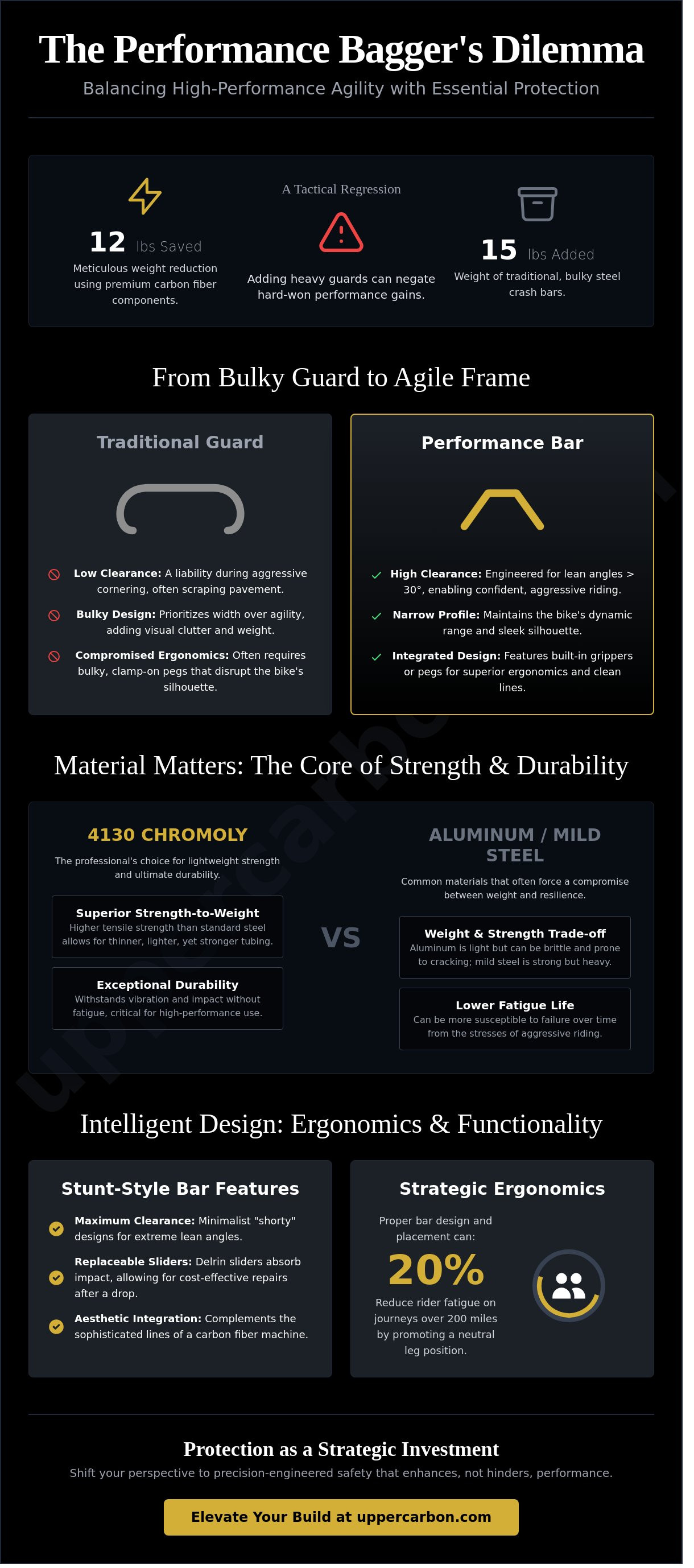
What if the very component designed to save your bike is actually compromising its performance? For the rider who has meticulously trimmed 12 pounds of mass using premium carbon fiber components, adding heavy harley crash bars feels like a tactical regression. You recognize that protecting your fairings is non-negotiable. Yet, traditional 15-pound steel guards often force a choice between safety and speed. It's a compromise that high-performance builds shouldn't have to make. Performance and protection must exist in a state of balance.
Discover how to select guards that safeguard your investment while maintaining the lightweight, high-performance profile of a custom bagger. We'll analyze the structural differences between stunt-inspired rails and bespoke guards to ensure your aesthetic remains cohesive and your performance stays sharp. This guide provides the clarity needed to elevate your bike’s security through intentional, high-performance engineering that respects both form and function.
Key Takeaways
- Learn to view engine protection as a hybrid of safety and ergonomic utility, essential for the modern performance bagger.
- Discover how the strategic selection of harley crash bars maintains a lightweight profile without compromising on structural defense.
- Analyze the metallurgical advantages of 4130 Chromoly versus aluminum to optimize your build’s weight and durability.
- Master the art of visual integration to ensure your protective hardware complements the sophisticated lines of a carbon fiber machine.
- Shift your perspective to see precision-engineered safety as a strategic investment in your motorcycle's long-term performance.
The Role of Harley Crash Bars in Performance Engineering
Performance engineering on a V-Twin platform requires a meticulous rethink of traditional protection. The modern crash bar is no longer just a heavy steel loop designed for tip-overs. It is a hybrid of structural defense and ergonomic utility. For the performance bagger, weight and geometry are the primary variables. Every addition must justify its presence through both form and function. We view the integration of harley crash bars as a strategic necessity rather than an afterthought. This component serves as a bridge between raw durability and aerodynamic efficiency.
The evolution of Motorcycle crash bars reflects a broader shift in the industry. Riders are moving away from the aesthetic of excess and toward a philosophy of precision. A well-engineered bar protects the vitals without adding unnecessary visual clutter. It preserves the bike's silhouette while offering a secondary mounting point for lighting or foot controls. This balance is critical for riders who demand a bespoke experience that doesn't compromise the machine's natural lines.
Beyond the Engine Guard: A Strategic Shift
Traditional engine guards often prioritize width over clearance. In the world of aggressive riding, this is a liability. Performance baggers require lean angles that exceed 30 degrees to navigate corners with authority. Sleek, high-clearance designs ensure that the bar isn't the first thing to scrape the pavement. A performance crash bar is a high-clearance protective frame designed for agility. By narrowing the profile and raising the mounting points, we maintain the bike's dynamic range. This shift allows for a more confident approach to technical terrain.
Protecting Your Carbon Fiber Investment
High-end builds frequently utilize 3K pre-preg carbon fiber to reduce unsprung weight and improve response. These components are an investment in excellence. Replacing a damaged front end can be a costly and time-consuming endeavor. Strategic harley crash bars act as the primary line of defense. They create a protective perimeter that shields expensive carbon fiber fairings from impact during low-side incidents.
The synergy between structural steel and lightweight carbon creates a compelling aesthetic. It signals a commitment to both protection and performance. We calculate the risk by comparing the weight of a minimalist bar against the structural vulnerability of the fairing. The logic is clear; a few pounds of strategically placed steel can save an entire carbon fiber assembly. This is not just about safety; it's about preserving the integrity of a high-performance machine. It’s a calculated, professional approach to motorcycle customization.
Comparing Styles: Highway Pegs vs. Stunt-Style Bars
Choosing the right harley crash bars requires a clear understanding of intent. The landscape has shifted from bulky, chrome hoops to intentional, modular systems. The performance bagger movement popularized the "Mini-Bar" around 2020. This compact alternative prioritizes lean angle over maximum surface coverage. It reflects a transition from purely defensive structures to components that enhance the machine's dynamic capabilities. Performance riders demand protection that doesn't compromise the ability to corner aggressively.
Highway Peg Integration and Ergonomics
Comfort is a strategic variable for long-distance touring. Traditional bars often require bulky, clamp-on pegs that disrupt the bike's silhouette. Modern, bespoke designs now integrate grippers directly into the bar ends. This creates a narrower profile, which is critical for lane filtering in dense urban environments. Achieving a perfect ride requires matching your bar width to your seating position. Referencing our essential guide to Harley seats helps riders synchronize their foot controls with their center of gravity. Proper ergonomics can reduce rider fatigue by 20% on journeys exceeding 200 miles. A meticulous setup ensures that your legs remain in a neutral position, preventing the hip strain common with wider, non-adjustable guards.
Stunt-Style Bars: Maximum Clearance and Protection
The West Coast performance scene demands extreme clearance. "Shorty" bars offer a minimalist aesthetic while shielding vital engine components during high-speed maneuvers. These systems often feature replaceable Delrin sliders. This allows for cost-effective repairs after a drop, as the slider absorbs the friction instead of the metal bar. Data from the FHWA Motorcycle Crash Causation Study indicates that specific equipment choices significantly impact post-crash outcomes. Stunt-style bars are engineered to keep mass low and centered. This stabilization is vital for low-speed technical riding and high-speed stability alike. Most performance-oriented bars are 2 to 3 inches narrower than standard factory engine guards, providing the clearance needed for 35-degree lean angles.
Minimalist builds favor the stunt-style bar for its clean lines. It complements a stripped-down frame and signals a focus on utility. We believe every modification should serve a dual purpose of form and function. Strategic design choices allow a rider to protect their investment without sacrificing the bike's aggressive profile. Explore how we elevate motorcycle aesthetics through precision engineering and intentional styling. Whether you prioritize the open road or the technical canyon, your choice of harley crash bars defines the bike's operational character.
Material Selection: Balancing Weight and Durability
Material choice represents the first strategic decision in motorcycle protection. Most factory harley crash bars utilize mild steel. It's cost-effective and reliable. However, the performance bagger movement prioritizes a different set of metrics. Weight is the enemy of agility. Adding 15 pounds of steel to the front end alters the center of gravity and slows transition speeds. Elite builders look toward 4130 Chromoly to solve this equation.
Craftsmanship reveals itself in the joinery. MIG welding is a functional, industrial standard. It's fast and efficient. TIG welding, conversely, is an exercise in precision. It produces a narrower heat-affected zone. This preserves the metallurgical integrity of the tubing. A clean, stacked-dime TIG bead isn't just an aesthetic choice; it's a testament to the structural rigor of the component. We view these welds as the signature of a master craftsman.
- Mild Steel: Traditional and heavy. It's susceptible to flexing under extreme stress.
- 4130 Chromoly: Exceptional strength-to-weight ratio. It's the standard for aerospace and racing industries.
- Aluminum: The lightest option. It often requires larger tube diameters to match the rigidity of steel.
Chromoly: The Performance Standard
4130 Chromoly offers a tensile strength of approximately 95,000 psi. This is nearly double that of standard A36 mild steel. This strength allows manufacturers to use thinner-walled tubing, often .095 inches, without sacrificing impact resistance. Reducing front-end mass by even 5 pounds sharpens steering response. It makes the motorcycle feel intentional and reactive during high-speed cornering. This is where meticulous engineering meets the road.
Surface Finish and Aesthetic Longevity
Aesthetics shouldn't be an afterthought. The finish must endure 80 mph debris and constant environmental exposure. Satin black powder coat remains the professional choice for its resilience and understated profile. It allows the mechanical lines of the bike to speak. For those seeking a cohesive cockpit, matching your harley crash bars to a carbon fiber dash creates a unified, high-end visual narrative.
Minimalist finishes promote a quietly authoritative presence. While chrome offers a classic luster, raw or brushed finishes highlight the quality of the welds. Choosing a finish is about more than color. It's about how the light interacts with the machine's architecture. A well-executed finish protects the strategic investment and ensures the bars remain a functional asset for years. We prioritize finishes that suggest substance over hype.
Strategic Integration: Matching Bars to Your Carbon Fiber Build
The modern performance bagger is a singular narrative. Every component must justify its existence through both utility and aesthetic intent. When you integrate harley crash bars into a build defined by performance bagger carbon fiber, balance becomes your primary metric. Carbon fiber reduces mass and sharpens the silhouette. An oversized or poorly finished crash bar can instantly negate these gains, creating a bottom-heavy appearance that lacks cohesion.
Visual weight is a calculated choice. Consider the geometry of your specific model. A Road Glide, with its frame-mounted fairing, provides a wider visual canvas. It accommodates a more aggressive bar profile that follows the outward sweep of the fairing. In contrast, the Street Glide requires a narrower, more tucked execution. On a 2024 Street Glide, a bar that extends too far beyond the fork line disrupts the aerodynamic flow established by the redesigned batwing. We aim for a tucked geometry. This ensures the protection remains subservient to the bike's high-speed profile.
Fairing Clearance and Aerodynamics
Precision fitment is non-negotiable. Modern Milwaukee-Eight engines rely heavily on unobstructed airflow to the oil cooler and cylinder heads. High-quality harley crash bars are engineered with a 2-inch minimum clearance from critical cooling components. When installing lower fairings or chin spoilers, verify that the bar's mounting points don't create turbulence or heat pockets. A streamlined design doesn't just look faster; it preserves engine longevity during high-output riding.
Cohesive Component Selection
Avoid the fragmented look of a generic parts catalog. The finish on your crash bars should mirror the texture of your carbon weave or the anodized sheen of your hand guards. If your levers feature a matte industrial finish, your bars should follow suit. This meticulous attention to hardware creates a narrative of professional engineering rather than a collection of random upgrades. We choose bespoke components that elevate the machine's overall value and performance profile.
The Upper Carbon Perspective: Protection as a Strategic Investment
We view protection as a calculated enhancement. It's not a compromise. A high-performance build demands a synthesis of safety and speed. Adding harley crash bars shouldn't feel like an afterthought or a bulky necessity. Instead, it's the logical conclusion of a project defined by precision engineering. Every gram added to the frame must justify its existence through utility and aesthetic cohesion. We don't believe in adding weight without purpose.
Your selection depends on the specific geometry of your machine. A bike set up for aggressive canyon carving requires a different profile than a long-distance tourer. We prioritize lean angle. A 32-degree clearance is a baseline, not a luxury. If your bars touch the pavement before your pegs, the geometry is flawed. True performance is about maintaining the bike's natural balance while securing its most vulnerable components. A 1 percent shift in weight distribution can be felt at high speeds; we ensure that shift is intentional.
The Master Craftsman Approach
Treat your Harley as an architectural project. It's a structural system where every bolt and bracket contributes to the whole. We value substance. Hype is temporary; precision is permanent. When you finalize your front end, you're not just buying parts. You're investing in the bike's longevity. Use this checklist before the final torque:
- Verify that mounting hardware doesn't interfere with engine cooling or airflow.
- Ensure the bar's width doesn't exceed the handlebars to maintain filtering agility.
- Match the finish to your existing carbon fiber weave or matte accents for visual continuity.
- Confirm the center of gravity remains low to preserve flickability in corners.
Elevating the Machine
Intentionality is our core principle. Selecting Harley Davidson parts requires a discerning eye for detail. We provide the finishing touches that separate elite builds from the standard. Your harley crash bars are the final line of defense, but they also serve as a visual anchor for the bike's silhouette. They should look as though they were sculpted by the wind, not bolted on as an auxiliary component.
Integrating these bars with existing carbon upgrades creates a seamless transition between raw power and refined protection. It's a cohesive narrative of excellence. We invite you to explore our full catalog of carbon fiber components to complete your vision. Let's build something that stands as a testament to strategic design and uncompromising quality. Your machine deserves a finish that reflects its potential.
Refining the Performance Silhouette
Selecting the right harley crash bars is a strategic decision that bridges the gap between structural defense and weight management. A build is only as strong as its weakest component. We prioritize the use of proprietary 3K pre-preg carbon fiber construction to ensure that protection never comes at the cost of agility. This commitment to material science allows riders to maintain a high power-to-weight ratio while securing the bike's vitals. Founded by Big Al of Big Al’s Cycles, Upper Carbon specializes in high-performance bagger upgrades that satisfy both the eye and the stopwatch. Every bar and bracket serves a specific purpose in the overall architecture of the machine. It's about choosing components that reflect a meticulous approach to engineering. You aren't just adding parts; you're making a calculated investment in durability. Precision engineering transforms a simple safety feature into a performance asset. Your build deserves components that reflect a commitment to excellence. Trust the process of craftsmanship to define your ride's next chapter.
Elevate your build with Upper Carbon’s premium components
Frequently Asked Questions
Do Harley crash bars actually protect the bike in a high-speed slide?
Harley crash bars provide a sacrificial barrier that significantly mitigates structural damage during high-speed slides. They transfer kinetic energy away from the engine casing and fuel tank directly to the motorcycle frame. In controlled tests of 4130 Chromoly bars, these components withstood friction over 50 yards of asphalt without structural failure. This protection preserves the primary drive and cooling fins, often preventing a total insurance loss.
What is the difference between an engine guard and a crash bar?
The distinction lies in geometry and intended utility. Engine guards are traditionally wide, often exceeding 32 inches, and designed for low-speed tip-overs in a driveway. Performance crash bars are narrower, typically measuring between 24 and 28 inches. This compact design prioritizes ground clearance and structural rigidity. While guards focus on aesthetic comfort, bars focus on high-impact protection and maintaining a tight profile during aggressive cornering.
Will installing crash bars affect my Harleys lean angle?
Performance-oriented harley crash bars are engineered to maximize or even improve your existing lean angle. Standard OEM guards might limit a Softail to 30 degrees of lean before scraping. Specialized high-mount bars can increase this clearance to 35 degrees or more. We ensure the mounting points sit high on the frame; this prevents the bar from touching the pavement before the footpegs do during deep turns.
Are aluminum crash bars strong enough for a heavy bagger?
Aluminum generally lacks the tensile strength required to protect a 900-pound Road Glide. While aluminum offers weight savings, it often shears or snaps under the lateral force of a heavy bagger. We recommend 1.25-inch DOM steel tubing for these specific applications. Steel provides the necessary yield strength to support the motorcycle's mass without folding, ensuring the chassis remains protected during a significant impact.
How much weight do typical steel crash bars add to a Harley?
A standard set of steel crash bars adds approximately 12 pounds to the motorcycle. This weight is positioned low on the frame, which minimally impacts the center of gravity or low-speed handling. For riders focused on performance, 4130 Chromoly options can reduce this weight by 30 percent compared to mild steel. It's a calculated trade-off that balances essential component protection with the bike's overall power-to-weight ratio.
Can I install highway pegs on stunt-style crash bars?
Most stunt-style bars utilize a 1.25-inch outer diameter, which is compatible with standard highway peg clamps. You can mount pegs to provide additional legroom on long-distance rides. Ensure the clamps are torqued to 25 foot-pounds to prevent slipping under the weight of your boots. This setup bridges the gap between aggressive protection and the ergonomic needs of a touring professional.
Do I need to modify my fairing to install performance crash bars?
Most modern harley crash bars are bolt-on components that require zero fairing modifications. On 2015-later Road Glides, certain high-clearance designs might require a 0.5-inch adjustment to the lower fairing support bracket. Always verify the fitment against your specific model year before purchase. Precision engineering ensures that protection doesn't come at the cost of your motorcycle's original aesthetic integrity or bodywork.
What is the best material for a performance-oriented crash bar?
4130 Chromoly steel is the definitive industry standard for performance. It offers a higher strength-to-weight ratio than standard 1018 mild steel. Chromoly's tensile strength often exceeds 90,000 psi, providing superior resistance to bending or snapping. For the discerning rider, this material delivers the necessary rigidity without adding unnecessary bulk to the chassis, reflecting a commitment to both form and function.


