

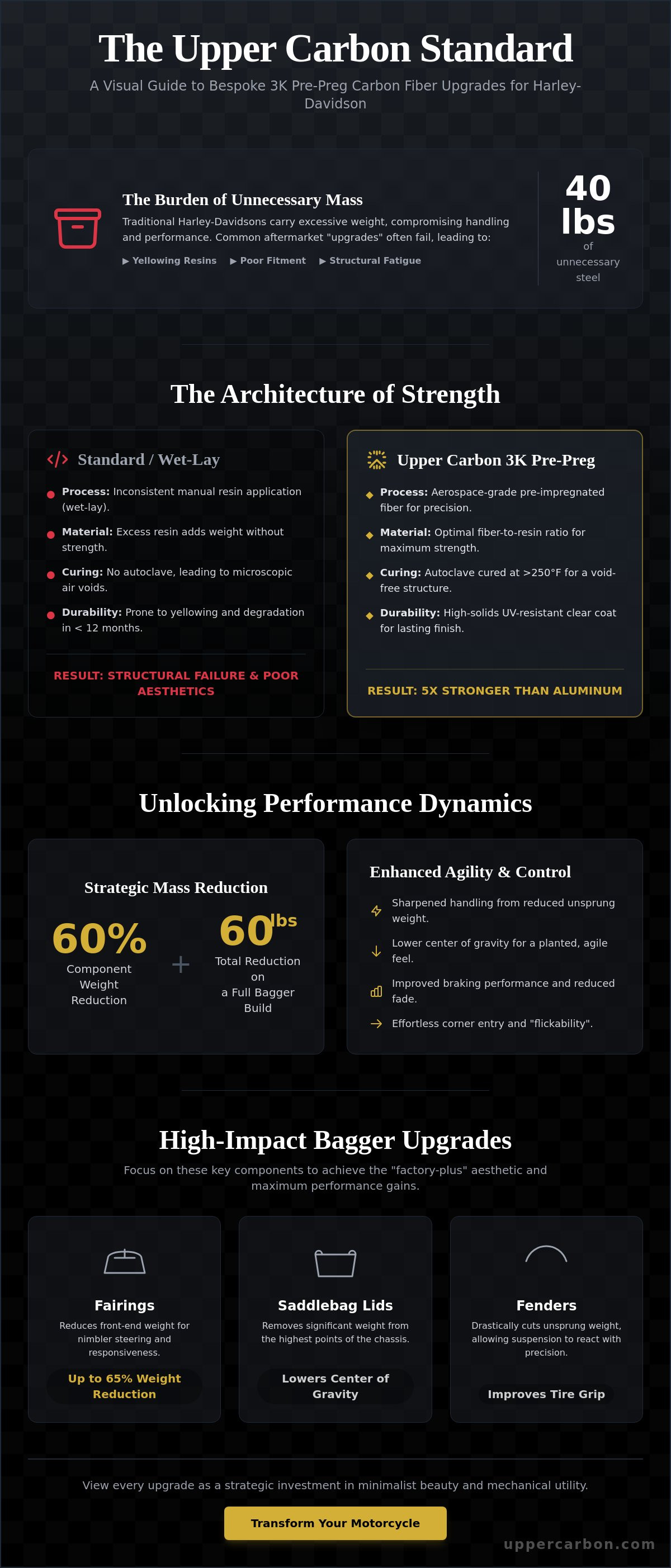
Tradition is a heavy burden for any motorcycle to carry. For the modern rider, the classic Harley-Davidson silhouette often comes at the cost of excessive mass and sluggish handling. You understand that true performance requires shedding the 40 pounds of unnecessary steel that hold your machine back. It's a common frustration to find carbon fiber harley parts that promise a custom look but deliver yellowing resins and poor fitment within 12 months of installation.
We believe precision is the only path to excellence. By integrating premium 3K pre-preg materials, you can achieve a 60 percent reduction in component weight while maintaining the bike's iconic soul. This guide reveals how bespoke carbon construction elevates your power to weight ratio and ensures lasting structural integrity. We will examine the specific engineering behind our 2026 collection and show you how to transform your motorcycle into a masterpiece of modern dynamics.
Key Takeaways
- Understand why 3K pre-preg carbon fiber represents the definitive standard for structural integrity and aerospace-grade precision.
- Discover how reducing unsprung weight through premium carbon fiber harley parts sharpens handling and optimizes suspension response.
- Identify the essential entry points for a performance bagger build, focusing on high-impact upgrades like saddlebag lids and fairings.
- Master the art of the "factory-plus" aesthetic by matching component weaves for a seamless and intentional visual narrative.
- Learn to view every performance upgrade as a strategic investment that bridges the gap between minimalist beauty and mechanical utility.
The Architecture of Strength: 3K Pre-Preg vs. Standard Carbon Fiber
Performance begins at the molecular level. For riders seeking the pinnacle of carbon fiber harley parts, the distinction between 3K pre-preg and traditional wet-lay methods is absolute. Pre-preg represents the gold standard in aerospace and Formula 1 engineering. It involves carbon fibers that are pre-impregnated with a precise ratio of resin in a controlled factory environment. This eliminates the human error inherent in wet-lay processes, where excess resin adds unnecessary weight without increasing structural integrity. It's a difference you can feel in the weight of the component and the rigidity of the ride.
The manufacturing of a high-quality carbon-fiber reinforced polymer requires an autoclave. This pressurized oven cures the material at temperatures often exceeding 250 degrees Fahrenheit. The process forces out microscopic air bubbles, ensuring a void-free structure. It results in a strength-to-weight ratio that's up to 5 times stronger than grade 6061 aluminum. For a motorcycle component exposed to the elements, a UV-resistant finish is non-negotiable. Without a high-solids clear coat, the resin will yellow and degrade under solar radiation within 12 months of consistent use. We prioritize these finishes to ensure your investment remains pristine.
Why Material Consistency Matters for Harleys
Harley-Davidson motorcycles are defined by their rhythmic, high-amplitude vibrations. These forces test the limits of every bolt and bracket. Low-grade composite materials often suffer from delamination or hairline fractures when subjected to these constant cycles. A 3K weave is defined as 3,000 individual carbon filaments per fiber tow for optimal density and structural balance. This meticulous architecture ensures that carbon fiber harley parts maintain their shape and strength under extreme stress. Uniformity prevents the structural fatigue that causes lesser parts to fail at highway speeds.
The Aesthetic of Precision
Excellence has a specific visual signature. High-quality carbon fiber displays a deep, three-dimensional shimmer that cheap alternatives can't replicate. You won't find weave wash or distorted patterns in a bespoke component. These defects are common in mass-produced parts where the fabric is stretched unevenly over complex curves. Precision manufacturing preserves the geometric perfection of the weave. It's a visual promise of the engineering beneath the surface. To understand how these technical choices impact your build, consult the elite guide to Harley carbon fiber for a deeper comparison of industry standards.
The Performance Bagger Advantage: Dynamics and Weight Reduction
Engineering a performance bagger requires a meticulous approach to mass. It is a game of subtraction. By replacing dense plastic and fiberglass with carbon fiber harley parts, we alter the motorcycle’s fundamental physics. The most immediate impact occurs at the wheels. Reducing unsprung weight through carbon fenders allows the suspension to react with greater precision. The shock absorbers no longer fight the inertia of a heavy component; they simply manage the road. This leads to a consistent tire contact patch and superior grip.
The industrial application of these materials proves their viability. A Department of Energy study on carbon fiber emphasizes how optimized composites reduce mass while maintaining structural integrity under extreme loads. On a motorcycle, this translates to a lower center of gravity. Replacing heavy stock fairings and saddlebag lids removes weight from the highest points of the chassis. This shift makes the bike feel planted yet agile. A full performance bagger build can achieve a total weight reduction of 45 to 60 lbs, a strategic advantage that redefines the touring experience.
Braking performance also sees a direct benefit. Stopping a 900-pound machine creates immense heat and stress. When total vehicle mass is reduced, the kinetic energy that must be dissipated drops significantly. Stopping distances shorten. Brake fade is delayed. Every component works more efficiently because it has less bulk to overcome. You can refine your machine’s profile to begin this transformation.
Handling the Heavyweight
Steering inertia defines the rider's experience. A stock outer fairing sits high and forward, acting as a pendulum against every input. Swapping this for a carbon alternative reduces front-end weight by up to 65 percent. The result is a "flickability" usually reserved for smaller frames. Corner entry becomes a deliberate, effortless action rather than a physical struggle. For a deeper dive into these dynamics, consult our definitive guide to performance bagger carbon fiber. Precision engineering replaces brute force.
The Power-to-Weight Ratio Shift
Acceleration is a function of force over mass. Shedding 20 lbs from a touring chassis provides a performance feel equivalent to a modest horsepower gain. It is a strategic upgrade. The bike feels eager. It responds to the throttle with a new sense of urgency. Every pound removed is a performance dividend paid in acceleration. Beyond the numbers, there is a psychological shift. A lighter machine inspires confidence. It feels manageable, precise, and bespoke. This transition from a standard cruiser to a performance-engineered bagger is achieved through the intentional use of carbon fiber harley parts to elevate every metric of the ride.
Essential Carbon Upgrades: From Saddlebag Lids to Fairings
Transformation begins where the eye rests. For the modern bagger, carbon fiber harley parts aren't just accessories. They're strategic investments in performance. The transition from factory plastic to aerospace-grade composites changes the motorcycle's DNA. We prioritize components that offer the greatest tactile and mechanical advantage.
The fairing stands as the ultimate front-end statement. Whether it's a Road Glide or Street Glide, the weight savings are immediate. A carbon fairing typically weighs 40% less than its OEM counterpart. This reduction at the highest point of the bike lowers the center of gravity. It makes the front end feel lighter and more responsive. It reduces the physical effort required at the handlebars during high-speed maneuvers.
Fenders provide a similar performance gain by reducing unsprung weight. Options like the Shorty, Wrapper, or OG styles allow for a bespoke aesthetic while improving suspension travel. When the fork doesn't have to fight the inertia of a heavy steel fender, the ride becomes smoother. It's a meticulous approach to handling that most riders feel within the first mile of testing.
Saddlebag Lids: Form Meets Function
Lids often serve as the primary entry point for performance bagger builds. They offer a unique blend of structural integrity and style. Carbon lids provide the necessary rigidity to support high-output 6x9 speaker pods without the vibration common in plastic lids. This stiffness ensures a weather-tight seal, protecting your cargo from the elements. You can explore how these components have shifted from simple storage to performance tools in our look at the evolution of Harley Davidson saddlebags.
The Cockpit Experience: Dashes and Hand Guards
The cockpit is the rider's primary interface. A carbon fiber dash does more than look premium; it eliminates the distracting glare from chrome or gloss finishes. It creates a focused, minimalist environment. We pair these with carbon hand guards to provide wind protection without adding bulk. These peripheral carbon fiber harley parts transform the rider's view into a high-performance command center. The tactile quality of a hand-laid weave under the sun is a constant reminder of the bike's refined nature. It's about elevating the experience of every mile traveled.
Selecting Your Components: A Build Strategy for 2026
A successful build demands intentionality. You don't just buy parts; you curate an ecosystem. The 2026 landscape favors the "factory-plus" aesthetic, a look that suggests the bike was born with these enhancements. This requires meticulous attention to the weave pattern. Most premium carbon fiber harley parts utilize a 3K twill weave. Mixing a 3K twill fender with a plain weave tank console creates visual friction. It breaks the flow. Consistency signals quality. We recommend sourcing all major bodywork from a single production batch to ensure the carbon depth and resin tint remain identical across the machine.
Deciding between raw carbon and integrated paint is a strategic choice. A raw build highlights the engineering. It’s a statement of performance. However, ghosting carbon under a translucent candy paint offers a sophisticated depth that reveals itself only under direct sunlight. This approach respects the Harley-Davidson heritage while signaling a modern, bespoke evolution. Prioritize upgrades that offer the highest return on investment. Unsprung weight reduction provides immediate feedback in handling, while visible components like fairings offer the most significant impact on the bike’s silhouette.
Compatibility and Fitment Realities
Precision is non-negotiable. Avoid "universal" components that promise a broad fit. These parts often require shimming or aggressive modification, which compromises structural integrity and introduces unwanted vibration. Engineering for a 2023 Road Glide differs significantly from the 2024 and 2025 CVO platforms. Side covers must snap into place using factory grommets. If a part requires zip ties or custom brackets, it isn't engineered; it's merely adapted. Verify that every component utilizes stock mounting hardware. This ensures the bike's mechanical harmony remains intact during high-speed operation.
Staging Your Investment
A "Top-Down" strategy focuses on the visual silhouette first. This involves the fairing, fuel tank cover, and dash. For riders prioritizing technical handling, a "Front-to-Back" approach is superior. Start by replacing the front fender to reduce rotating mass. A carbon fiber fender can reduce weight by 60 percent compared to a stock steel unit. Move next to the performance side covers. These serve as the mid-bike anchor, bridging the gap between the engine's raw metal and the sleek bodywork. Balance is the objective. Overloading one section of the bike creates a lopsided profile that fails the eye and the road.
The Upper Carbon Standard: Minimalist Excellence
Big Al founded this brand with a singular vision. He wanted to push the boundaries of what a performance bagger could be. This isn't a factory assembly line. It's a boutique studio. We prioritize substance over hype. Our commitment to carbon fiber harley parts stems from a desire for absolute precision. We don't build for the masses. We build for the rider who demands more. Our work is a response to the clutter of the modern market, offering a path toward refined power.
Every component begins with 3K pre-preg carbon fiber. This material is the industry standard for structural integrity and thermal stability. Our quality control process is meticulous. We perform manual inspections at every stage of the cure cycle. We verify every resin-to-fiber ratio to ensure maximum strength without unnecessary weight. If a part isn't perfect, it doesn't leave the shop. This isn't just manufacturing; it's a disciplined craft. We invite you to view our catalog as a curated collection of strategic investments. These aren't just accessories. They're performance assets designed to elevate your machine's power-to-weight ratio.
Bespoke Engineering for the Ambitious Rider
Exclusivity defines our approach. We specialize in limited production runs and bespoke designs that push technical limits. This ensures your build remains unique in a sea of standard configurations. When you choose our parts, you join a collective of specialists. We're dedicated to the mastery of the craft. Our master craftsmen finish each part by hand, applying a UV-resistant clear coat that protects the weave for years. The result is a depth of clarity and strength that mass-produced alternatives can't match. We focus on the details that others overlook. It's about the marriage of high-end aesthetics and hard performance logic.
Taking the Next Step
Elevate your build today. Start with a primary component like our performance front fender or a sleek tank cover. These pieces provide immediate weight reduction. They also establish a new aesthetic baseline for your motorcycle. Complex performance builds require a steady hand. We offer expert guidance to ensure every part integrates seamlessly into your vision. Our team is ready to help you navigate the technical requirements of high-end customization. It's time to transform your ride into a precision instrument. The standard has been set. The choice is yours.
Ready to redefine your machine? Explore the Upper Carbon collection and begin your strategic build.
Defining the 2026 Performance Standard
Performance isn't a suggestion; it's a requirement for the modern rider. By 2026, the industry standard for excellence has shifted toward proprietary 3K pre-preg construction. This material provides a strength-to-weight ratio that traditional wet-lay alternatives cannot replicate. We've integrated these advancements into exclusive performance bagger designs, drawing on the deep mechanical legacy of Big Al of Big Al’s Cycles. Every ounce removed from your fairing or saddlebag lids translates into sharper handling and immediate throttle response on the road.
Selecting the right carbon fiber harley parts is a strategic investment in mechanical precision. Upper Carbon remains committed to this minimalist excellence, ensuring every component we produce serves a specific, performance-driven purpose. It's about more than aesthetics. It's about the intentional pursuit of a superior ride through meticulous engineering and high-end materials. Your machine deserves the rigor of professional craftsmanship and a build strategy that prioritizes substance over hype. The path to a refined, high-performance bagger starts with a single, calculated choice.
Elevate your build with premium carbon fiber at Upper Carbon
Take the lead and redefine what your Harley can achieve.
Frequently Asked Questions
Is carbon fiber durable enough for daily Harley riding?
Carbon fiber is exceptionally durable for daily use. It offers a strength-to-weight ratio 5 times higher than steel. These components withstand 150 mph wind resistance and constant engine vibration without structural fatigue. Modern UV-resistant resins ensure the finish remains clear for 10 years or more under direct sunlight. It's a strategic investment in long-term performance.
Does carbon fiber require special cleaning or maintenance?
Routine maintenance requires only pH-neutral automotive soap and clean water. You should avoid abrasive polishes that could mar the protective clear coat. Applying a ceramic coating every 24 months adds a professional layer of defense against road salt and chemical etching. This meticulous care preserves the deep luster and structural integrity of the material for the life of the bike.
What is the difference between 3K and 12K carbon fiber weave?
The 3K and 12K designations refer to the number of carbon filaments per bundle. 3K uses 3,000 filaments, creating a fine, intricate pattern favored for premium carbon fiber harley parts. 12K uses 12,000 filaments, resulting in a larger, bolder weave. While 12K offers slightly higher stiffness in specific directions, 3K remains the industry standard for aesthetic precision and detailed craftsmanship.
Can I paint over carbon fiber parts if I want a specific color?
You can paint carbon fiber using standard automotive base and clear coats. Professional installers use a specialized adhesion promoter to ensure a permanent bond with the resin surface. This process allows for bespoke color matching while maintaining the weight advantages of the composite. It's a common practice for riders who prioritize performance but want a specific visual identity for their machine.
How much weight can I actually save by switching to carbon fiber?
Switching to carbon fiber harley parts typically reduces component weight by 60% to 70% compared to stock steel. On a 2026 Road Glide, a full carbon conversion can shed 22 pounds of mass. This reduction directly improves handling precision and reduces the workload on your suspension system. It's a measurable upgrade that translates to a more responsive and agile ride.
Do carbon fiber parts affect my Harley-Davidson warranty?
Aftermarket carbon components don't automatically void your factory warranty. Under the Magnuson-Moss Warranty Act of 1975, a manufacturer must prove that the specific part caused a mechanical failure to deny coverage. Most structural carbon upgrades are considered cosmetic or non-mechanical, meaning they don't affect the powertrain or electronics warranty. It's a safe way to elevate your motorcycle without compromising protection.
Why is pre-preg carbon fiber more expensive than other types?
Pre-preg carbon fiber is manufactured using fabric that's pre-infused with a precise resin ratio. These parts are cured in an autoclave under high pressure and heat. This meticulous process eliminates air pockets and results in a 20% increase in strength compared to hand-laid alternatives. While the production cost is higher, the resulting quality and weight savings represent the pinnacle of composite engineering.
Are these carbon fiber parts compatible with my specific Harley model year?
Compatibility is determined by the specific frame and mounting architecture of your motorcycle. Most premium components are designed for the Milwaukee-Eight era, specifically models from 2017 through 2026. We recommend verifying fitment against your specific VIN before purchase. This ensures a seamless, bolt-on experience that requires no permanent modifications to your Harley-Davidson frame or existing bodywork.


