

A production motorcycle exceeding 310 horsepower is no longer a theoretical exercise; it is the reality of the Kawasaki Ninja H2R. For the 2026 model year, the ninja h2 horsepower remains the definitive benchmark for forced-induction engineering. These figures often spark debate due to the variance between ISO and SAE measurement standards, leaving many enthusiasts caught between conflicting data sheets. You understand that raw power is meaningless without the sophisticated control required to harness it.
We provide a meticulous analysis of the H2's supercharged output and the bespoke engineering required to manage such intensity. You'll gain a clear understanding of the 2026 technical specifications and the role of planetary gears in the bike's 130,000 RPM supercharger. We examine how carbon fiber winglets and advanced aerodynamics transform extreme force into stable velocity. This is a study in how precision craftsmanship elevates a machine from a vehicle to a strategic masterpiece of speed.
Key Takeaways
- Quantify the 228-hp output of the 2026 model and understand the meticulous engineering that defines the ninja h2 horsepower benchmark.
- Explore the bespoke centrifugal supercharger, an in-house masterpiece that differentiates the H2 from standard forced-induction systems.
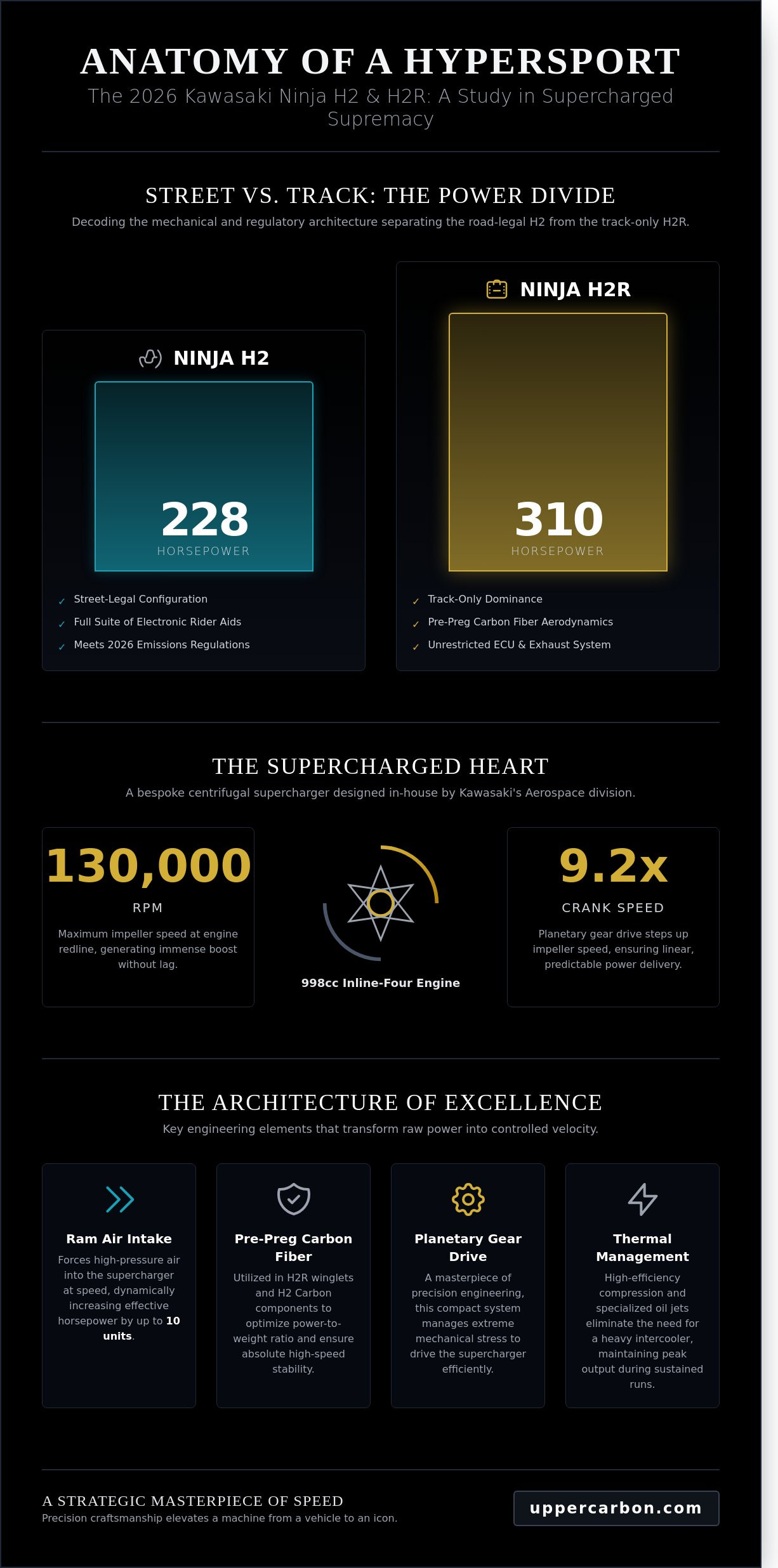
- Decode the mechanical architecture and internal variances that separate the street-legal H2 from the track-only H2R’s 310-horsepower threshold.
- Analyze the critical role of pre-preg carbon fiber in optimizing power-to-weight efficiency for absolute stability at high speeds.
- Learn the strategic maintenance protocols required to preserve the longevity and performance of a high-output, supercharged machine.
Quantifying the Output: Ninja H2 Horsepower Figures in 2026
The 2026 Ninja H2 produces approximately 228 horsepower in its street-legal configuration. This figure represents the current peak of forced-induction engineering. Kawasaki achieves this output through a meticulously designed 998cc supercharged engine. To understand these numbers, one must look at the ISO 4106 standard. Kawasaki utilizes this international metric to measure net power at the crankshaft. It differs from the SAE J1349 standards often used by North American automotive manufacturers. The ISO standard provides a more accurate reflection of the engine's capability within the constraints of motorcycle cooling and exhaust systems.
Static dyno tests don't capture the full potential of the machine. The ninja h2 horsepower increases dynamically at high velocities. This phenomenon occurs because of the Ram Air intake system. As the motorcycle accelerates, the forward motion forces high-pressure air into the intake duct. This increases the air density before it even reaches the supercharger. At speeds surpassing 250 km/h, the effective output can rise by nearly 10 units. The Ninja H2 serves as the absolute benchmark for production hypersport motorcycles, defining the intersection of aerospace-grade forced induction and road-going reliability.
Street-Legal Performance vs. Track Dominance
The Ninja H2 ABS provides a balanced experience for the road. It delivers 228 hp alongside a full suite of electronic rider aids. In contrast, the Ninja H2 Carbon elevates the platform with bespoke material integration, utilizing carbon fiber components to reduce weight and increase structural rigidity. While the core architecture remains consistent with the data found on the Kawasaki Ninja H2 Wikipedia page, the street models face unique constraints. Street compliance requires specific ECU mapping and heavy exhaust catalysis to meet 2026 emissions regulations. These restrictions are the primary reason for the gap between the H2 and the track-only H2R variant.
The 2026 Power Evolution
Refinement has been the focus of the last decade. The 2026 model doesn't just chase higher numbers; it focuses on the quality of delivery. Incremental software updates have smoothed the transition from vacuum to boost. Electronic throttle valves now manage the ninja h2 horsepower with surgical precision. This system allows the rider to deploy massive torque without upsetting the chassis. When compared to the current hypersport field, the H2 stands alone. Most competitors rely on high-revving natural aspiration, but the H2 uses its supercharger to provide a broad, linear power band that feels limitless. It remains a masterclass in strategic mechanical advantage.
The Supercharged Heart: Mechanism of the 998cc Inline-Four
The 998cc inline-four engine represents a departure from traditional forced induction. Most manufacturers source components from external suppliers. Kawasaki chose a different path. They leveraged their Aerospace Company to design a bespoke centrifugal supercharger. This in-house approach ensured every component worked in perfect harmony. The goal was simple: provide a level of ninja h2 horsepower that feels endless. Precision engineering dictates every curve of the impeller, which is machined from a single block of forged aluminum. It's a masterclass in technical synergy.
The supercharger isn't a bolt-on afterthought. It's the core of the machine's identity. At peak performance, the impeller spins at speeds exceeding 100,000 RPM. This creates immense heat. To manage this, Kawasaki avoided a bulky intercooler. They focused on high-efficiency compression instead. The result is a compact, lightweight system that delivers consistent power without the weight penalty of traditional cooling systems. Every millisecond of operation is monitored to ensure thermal stability. This dedication to thermal management allows the engine to maintain peak output during sustained high-speed runs.
Centrifugal Efficiency and High-RPM Gains
Precision defines the planetary gear drive. This system steps up the impeller speed to 9.2 times the crankshaft speed. When the engine reaches its 14,000 RPM redline, the impeller is moving at nearly 130,000 RPM. Unlike a turbocharger, there's no lag. Power delivery is linear and predictable. Meticulous cooling is required at these speeds. Kawasaki utilized specialized oil jets to lubricate the supercharger chain and gears. This ensures longevity despite the extreme mechanical stress. The auditory signature of this process is the chirp. This sound occurs when the blow-off valve releases excess pressure during deceleration. It's a marker of elite performance that signals the machine's readiness for the next gear.
Engine Internals and Structural Rigidity
Standard internals cannot withstand these cylinder pressures. Kawasaki engineers utilized forged pistons and a lower compression ratio than naturally aspirated liter bikes. This allows the engine to handle massive boost without detonation. The chassis plays a role in thermal management too. A minimalist trellis frame was selected over a twin-spar design. This open structure allows heat to dissipate from the engine block more effectively. Air is channeled from the front fairing directly into a high-rigidity aluminum airbox. This path is critical for maintaining the unmanageable power of the Ninja H2R and its street-legal counterparts. Optimizing ninja h2 horsepower requires this level of structural intentionality.
Strategic design transforms raw energy into a refined experience. Every detail reflects a commitment to excellence. At Upper Carbon, we believe that bespoke engineering is the only way to achieve true distinction in a crowded market.
H2 vs. H2R: The Gap Between Street and Track
The Ninja H2 and H2R represent two distinct expressions of the same supercharged soul. While the street-legal Ninja H2 delivers a controlled 228 horsepower, its track-only sibling, the H2R, achieves a staggering 310 horsepower. This figure climbs to 326 horsepower when the Ram Air system reaches peak efficiency at high velocity. The internal architecture reveals why. Kawasaki engineers specified unique camshaft profiles and reinforced head gaskets for the H2R to sustain higher combustion pressures. This isn't merely a tuning difference; it's a fundamental shift in mechanical limits. With a power density exceeding that of a modern Formula 1 car, the H2R remains a benchmark of internal combustion engineering.
The visual profile of each machine serves a functional purpose. The H2 utilizes mirrors for street compliance, yet the H2R replaces these with an aerodynamic design and carbon-fiber wings. These wings generate essential downforce at speeds exceeding 200 mph. It's a meticulous balance of drag reduction and stability. Every surface is sculpted to elevate performance through precision air management.
Performance Metrics: Acceleration and Top Speed
The street-legal H2 clocks a 0-60 mph time of approximately 2.6 seconds. It clears the quarter-mile in roughly 9.6 seconds. These numbers define the elite tier of production motorcycles. The H2R pushes further. It holds a 249 mph speed record, a testament to its raw supercharged potential. The H2 Carbon bridges this gap. It pairs the street-legal ninja h2 horsepower with the exotic aesthetics of a pre-preg carbon fiber upper cowl, offering a bespoke experience for the discerning rider.
Electronic Management Systems
Managing this output requires digital precision. The Bosch IMU monitors six degrees of freedom to synchronize traction and lean angle. Kawasaki Launch Control Mode (KLCM) ensures the ninja h2 horsepower translates to forward momentum rather than wheelspin. Even deceleration is curated. Engine brake control allows riders to tune back-torque, providing confidence during aggressive corner entries. This suite of electronics transforms raw power into a strategic asset.
- Bosch IMU: Real-time data processing for chassis orientation.
- KLCM: Optimized start-line performance with three selectable modes.
- Engine Brake Control: Meticulous tuning of the deceleration phase.
The result is a machine that feels both visceral and intentional. It's a masterclass in balancing high-output engineering with sophisticated rider aids. By bridging the gap between track-focused innovation and street-legal utility, Kawasaki has created a digital product of mechanical excellence.
The Science of Speed: Power-to-Weight and Pre-Preg Carbon Fiber
Performance is rarely a product of raw force alone. It's a calculated equation of mass and momentum. While the ninja h2 horsepower peaks at a staggering 231 hp for the street-legal model, the bike's 524-pound curb weight remains a challenge for pure agility. Reducing mass is as critical as increasing output. Precision engineering demands a reduction in parasitic weight to elevate the power-to-weight ratio. Pre-preg carbon fiber provides the architecture for this transformation. It allows a 500lb machine to handle with the flickability of a middleweight sportbike. This meticulous approach to weight reduction is detailed in our Performance Bagger Carbon Fiber: The Definitive Guide to Lightweight Engineering.
Pre-Preg Carbon vs. Wet Layup
Wet layup is common but lacks precision. It relies on hand-applied resin, which often leads to excess weight and structural inconsistencies. 3K pre-preg carbon fiber is different. It utilizes a factory-calibrated resin ratio and high-pressure autoclave curing to achieve maximum density. The Ninja H2 Carbon utilizes this specific material for its upper cowl to lower the center of gravity and improve turn-in response. This isn't just an aesthetic choice; it's a structural necessity. The uniform resin distribution within pre-preg carbon fiber prevents structural failure at 200+ mph by ensuring the weave doesn't delaminate under extreme load.
Aerodynamic Stability at Velocity
Velocity creates immense physical pressure. At high speeds, the fairing must manage significant drag while simultaneously funneling air to cool the supercharged 998cc engine. Standard plastics often flex or vibrate under these conditions, disrupting airflow. Carbon fiber components maintain their exact geometry under extreme wind pressure, preserving the aerodynamic profile intended by Kawasaki engineers. It's a strategic investment in predictability. Elite performance builds rely on this rigidity to ensure the bike remains planted when the ninja h2 horsepower is fully unleashed. Every component serves a dual purpose: shedding weight and stabilizing the chassis.
Excellence requires precision at every layer. Explore our bespoke carbon fiber solutions to elevate your build.
The Architecture of Excellence: Managing Absolute Power
The Kawasaki Ninja H2 represents more than a peak in technical specifications; it's a strategic statement of engineering intent. While the factory ninja h2 horsepower is rated at approximately 200 hp at 11,000 rpm, the real achievement lies in the management of that energy. It's a machine designed to withstand the violent physics of forced induction. Every component, from the trellis frame to the aerodynamic winglets, serves a singular purpose: stability under duress.
Longevity for such a high-performance, supercharged machine requires a commitment to precision. The supercharger's impeller, machined from a single forged aluminum block, operates at speeds exceeding 100,000 rpm. Maintaining this level of performance necessitates a meticulous approach to service. Owners must prioritize oil quality and cooling system integrity to ensure the supercharged 998cc engine remains a reliable source of power. It's about preserving the integrity of the original design through disciplined care and high-grade consumables.
The H2's legacy now influences the burgeoning world of modern performance baggers. We see this influence in the shift toward lightweight materials and forced induction in platforms previously defined by mass. This evolution represents a broader trend in the industry where power density is the primary metric of success. For a deeper look at how these engineering philosophies are being applied to other sectors, explore our pillar article, Mastering the Machine: The Definitive Guide to Carbon Fiber for Harley-Davidson in 2026.
The Aesthetic of Performance
Visual impact is rarely accidental. The "Mirror Coated Spark Black" paint is a bespoke finish that utilizes a chemical silver-thinning process. It creates a surface so reflective it appears liquid. When paired with high-modulus carbon fiber, the result is a visual language that communicates speed even at a standstill. These materials aren't just for show; they are strategic investments in the bike's aerodynamic profile and weight distribution. For a comprehensive look at how these surfaces function, see The Definitive Guide to Carbon Fiber Fairings for Performance Motorcycles.
Conclusion: The Logical Choice for Ambitious Riders
The Ninja H2 remains the definitive choice for riders who demand the pinnacle of power. It represents a rare intersection of raw ninja h2 horsepower and sophisticated material science. Choosing this machine is a logical step for those who value the absolute over the adequate. It's a testament to what's possible when engineering is allowed to reach its natural conclusion without compromise.
Elevate your own machine with the same meticulous attention to detail that defines the world's most elite motorcycles. Visit Upper Carbon to explore the next level of performance engineering and bespoke carbon fiber solutions. We provide the tools for those who refuse to settle for the standard.
Mastering the Apex of Engineering
The Ninja H2 represents more than a speed milestone; it's a testament to what's possible when engineering meets obsession. With 2026 models delivering a ninja h2 horsepower output of 228 in street trim and 310 in the track-only H2R, the benchmark for performance is clear. This output relies on a 998cc supercharged heart and a chassis designed for absolute stability. True speed isn't just about the engine. It's about the materials that hold it together.
We understand this pursuit of excellence. Founded by Big Al Lloyd of Big Al’s Cycles, Upper Carbon applies this same level of meticulous engineering to the performance bagger community. We utilize 3K Pre-Preg Carbon Fiber Construction to ensure every component meets a standard of professional rigor. Your machine deserves an architecture that matches its potential. The path to superior performance starts with a commitment to quality and precision.
Elevate your ride with Upper Carbon’s bespoke performance components.
Your journey toward a more refined ride is just beginning.
Frequently Asked Questions
How much horsepower does a stock Ninja H2 have?
A stock Kawasaki Ninja H2 produces approximately 228 horsepower at 11,500 rpm. This figure represents the peak output for models released after the 2019 engine update. Earlier versions from 2015 delivered 200 horsepower. This power is managed by a 998cc inline-four engine paired with a centrifugal supercharger. It's a meticulous balance of engineering and raw force.
What is the difference in horsepower between the Ninja H2 and the H2R?
The Ninja H2R delivers 310 horsepower, which increases to 326 horsepower with ram-air assistance. This creates a gap of 98 horsepower compared to the street-legal H2 model. The H2R achieves this through higher boost pressure and aggressive ECU mapping. It's a bespoke machine built specifically for closed-course circuits rather than public roads.
Is the Ninja H2 the fastest motorcycle in the world?
The Ninja H2R holds the title for the fastest production motorcycle with a documented top speed of 400 kilometers per hour. Kenan Sofuoglu achieved this mark in 2016 on the Osman Gazi Bridge. While other custom builds exist, the H2R remains the benchmark for factory performance. Its aerodynamic design and high ninja h2 horsepower output ensure it dominates straight-line speed categories.
Does the Ninja H2 require special maintenance because of the supercharger?
The Ninja H2 requires specific maintenance intervals for the supercharger system to ensure long-term reliability. Kawasaki recommends inspecting the supercharger impeller every 15,000 kilometers for signs of wear or debris. Owners must use high-quality synthetic oil to lubricate the planetary gear drive, which spins at speeds exceeding 130,000 rpm. Precision maintenance is essential for preserving this complex forced-induction system.
Can you increase the horsepower of a street-legal Ninja H2?
You can increase the ninja h2 horsepower of a street-legal model through ECU remapping and high-flow exhaust systems. An ECU flash typically unlocks the electronic restrictions placed on the throttle butterflies. This modification can elevate power from 228 to over 250 horsepower on 91-octane fuel. It's a strategic upgrade for riders seeking to bridge the performance gap between the H2 and the track-only H2R.
What is the top speed of the Ninja H2 Carbon?
The Ninja H2 Carbon is electronically limited to a top speed of 299 kilometers per hour to comply with the 1999 Gentleman's Agreement. Without this limiter, the motorcycle is capable of reaching speeds exceeding 330 kilometers per hour. Its lightweight pre-preg carbon fiber fairings reduce drag and improve stability during high-speed runs. Every gram of weight saved contributes to its exceptional power-to-weight ratio.
Why does Kawasaki use a supercharger instead of a turbocharger?
Kawasaki utilizes a supercharger to provide immediate throttle response and a linear power curve. Unlike a turbocharger, which relies on exhaust gas and often suffers from lag, the supercharger is gear-driven directly from the crankshaft. This mechanical connection ensures boost is available at any engine speed. It's an intentional design choice that prioritizes predictable performance over the peaky delivery typical of turbocharged engines.