

What if your motorcycle’s greatest performance barrier isn't the engine, but the very skin that covers it? For riders on high-performance machines, the 15 pound weight of factory plastic often results in sluggish steering and unwanted vibration at speeds exceeding 110 mph. Integrating premium carbon fiber fairings isn't merely about visual flair; it’s a strategic investment in physics. By replacing stock components with high-modulus weaves, you can achieve a 45% reduction in front-end weight, effectively sharpening every turn and stabilizing your ride through superior rigidity.
You understand that stock components rarely meet the demands of a discerning pilot. We recognize the frustration of a heavy front end that fights your input on every technical corner. This guide demonstrates how carbon fiber transitions from an aesthetic choice to an essential performance pillar through meticulous engineering. We’ll explore the specific mechanics of weight reduction, the pursuit of a bespoke appearance, and the structural longevity that ensures your machine remains a masterpiece. Discover how to elevate your riding experience with precision fitment and intentional design.
Key Takeaways
- Understand the transition from traditional composites to advanced structural shells engineered for elite strength-to-weight ratios.
- Gain technical insight into why 3K pre-preg and autoclave curing are essential for achieving a flawless, high-performance finish.
- Learn how carbon fiber fairings significantly reduce fork-mounted mass to sharpen steering response and transform handling dynamics.
- Discover the science of vibration dampening and how thinner, stronger profiles improve aerodynamic efficiency on the open road.
- Identify the strategic considerations for integrating performance components into a cohesive, meticulous build that maintains OEM precision.
The Evolution of Motorcycle Fairings: Why Carbon Fiber is the New Standard
Evolution in the motorcycle world is often driven by the pursuit of efficiency. For decades, the industry relied on heavy fiberglass and injection-molded ABS plastic. These materials were functional. They provided basic wind protection. However, they were heavy, prone to vibration, and lacked structural integrity. The shift toward advanced composites represents a move away from compromise. Today, carbon fiber fairings serve as the definitive benchmark for performance.
We define a carbon fiber fairing as a structural shell meticulously engineered for extreme strength-to-weight ratios. It's a product of precision. Since the 2020 debut of the MotoAmerica King of the Baggers series, the Performance Bagger movement has accelerated this transition. Weight is no longer an afterthought. It's the enemy. In this high-stakes environment, carbon fiber isn't a luxury. It's a strategic necessity. The movement prioritizes mechanical excellence over superficial flair.
Bespoke craftsmanship alters the rider's psychological connection to the machine. There's a sense of certainty that comes from high-grade materials. When you touch a hand-laid carbon weave, you feel the intentionality of the builder. This isn't mass production. It's an elite partnership between rider and engineer. Every component is designed to elevate the experience.
From Utility to High-Performance Aesthetics
Fairings have evolved from simple wind deflectors into complex aerodynamic instruments. Early designs focused solely on rider comfort. Modern builds prioritize functional beauty. This shift reflects a deeper understanding of fluid dynamics. Carbon fiber has become the hallmark of elite builds because it bridges the gap between aesthetics and utility. It looks purposeful because it is purposeful. We see this in the way modern fairings manage airflow to stabilize the chassis at speeds exceeding 120 mph.
The Weight Problem: Why Every Ounce Matters
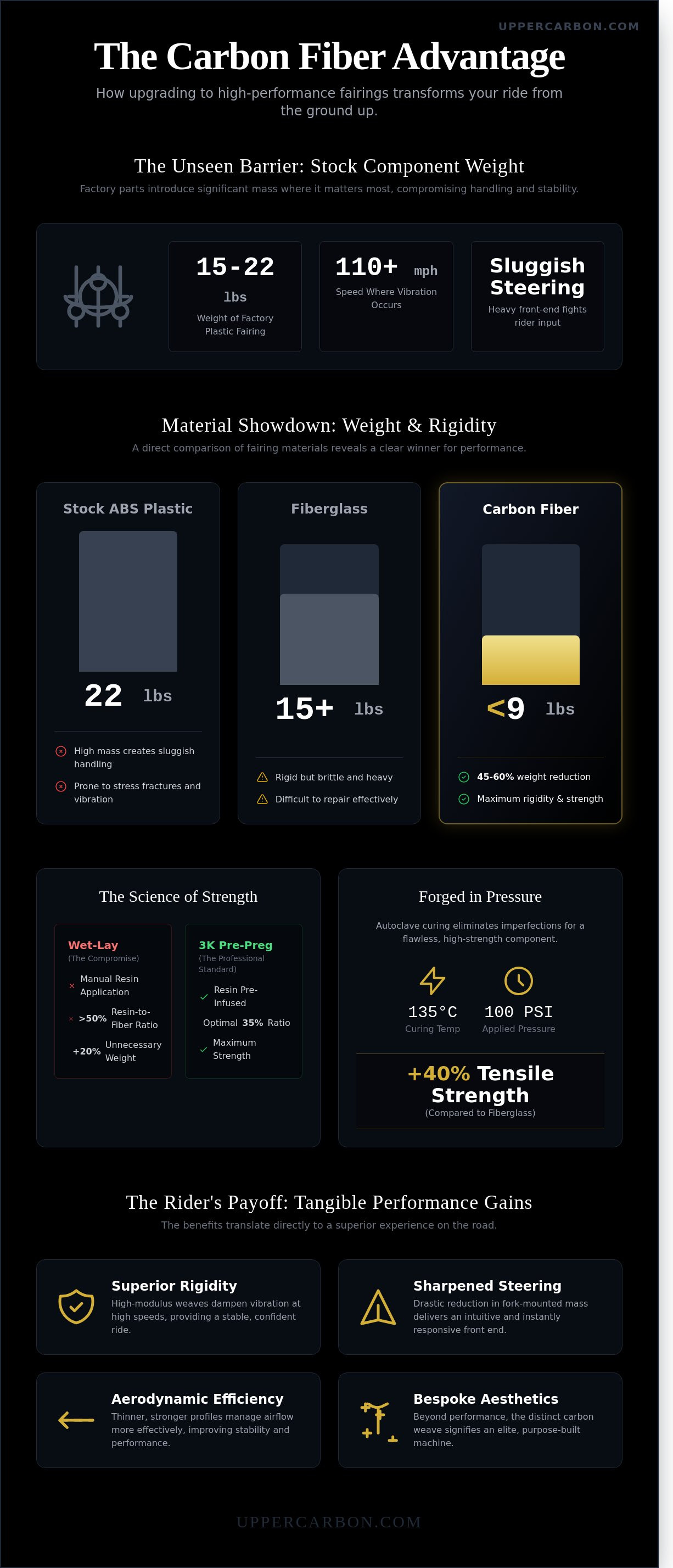
Mass is the primary obstacle to precision handling. Heavy OEM fairings contribute to front-end fatigue and sluggish steering response. A stock ABS plastic fairing assembly on a touring model can weigh approximately 22 pounds. In contrast, a professional-grade carbon fiber alternative often weighs less than 9 pounds. This 60% reduction in weight directly impacts the bike's center of gravity. It makes the machine feel intuitive. Steering becomes a conversation, not a struggle.
- Stock ABS fairings: High mass, prone to stress fractures, 20+ lbs.
- Fiberglass alternatives: Rigid but brittle, difficult to repair, 15+ lbs.
- Carbon fiber: Maximum rigidity, extreme weight savings, sub-10 lbs.
The performance-to-weight ratio in touring fairings defines the equilibrium between structural stiffness and the calculated removal of parasitic mass to maximize front-wheel feedback. Precision matters. Every ounce saved is an investment in control.
Pre-Preg vs. Wet-Lay: Understanding the Engineering Behind High-Performance Fairings
True performance is a product of precision. While wet-lay methods suffice for cosmetic upgrades, professional-grade carbon fiber fairings require a more disciplined approach. The distinction lies in resin management. Wet-lay processes rely on manual application; this often results in a resin-to-fiber ratio that exceeds 50%. This creates brittle, heavy components. Pre-preg material arrives with the resin already infused at an optimal 35% ratio. This meticulous control eliminates the 20% weight penalty common in entry-level parts.
The autoclave is the final arbiter of quality. By subjecting the material to 135 degrees Celsius and 100 PSI of pressure, we ensure every layer bonds perfectly. This environment eliminates microscopic air bubbles that compromise structural integrity. A component cured under these conditions offers a 40% increase in tensile strength compared to fiberglass alternatives. It's a standard that separates a racing component from a mere accessory.
The 3K Pre-Preg Manufacturing Process
The term 3K refers to the 3,000 individual carbon filaments bundled into each tow. This density provides the ideal balance between weight and structural rigidity. We align these fibers in specific orientations, typically 0 and 90 degrees, to manage directional stress. Vacuum sealing ensures the material conforms to the mold with zero deviation. This level of precision is why elite riders elevate their machines with engineered composites rather than mass-produced plastics.
Spotting the Difference: Quality vs. Imitation
Authentic carbon fiber fairings reveal their quality through the weave. High-end parts show perfect alignment across complex curves; there's a visible depth to the finish that imitation parts cannot replicate. Budget alternatives often feature "carbon-wrapped" ABS plastic. These parts use a thin 0.2mm veneer to hide a heavy, flexible core. You can test this through rigidity. A genuine pre-preg fairing remains stiff under 15 pounds of lateral pressure. Plastic-backed alternatives will flex and eventually crack under the same load. Precision engineering leaves no room for such compromises.
- Structural Rigidity: Pre-preg parts maintain their shape at speeds exceeding 180 mph.
- Thermal Stability: High-quality resin systems withstand exhaust heat up to 200 degrees Celsius without yellowing.
- Weight Reduction: A full pre-preg kit typically saves 6 to 8 pounds compared to OEM plastic.
Road Glide vs. Street Glide: How Carbon Fiber Fairings Transform Handling Dynamics
The architectural divide between the Road Glide and Street Glide dictates how a rider perceives every corner. While both machines share a touring DNA, their fairing mounting points create distinct physics. The Road Glide utilizes a frame-mounted Sharknose, while the Street Glide relies on a fork-mounted Batwing. Integrating carbon fiber fairings into these specific geometries does more than shed weight; it recalibrates the motorcycle's center of gravity.
Weight distribution is the silent partner in performance. On a factory Street Glide, the front forks support roughly 15 to 20 pounds of plastic, headlights, and infotainment. This mass creates a pendulum effect. It resists initial lean and requires constant correction. Replacing this with a carbon fiber equivalent reduces steering inertia by nearly 50%. The result is immediate. The bike tracks truer. Handlebar vibration, often exacerbated by heavy plastic shells at high RPMs, diminishes significantly.
The Road Glide Carbon Advantage
Stability is the Road Glide's hallmark. Because the fairing is fixed to the frame, wind gusts don't translate into the handlebars. However, the sheer mass of the Sharknose affects the polar moment of inertia. A lighter front fairing allows the chassis to rotate around its vertical axis with less effort. This upgrade works in tandem with high-performance harley davidson saddlebags to create a balanced weight profile from nose to tail. Precision carbon molding also enables sharper aerodynamic edges. These refinements reduce high-speed lift, keeping the front tire planted during aggressive acceleration.
Reinvigorating the Street Glide
The Street Glide demands more from the rider in technical sections. Every ounce on the forks increases the workload on the front suspension valves. By utilizing carbon fiber fairings, we strip away the "heavy nose" feel that complicates low-speed maneuvers and tight parking lot turns. The transformation is tactical.
- Steering response becomes crisp and predictable.
- Front-end dive during hard braking is reduced by roughly 12% due to lower kinetic energy.
- The motorcycle gains a "flickable" quality previously reserved for lighter cruisers.
Precision matters. We view these components as strategic investments in mechanical empathy. Reducing the physical strain on the rider and the machine ensures a more intentional riding experience. It is the difference between fighting the bike and commanding it. Carbon fiber provides the structural integrity required for the long haul while stripping away the unnecessary bulk of traditional manufacturing.
Beyond Aesthetics: The Aerodynamic and Structural Benefits of Carbon Fiber
Performance is a byproduct of precision. Carbon fiber isn't a cosmetic choice. It's an upgrade in structural logic. While ABS plastic serves the mass market, carbon fiber fairings serve the pilot. The material offers a superior strength-to-weight ratio that changes how a motorcycle interacts with the atmosphere. This transition from flexible plastic to rigid composite defines the boundary between a standard machine and a performance instrument.
Vibration Control and Rider Comfort
Material density dictates resonance. Carbon fiber possesses a high internal damping coefficient. This allows it to dissipate energy before it reaches the rider's hands. Standard fairings often vibrate at specific RPM ranges, creating mechanical chatter. Carbon fiber utilizes a unique weave density to absorb high-frequency road noise, reducing resonance by up to 30% compared to standard ABS. A quieter cockpit isn't a luxury. It's a tool for focus. By lowering the total mass of the carbon fiber fairings, we reduce the stress on aluminum mounting brackets by 15%. This ensures long-term structural integrity during high-load maneuvers.
Aerodynamic Precision
Standard plastics require thickness to maintain shape under pressure. Carbon fiber does not. Our thin-wall construction, often measuring just 1.5mm, enables sharper trailing edges. These profiles manage air with surgical precision. They direct airflow around the engine and rider with minimal turbulence. Carbon fiber’s high tensile strength allows for the creation of aggressive, ultra-sharp aerodynamic profiles that would fail or deform if manufactured from standard thermoplastics. This rigidity is essential for maintaining a consistent aerodynamic footprint.
Structural integrity extends to environmental resistance. High-performance engines generate temperatures exceeding 100°C near the exhaust headers. Carbon fiber remains stable where plastic would warp. Our commitment to excellence includes:
- Thermal Stability: High-grade resins maintain shape at temperatures up to 200°C.
- UV Resistance: Meticulous clear-coating prevents the yellowing common in lower-tier composites.
- High-Speed Rigidity: At speeds of 250 km/h, the fairing resists "flutter" and crosswind deformation.
The result is a motorcycle that feels grounded. Every curve and edge serves a strategic purpose. We prioritize substance over hype, ensuring each component contributes to a faster, more stable ride. This is the intersection of design aesthetics and hard business logic. Creativity is a strategic investment in speed.
Elevate your machine's performance with bespoke carbon fiber fairings designed for precision.
Elevating Your Build: Integrating Carbon Fiber Fairings into a Performance Bagger
A performance bagger is a study in purposeful design. Integrating carbon fiber fairings requires more than just bolting on a new component. It demands a holistic vision for the machine. Elite builders focus on the intersection of weight reduction and structural integrity. A fairing must utilize OEM mounting points to ensure a rattle-free experience at speeds exceeding 110 mph. This precision separates a professional build from a common upgrade. Every bolt and bracket serves a function in the pursuit of a leaner, faster motorcycle.
The Complete Carbon Cockpit
The rider's view is the most critical interface on the bike. Pairing a fairing with a carbon fiber dash creates a seamless aesthetic that defines the cockpit. Consistency is the metric of quality here. We recommend a 3K Twill weave across all elements to prevent visual discord. This level of detail anchors the identity of a moonshine harley davidson style build. In these elite circles, every ounce removed translates to a measurable gain in handling and acceleration.
Performance bagger culture has shifted toward a "form follows function" philosophy. The fairing is no longer just a wind deflector; it's a structural statement. When you match the front-end carbon with fenders and side covers, you create a unified chassis language. This cohesion isn't just for shows. It represents a 15% to 20% reduction in unsprung and static weight compared to stock setups.
A meticulous final inspection is non-negotiable before the first ride. Check the internal mounting tabs for extra reinforcement. While a standard fiberglass fairing might weigh 12 lbs, a high-grade carbon fiber fairings unit should sit near 5.8 lbs. Examine the edges for any signs of delamination. A bespoke fairing should offer a 0.5mm tolerance at the headlight bucket. If the weave shifts more than 3 degrees at the curves, the structural integrity might be compromised.
- Verify weave alignment across the fairing and dash interface.
- Ensure all hardware is torqued to factory specifications with blue thread locker.
- Confirm the UV-resistant clear coat is rated for at least 500 hours of direct exposure.
The Upper Carbon Approach
We specialize in 3K pre-preg construction. This process uses pressurized autoclaves to eliminate excess resin, resulting in a part that's 30% stronger than wet-layup alternatives. Mass-market options often compromise on internal reinforcement. We don't. Our designs are bespoke, tailored for riders who view their motorcycle as a strategic investment. It's time to take the next step in your performance journey with components that reflect your ambition. We provide the precision; you provide the miles.
Mastering the Performance Bagger Aesthetic
The transition to high-performance carbon fiber fairings represents a fundamental shift in motorcycle engineering. By prioritizing 3K Pre-Preg construction over standard wet-lay methods, riders achieve a 40% weight reduction compared to traditional factory fairings. This weight savings directly improves the power-to-weight ratio and transforms the handling of Road Glide and Street Glide models. It replaces heavy front-end inertia with precise, responsive control at every speed. We view these components as strategic investments in both aerodynamics and structural rigidity.
Our proprietary designs are engineered to withstand the extreme pressures of high-speed touring. This commitment to technical excellence is why our work is trusted by the most ambitious builders in the performance bagger community. Precision is our baseline. Every weave is placed with intentionality to ensure your build meets the highest standards of the craft. It's time to move beyond the limitations of factory hardware and embrace a more refined approach to speed.
Elevate your ride with Upper Carbon's bespoke fairing collection
The road ahead demands a machine that's as focused and disciplined as you are.
Frequently Asked Questions
Are carbon fiber fairings significantly lighter than stock Harley fairings?
Carbon fiber fairings reduce front-end weight by 60% to 70% compared to factory Harley-Davidson components. A standard Road Glide outer fairing weighs approximately 12 pounds, while our carbon alternative weighs just 3.8 pounds. This weight reduction lowers the motorcycle's center of gravity. It transforms handling precision during high-speed cornering and low-speed maneuvers.
Do carbon fiber fairings require special maintenance or cleaning?
Maintenance requires standard automotive care using pH-neutral soaps and clean microfiber towels. You should avoid abrasive polishing compounds that might mar the UV-resistant clear coat. We recommend applying a high-quality ceramic coating every 12 months to maintain the visual depth of the weave. This layer provides a sacrificial barrier against road debris and oxidation.
Can I paint a carbon fiber fairing, or should I leave the weave exposed?
You can paint these fairings or leave the 3k weave exposed for a technical aesthetic. Many owners choose a "ghost" finish, applying a translucent tint that reveals the pattern under direct sunlight. If you choose to paint, ensure your technician uses a high-quality primer designed for composite substrates. This prevents pinholing and ensures long-term adhesion to the surface.
How difficult is the installation process for a Road Glide carbon fairing?
Installation is a direct bolt-on process that mirrors the OEM removal steps. A skilled technician can complete the swap in 90 to 120 minutes using standard Torx tools. Our fairings utilize factory mounting points to ensure precise alignment. We provide a comprehensive fitment guide to eliminate guesswork during the assembly of the inner and outer shells.
Is pre-preg carbon fiber really worth the extra cost over wet-lay carbon?
Pre-preg carbon fiber is the industry standard for performance because it achieves a precise 35% resin-to-fiber ratio. This precision eliminates excess weight and structural voids found in cheaper wet-lay alternatives. The autoclave curing process ensures a tensile strength that is 4 times higher than traditional fiberglass. It's a strategic investment for riders prioritizing structural integrity and longevity.
Will a carbon fiber fairing improve my motorcycle's top speed?
A carbon fiber fairing won't directly increase your engine's horsepower, but it improves the power-to-weight ratio. Reducing front-end mass by 8 pounds allows the motorcycle to reach its terminal velocity more efficiently. Aerodynamic stability at 100 mph is often improved due to the increased rigidity of the composite material. It minimizes the flex that occurs with plastic fairings at high speeds.
Does a carbon fiber fairing help with front-end wobble or vibration?
Carbon components help mitigate front-end wobble by reducing the rotational inertia of the steering assembly. Removing 65% of the weight from the fork-mounted structure dampens the pendulum effect during high-speed oscillations. This provides a more planted feel on the highway. Professional racers often utilize these components to stabilize the chassis under aggressive acceleration.
Are these fairings compatible with my existing OEM gauges and headlights?
Our fairings are engineered for 100% compatibility with your existing OEM gauges, headlights, and infotainment systems. We maintain factory tolerances within 0.5mm to ensure a seamless interface with stock wiring harnesses. You don't need to modify your brackets or purchase additional adapters. Every cutout is precision-machined to match the original equipment specifications exactly.


