

Reducing unsprung mass by 1.2 kilograms at the rear axle provides a more immediate improvement to suspension response than most expensive engine tunes. Many riders settle for the excessive weight of a stock steel rear fender because they've been burned by the poor fitment of generic, universal parts. It's a compromise that sacrifices both agility and aesthetic cohesion. We believe that every gram and every millimeter must serve a calculated purpose in a performance build.
You recognize that a motorcycle is a collection of strategic investments. This guide will help you master the technical and aesthetic nuances of component selection to elevate your machine's profile. We'll examine why a 30% weight reduction through advanced materials is only valuable when paired with meticulous engineering. You'll learn how to evaluate carbon fiber quality and distinguish between GRP and ABS alternatives. We've simplified the selection process into a clear framework that ensures your new parts integrate seamlessly with your bike's existing lines.
Key Takeaways
- Understand the strategic role of the rear fender as a structural anchor that influences both subframe stability and high-speed aerodynamics.
- Compare the structural integrity of 3K pre-preg carbon fiber against traditional materials to ensure long-term durability and weight reduction.
- Evaluate shorty, wrapper, and full-length profiles to select the optimal silhouette for your specific performance requirements.
- Master the precise measurement steps for frame width and tire clearance to achieve a seamless, bespoke installation.
- Discover how meticulous craftsmanship and rider-focused engineering elevate your motorcycle’s profile beyond standard factory limitations.
The Strategic Role of the Rear Fender in Performance Bagger Geometry
The rear fender is often dismissed as a mere aesthetic shroud. In the context of a performance bagger, this is a strategic error. This component acts as a vital structural anchor. It secures integrated lighting systems and license plate mounts while providing essential lateral stability to the rear subframe. A well-engineered fender prevents the subtle flex that can occur when a machine is pushed through high-speed sweepers. Aerodynamics play a decisive role in high-speed air management. The profile of the rear fender determines how air exits the back of the motorcycle. At speeds exceeding 85 mph, a poorly shaped fender creates turbulent low-pressure zones. This drag destabilizes the chassis. Modern performance designs prioritize a clean release of airflow to maintain a planted feel. Weight distribution is the silent killer of handling. Mass located behind the rear axle creates a pendulum effect. This weight resists rapid direction changes and upsets the balance of the suspension. Reducing rear-end mass by even 5 pounds significantly improves the polar moment of inertia. Precision is the goal. Visual balance defines the stance of a performance machine. The fender dictates the line from the tank to the tail. It creates a silhouette that suggests forward momentum even at a standstill.Defining the Performance Bagger Aesthetic
The industry has moved away from the long and low geometry of show bikes. The new standard is high and tight. This transition is driven by the need for increased lean angles. Performance baggers often utilize 13-inch or 14-inch rear shocks to improve damping. The fender must accommodate this extra travel without sacrificing its streamlined profile. This aesthetic works in harmony with performance bagger carbon fiber components. Carbon fiber allows for thinner profiles that maintain higher rigidity than traditional fiberglass or heavy steel. This material choice enables a minimalist look that supports the aggressive, elevated stance required for modern performance builds.Function Over Form: Mud Protection vs. Airflow
Choosing a fender involves a calculated trade-off between environmental protection and aerodynamic efficiency. A full-coverage motorcycle fenderPre-Preg Carbon Fiber vs. Traditional Materials: A Structural Analysis
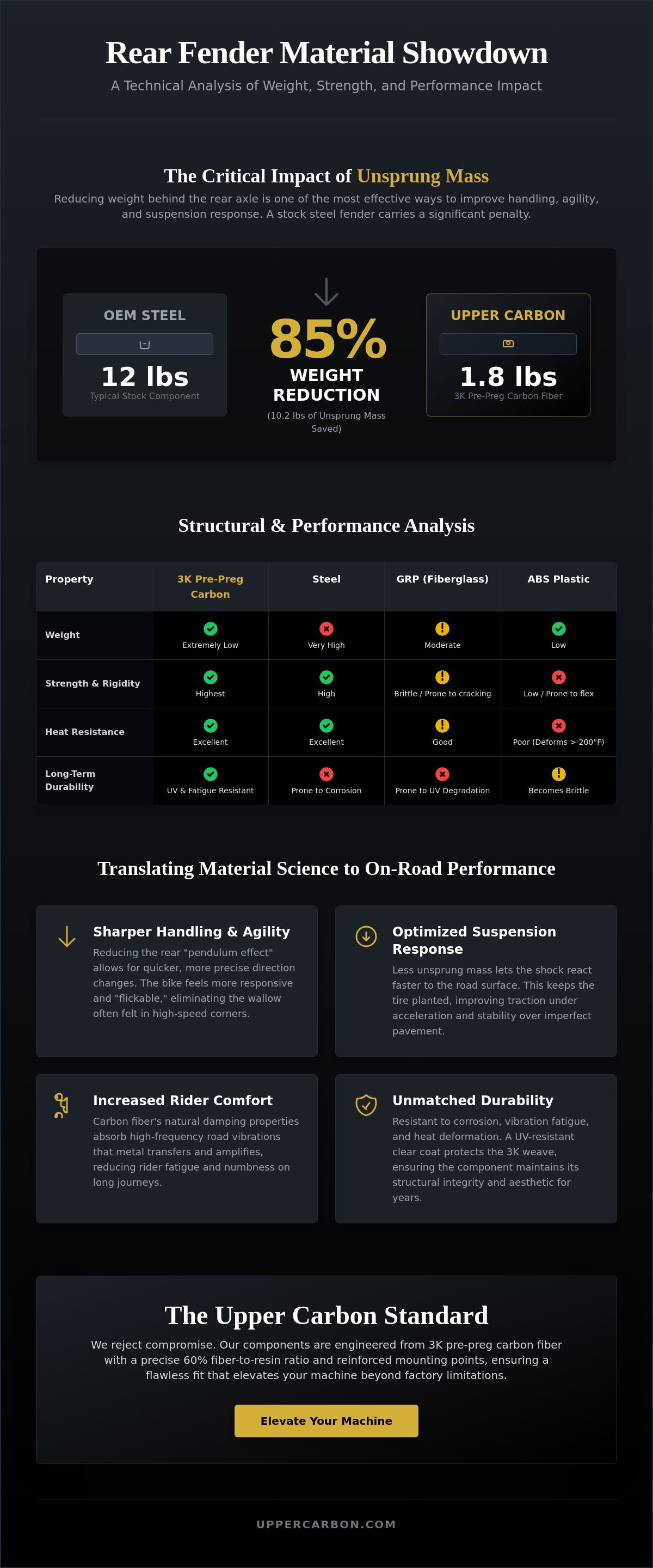
Stock steel components are relics of mass production. They carry excess mass. They succumb to corrosion. They suffer from vibration fatigue after repeated cycles. Traditional GRP (Glass Reinforced Plastic) and ABS offer lower entry costs but fail under the relentless stress of high-performance riding. GRP is prone to spider-web cracking; ABS deforms when exposed to exhaust heat exceeding 200 degrees Fahrenheit. These materials represent a compromise that performance-oriented riders cannot afford.
We prioritize 3K pre-preg carbon fiber. This material represents the pinnacle of structural integrity. Unlike wet-lay processes, pre-preg involves fibers pre-impregnated with a precise amount of resin. This ensures a consistent 60% fiber-to-resin ratio. The result is a rear fender that is 70% lighter than steel yet significantly stiffer. Carbon fiber also acts as a natural dampener. It absorbs high-frequency road buzz that metal amplifies. This meticulous construction improves rider comfort during 500-mile journeys by neutralizing the micro-vibrations that cause numbness.
Why Weight Matters at the Rear Axle
Reducing weight at the rear axle is a strategic move. This is unsprung mass. Every ounce removed allows the rear shock to react faster to road imperfections. A carbon fiber harley fender can weigh as little as 1.8 pounds compared to 12 pounds for an OEM steel unit. This 10-pound reduction improves flickability. It eliminates the wallow often felt during high-speed cornering. Precision in geometry is vital. Studies in motorcycle aerodynamic simulation demonstrate how component weight and shape directly influence high-speed stability and drag coefficients.
Structural Rigidity and Mounting Points
A carbon fiber rear fender maintains its profile under extreme thermal loads. It does not sag or warp. We reinforce mounting points with integrated composite layers to ensure longevity. This prevents hardware from pulling through the material under high torque. These fenders endure harsh environments without degradation. UV-resistant clear coats protect the weave from yellowing over years of exposure. For those seeking to elevate their machine with bespoke components, the choice of material is the first step toward excellence.
- Weight: 70% reduction over OEM steel.
- Durability: Zero risk of rust or oxidation.
- Precision: 3K weave for uniform structural strength.
- Comfort: Superior vibration dampening properties.
Evaluating Fender Profiles: Shorty, Wrapper, and Full-Length Styles
The profile of a performance rear fender dictates the architectural silhouette of the motorcycle. It isn't merely a decorative choice; it's a strategic decision that affects weight distribution, aerodynamics, and the bike's overall stance. Selecting the right profile requires a balance between the desired aesthetic and the practical realities of your specific build. We view this selection as the foundation of a cohesive design strategy.
The Minimalist 'Shorty' Approach
The shorty profile is a calculated choice for the rider who values agility. By stripping away excess material, these fenders can offer a 40% weight reduction compared to standard steel components. This minimalist design is ideal for high-clearance builds where the objective is to showcase the mechanical complexity of the rear suspension and wheel assembly. Precision is vital here. To maintain a balanced visual weight, we recommend pairing a shorty rear with a matching fender front to create a unified line from the fork to the swingarm.
There are practical trade-offs to consider with shortened coverage. While the aesthetic is aggressive, a shorty fender provides less protection against road debris. This makes them most suitable for performance baggers or club-style builds that prioritize weight savings over long-distance touring comfort. In these applications, the reduction in unsprung weight translates directly into more responsive handling during high-speed maneuvers.
The Aerodynamic 'Wrapper' Profile
The wrapper style represents the pinnacle of precision engineering. These fenders are designed to hug the tire with tight tolerances, often maintaining a consistent 0.25-inch gap between the bodywork and the rubber. This close proximity minimizes air turbulence around the rear wheel, which improves stability at speeds exceeding 80 mph. The wrapper profile creates a seamless visual flow that integrates perfectly with high-end carbon fiber fairings, resulting in a machine that looks as though it was carved from a single block of material.
Clearance is the primary technical challenge with wrapper styles. You must account for tire growth at high speeds. A 180mm or 200mm rear tire will expand slightly due to centrifugal force, so meticulous measurement is required during the installation phase. We focus on these minute details to ensure that the aerodynamic benefits don't come at the cost of mechanical interference.
Full-Length Performance Fenders
Full-length fenders bridge the gap between legacy Harley-Davidson silhouettes and modern material science. These components maintain the classic lines of a traditional bagger but swap heavy factory metals for advanced composites. This approach allows a rider to keep the iconic look while shedding 12 to 15 pounds of weight. It's a sophisticated solution for those who want the protection of full coverage without the performance penalty of excessive mass. When choosing your rear fender profile, consider these three factors:
- Tire Width: Ensure the fender width exceeds your tire width by at least 10mm to allow for lateral movement.
- Suspension Travel: Verify that the profile won't bottom out against the frame under heavy compression.
- Visual Balance: Match the fender's curvature to the radius of your specific wheel size, whether it's a 16-inch classic or an 18-inch performance wheel.
Every profile serves a specific strategic goal. Whether you choose the raw aggression of a shorty or the refined aerodynamics of a wrapper, the choice should reflect the intended purpose of your build.
How to Select and Match a Rear Fender to Your Custom Build
Precision defines the difference between a simple modification and a true transformation. Selecting a rear fender requires a meticulous evaluation of your motorcycle’s architecture. The process begins with identifying your specific frame type and measuring the rear strut width. This dimension dictates the maximum physical footprint available for the component. We approach this selection as a strategic investment in both form and function.
- Step 1: Confirm your frame geometry and measure internal strut-to-strut clearance.
- Step 2: Calculate wheel diameter and tire aspect ratio to prevent contact under load.
- Step 3: Define your lighting strategy, choosing between integrated LED arrays or external mounts.
- Step 4: Evaluate material synergy, ensuring carbon fiber weaves match existing bodywork.
- Step 5: Inspect mounting hardware points for seamless subframe integration.
Measuring for a Flawless Fit
A performance build demands tight tolerances. We recommend the two-finger rule to ensure adequate clearance for suspension travel. This method provides roughly 25 to 30 millimeters of space between the tire surface and the underside of the rear fender. You must also account for tire expansion. At speeds exceeding 120 mph, centrifugal force can increase a tire’s diameter by up to 5 millimeters. Measure your strut-to-strut width at the widest point of the frame. This ensures the fender sits flush without structural tension or aesthetic gaps.
Integrating Electronics and Lighting
Modern aesthetics favor a minimalist cockpit. Achieving this look requires internal wire routing. We design channels within the fender structure to hide the harness, protecting it from road debris while maintaining a clean profile. The lighting should mirror the aggressive lines of the build. It's essential to verify harley davidson parts compatibility before drilling into any carbon fiber surface. Proper integration ensures the electronics function reliably under high-vibration conditions without compromising the material integrity.
Strategic hardware selection completes the assembly. Use stainless steel or titanium fasteners to prevent galvanic corrosion when mounting to carbon fiber components. This attention to detail preserves the structural integrity of the subframe. Every component must serve a specific purpose, bridging the gap between raw utility and refined design. We prioritize a bespoke approach that treats the motorcycle as a cohesive digital product, where every pixel and every bolt matters.
Elevate your build with components designed for precision. Explore our performance collection.
The Upper Carbon Standard: Bespoke Engineering for the Modern Bagger
We don't build for the masses. Our 3K pre-preg carbon fiber represents a commitment to structural perfection that exceeds standard industry expectations. While typical aftermarket parts rely on wet layup processes, we utilize autoclave-cured materials to ensure an exact resin-to-fiber ratio. This meticulous approach results in a rear fender that is significantly lighter and stronger than any fiberglass or plastic alternative. It's a strategic investment in your machine's performance and longevity.
The 'Big Al' philosophy guides every design decision we make. We are riders first. We understand the specific stresses a V-Twin frame exerts on its bodywork at high speeds. Our parts are born from this lived experience, not just a computer screen. We prioritize substance over hype. Every component we produce must withstand the rigors of the open road while maintaining a showroom finish.
Bespoke finishing is our hallmark. We understand that a high-end build requires visual continuity. We ensure meticulous weave alignment across every part of the assembly. This level of detail elevates your motorcycle beyond the limitations of catalog-standard options. It creates a cohesive, intentional aesthetic that signals a higher level of craftsmanship. We bridge the gap between aggressive performance and refined design.
The Architecture of a Premium Fender
Structural integrity is the foundation of our work. We reinforce every mounting point with internal layers of high-tensile material to prevent stress fractures. Our designs integrate beauty and utility seamlessly. The collective expertise of our team ensures that every rear fender fits with precision, eliminating the need for aggressive modifications during installation. We focus on the details that others overlook, from wire management channels to heat-resistant internal coatings. It's a superior product because it's built by specialists who demand excellence.
Next Steps for Your Performance Build
Consulting with our experts allows you to explore bespoke carbon fiber solutions tailored to your specific vision. We help you navigate the complexities of material selection and finish options to ensure your build stands apart. Maintaining your investment is equally vital. We recommend regular cleaning with pH-neutral solutions and the application of high-quality ceramic coatings to preserve the UV-stable resin. This ensures long-term brilliance and protection against the elements.
Ready to transform your machine with world-class engineering? Explore our collection of premium carbon fiber components and experience the difference that professional rigor makes.
Defining Your Build's Silhouette
Transitioning from a stock setup to a performance bagger requires more than a simple aesthetic change. It demands a strategic approach to weight and structural rigidity. Selecting the right rear fender determines the bike's final geometry and handling characteristics. We focus on the precision of proprietary 3K pre-preg construction to ensure every component meets the Upper Carbon standard. This meticulous engineering exceeds the limitations of traditional fiberglass.
Our collection, designed by Big Al for the performance bagger community, prioritizes bespoke quality over mass production. Whether you choose a shorty, wrapper, or full-length profile, the result is a seamless integration of beauty and utility. We provide national shipping on all carbon fiber components to support builders across the country. It's where strategic design meets the road. Elevate your build with Upper Carbon's premium fenders. Your vision deserves a foundation built on excellence.
Frequently Asked Questions
Is a carbon fiber rear fender strong enough to support a passenger?
A performance rear fender crafted from pre-preg carbon fiber supports a passenger when engineered with internal structural reinforcements. High-end components often feature 3K or 12K weave patterns that provide a tensile strength of 500 ksi. This exceeds the load-bearing requirements of a standard 180-pound passenger. We ensure structural integrity through meticulous layering; this transforms the component from a cosmetic addition into a functional asset.
Do I need to paint my carbon fiber rear fender to protect it from UV rays?
You don't need to paint the component if it features a high-grade UV-resistant clear coat. Most premium carbon products use an automotive-grade 2K urethane finish that blocks 98% of ultraviolet radiation. This prevents yellowing or resin degradation over a 10-year period. The finish preserves the visual depth of the weave while acting as a sacrificial barrier against environmental elements.
Will a performance rear fender fit my stock Harley-Davidson struts?
Many performance options are designed for direct integration with stock 2018-present Harley-Davidson Softail or Touring struts. These bespoke units use CNC-machined mounting points to ensure a precise 0.5-millimeter tolerance. You won't need to modify the chassis; the design utilizes existing hardware locations. This deliberate engineering simplifies the upgrade process while maintaining the motorcycle's structural geometry and clean lines.
How much weight can I actually save by switching to a carbon fiber rear fender?
Switching to a carbon fiber rear fender typically reduces component weight by 60% compared to factory steel alternatives. A standard steel fender weighs approximately 12 pounds, while a pre-preg carbon version weighs closer to 4.5 pounds. This 7.5-pound reduction lowers the bike's center of gravity. It's a strategic investment that improves flickability and suspension response during high-speed transitions.
Can I install a rear fender myself, or do I need a professional shop?
You can install the component yourself if you possess basic mechanical tools and 3 hours of focused time. The process involves removing 4 to 6 primary bolts and disconnecting the lighting harness. However, professional installation ensures perfect alignment and secure electrical soldering. We recommend expert fitment for projects involving integrated LED lighting to maintain a seamless aesthetic and reliable performance.
What is the difference between hand-laid carbon and pre-preg carbon fiber?
Pre-preg carbon fiber is superior to hand-laid alternatives because the resin is pre-impregnated at a precise 35% ratio. Hand-laid carbon often fluctuates in resin content, leading to a 20% increase in weight and potential air pockets. Pre-preg components are cured in an autoclave under 100 psi of pressure. This meticulous process results in a denser, stronger, and more consistent structural laminate.
How do I clean a carbon fiber fender without scratching the finish?
Clean your carbon fiber using a pH-neutral automotive shampoo and a 400 GSM microfiber towel. Avoid circular motions; use straight, longitudinal strokes to prevent swirl marks on the clear coat. A 2022 industry study suggests that 90% of surface scratches occur during improper drying. Applying a ceramic coating provides a 9H hardness layer that further protects the finish from road debris and light abrasions.
Does a shorter rear fender affect the motorcycle's stability at high speeds?
A shorter profile doesn't negatively impact a motorcycle's stability at speeds up to 120 mph. Modern short-profile designs are aerodynamically tested to reduce drag by minimizing the surface area exposed to crosswinds. While stability remains constant, a shorter length increases road spray by 40% in wet conditions. It's a calculated trade-off between minimalist aesthetics and practical weather protection.


